Monuments
Moreira de Rei Castle
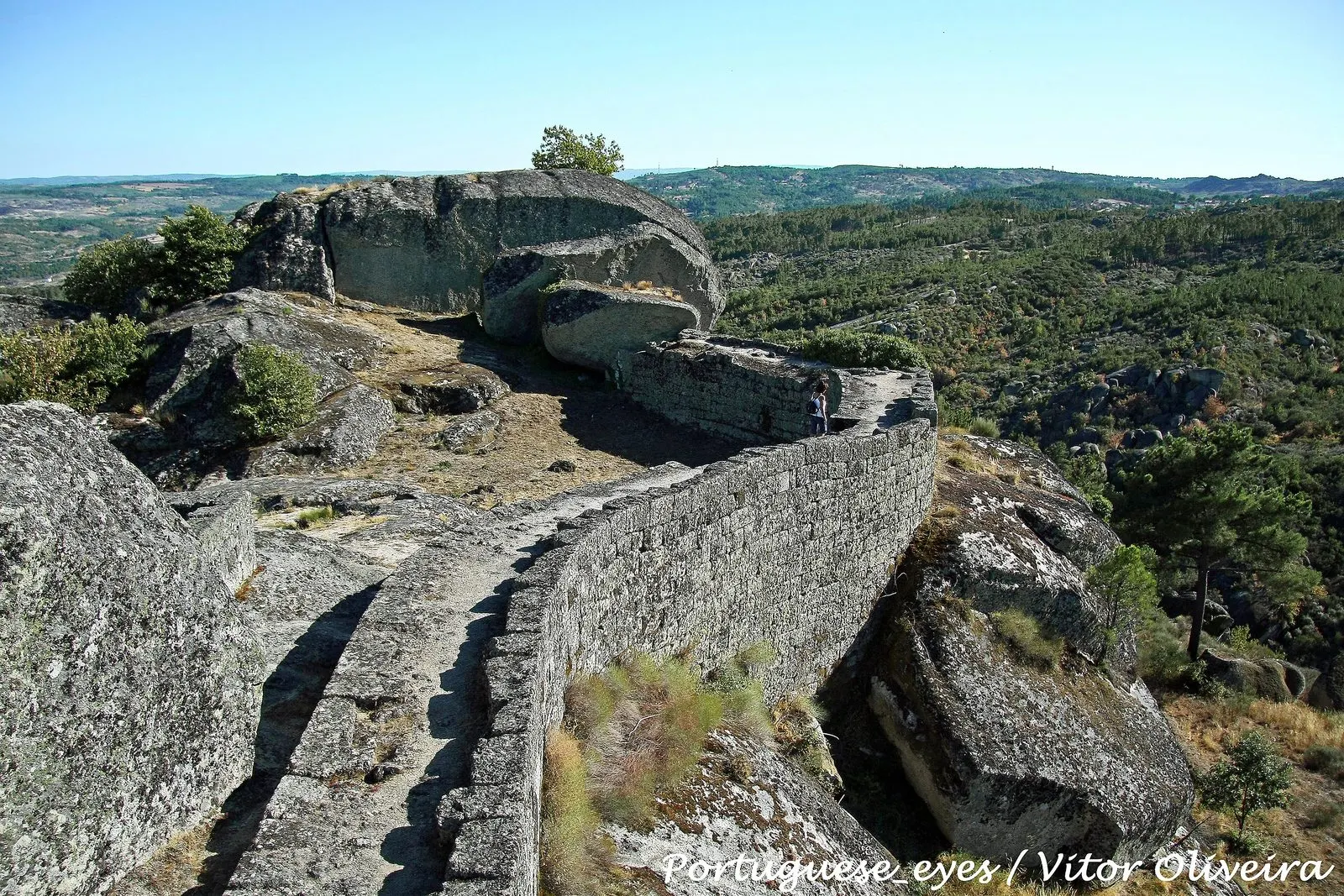
Castle of Moreira de Rei, in Trancoso: ruins of a Romanesque castle on a granite outcrop, in a place fortified since the 10th century. National Monument.
- Location
- Moreira de Rei, Trancoso, Guarda
- Built
- Séc. XII (castelo românico do tempo de D. Afonso Henriques), sobre um castelo documentado no séc. X
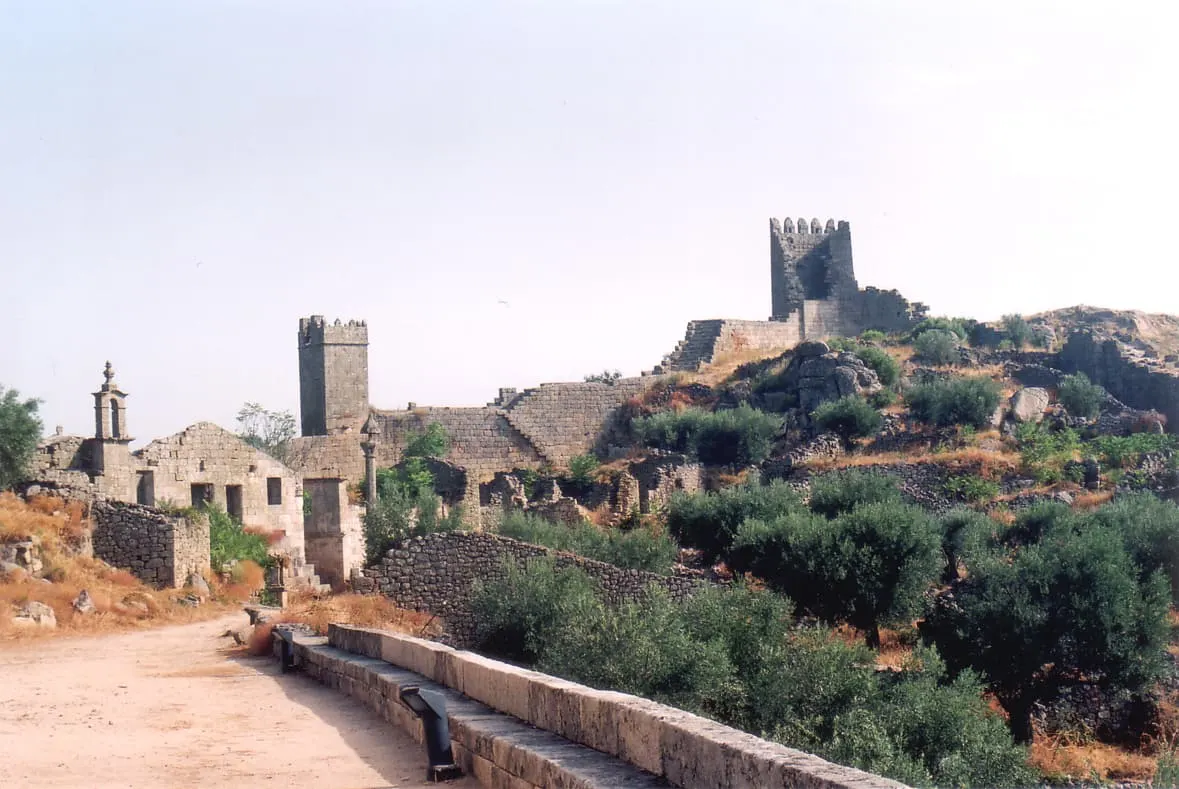
The Castle of Moreira de Rei rises on a granite outcrop overlooking the village of Moreira de Rei, in the municipality of Trancoso. The parish lies about 7.5 km from the town. Today it is a ruin: stretches of curtain wall wedged between large boulders and the base of a square keep remain. But the site has been fortified since at least the first half of the 10th century, and the village preserves, a few steps away, a Romanesque church and a vast medieval necropolis.
A castle documented in the 10th century
The national register of the Portuguese Cultural Heritage, I.P. dates the castle back to at least the first half of the 10th century, at the time of the expansion of the Asturian-Leonese kingdom. A document shows a castle belonging to D. Chamôa Rodrigues, or D. Flâmula, who donated it to the Monastery of Guimarães in 960. The Municipality of Trancoso adds that Flâmula was a niece of Mumadona, the founder of that monastery. Of the first stronghold, probably destroyed by Almanzor at the end of the 10th century, nothing is known. Based on what is known of other castles mentioned in the same document, the register admits it was a rudimentary structure.
Moreira was nonetheless one of the most important centres of the region. In the 1050s, when Fernando Magno conquered the centre of present-day Portuguese territory, the castle was one of the fortresses taken. The municipality dates that conquest to 1055.
Local tradition holds that the castle goes back to the time of the Lusitanians or the Romans, but this origin is not proven. The municipality also records that a Roman road passed through the parish, of which stretches of paving can still be seen.
The Romanesque castle
In the reign of D. Afonso Henriques, Moreira received a foral (charter) of unknown date, and the castle was reformed. According to the register, it is from this phase that the castle whose ruins have come down to us dates. It was built in a slightly peripheral position relative to the original settlement, a choice that the register, citing Mário Barroca, attributes to a rationalisation of military resources.
The castle followed the Romanesque model. It had a square-plan keep, isolated from the curtain wall, of which only the first course of ashlar stones survives. The entrance to the keep was through a door on the first floor, raised above the courtyard, reached by a wooden staircase; the sockets for it are still visible. The curtain wall enclosed a very small interior space, so that an enemy who got past the gate could not move about freely.
Contrary to what might be expected, the settlement was never truly walled. The register notes that Moreira de Rei never had the planned «vila nova» typical of the Gothic period in the border zones and the northern interior. The village remained relatively undefended, organised around the church.
Decline and ruin
After the 12th century, Moreira de Rei lost importance. The register sees a clear sign of this in the absence of any Gothic reform of the castle. The municipality indicates that D. Afonso II confirmed the charter in 1217 and that D. Manuel I granted a new charter in 1512. The Manueline charter and the pillory gave the town, in the register’s words, an «illusory dynamism» that the following decades disproved. The municipality of Moreira de Rei was abolished in 1855.
The castle suffered most in recent centuries, when the population used it as a quarry. In the 1940s, the Directorate-General for Buildings and National Monuments (DGEMN) rebuilt some parts of the curtain wall, but the whole retains the appearance of a ruin. The municipality recalls the description by Alexandre Herculano, who called Moreira a «kind of eagle’s nest on a heap of rocks». Next to the ruins is the Cadeira d’El-Rei, a seat carved into the rock.
Classification
The castle is a National Monument. Decree No. 21 354, of 1 June 1932, published in the Diário do Governo, I Série, No. 136, of 13 June 1932, classified in a single act the Church of Santa Marinha of the village of Moreira de Rei, the tombs found within it, the castle and the pillory. The castle is not part of any UNESCO listing.
The church and the necropolis
The Church of Santa Marinha is, according to the register, a late Romanesque rural church with a single nave and modest construction, dating from the turn of the 13th century. It replaced an earlier pre-Romanesque church, of which no structure survives, but which the necropolis of tombs carved into the rock, datable to the 10th century, documents. The municipality also notes medieval standard measures engraved on the main door.
Excavations that the Municipality of Trancoso began in August 2018, as part of the redevelopment of the square and the church, revealed a necropolis much larger than previously thought. In December 2019, the municipal archaeologist Maria do Céu Ferreira, in statements to the Lusa news agency, counted about 550 tombs carved into the rock, in a medieval cemetery spanning roughly the 8th–9th to the 12th–13th centuries. The project planned to leave tombs exposed and to create an interpretation centre for the necropolis inside the church.
The pillory, Manueline, rests on five octagonal steps and ends in a cage of eight small columns with an armillary sphere. It can be compared with other Portuguese pillories.
Planning your visit
The castle ruins stand at the top of the village, above the granite outcrop. When consulted on 5 November 2026, no official published opening hours for the castle were found, nor any information on guided visits. The terrain is rocky and uneven. For information, contact the Municipality of Trancoso.
The visit pairs well with the town of Trancoso, which belongs to the network of the Historic Villages of Portugal (Aldeias Históricas de Portugal), and its castle. To continue, consult the itinerary for Centro de Portugal or compare Moreira de Rei with other castles of Portugal.
Photograph by Vitor Oliveira, from 2012. Original on Wikimedia Commons, under CC BY-SA 2.0; resized and compressed for the web, without altering the composition.
Frequently asked questions
- When was the Castle of Moreira de Rei built?
- A castle is documented on the site in 960, when D. Flâmula donated it to the monastery of Guimarães. According to the national register of the Portuguese Cultural Heritage, I.P., the castle whose ruins can be seen today dates from a reform carried out during the reign of D. Afonso Henriques, in the 12th century.
- What remains of the castle?
- Stretches of curtain wall remain, partly rebuilt by the DGEMN in the 1940s, and the first course of ashlar stones of a square keep, isolated within the enclosure. The local population used the castle as a quarry for centuries.
- Is the castle classified?
- Yes. Decree No. 21 354, published in the Diário do Governo, I Série, No. 136, of 13 June 1932, classified as national monuments the Church of Santa Marinha, the tombs found within it, the castle and the pillory of Moreira de Rei.
- What else is there to see in Moreira de Rei?
- The Romanesque Church of Santa Marinha, surrounded by a large necropolis of tombs carved into the rock, and the Manueline pillory. In December 2019, the municipal archaeologist counted about 550 tombs around the church.
Sources
- Património Cultural, I.P. — Castelo da vila de Moreira de Rei (70420)
- Património Cultural, I.P. — Atlas do Património Classificado, Castelo da vila de Moreira de Rei (NINV 3020)
- Diário do Governo — Decreto n.º 21 354 (I Série, n.º 136, 13-06-1932)
- Município de Trancoso — Freguesia de Moreira de Rei
- RTP Notícias / Lusa — Trancoso tem maior necrópole de sepulturas antropomórficas da Península Ibérica (15-12-2019)
- Wikidata — Castelo de Moreira de Rei (Q5049798)
- Aldeias Históricas de Portugal — Página inicial (lista das 12 aldeias)
Keep exploring
Heritage nearby
More places to discover from here. Approximate straight-line distances, within 50 km.