Monuments
Paderne Castle
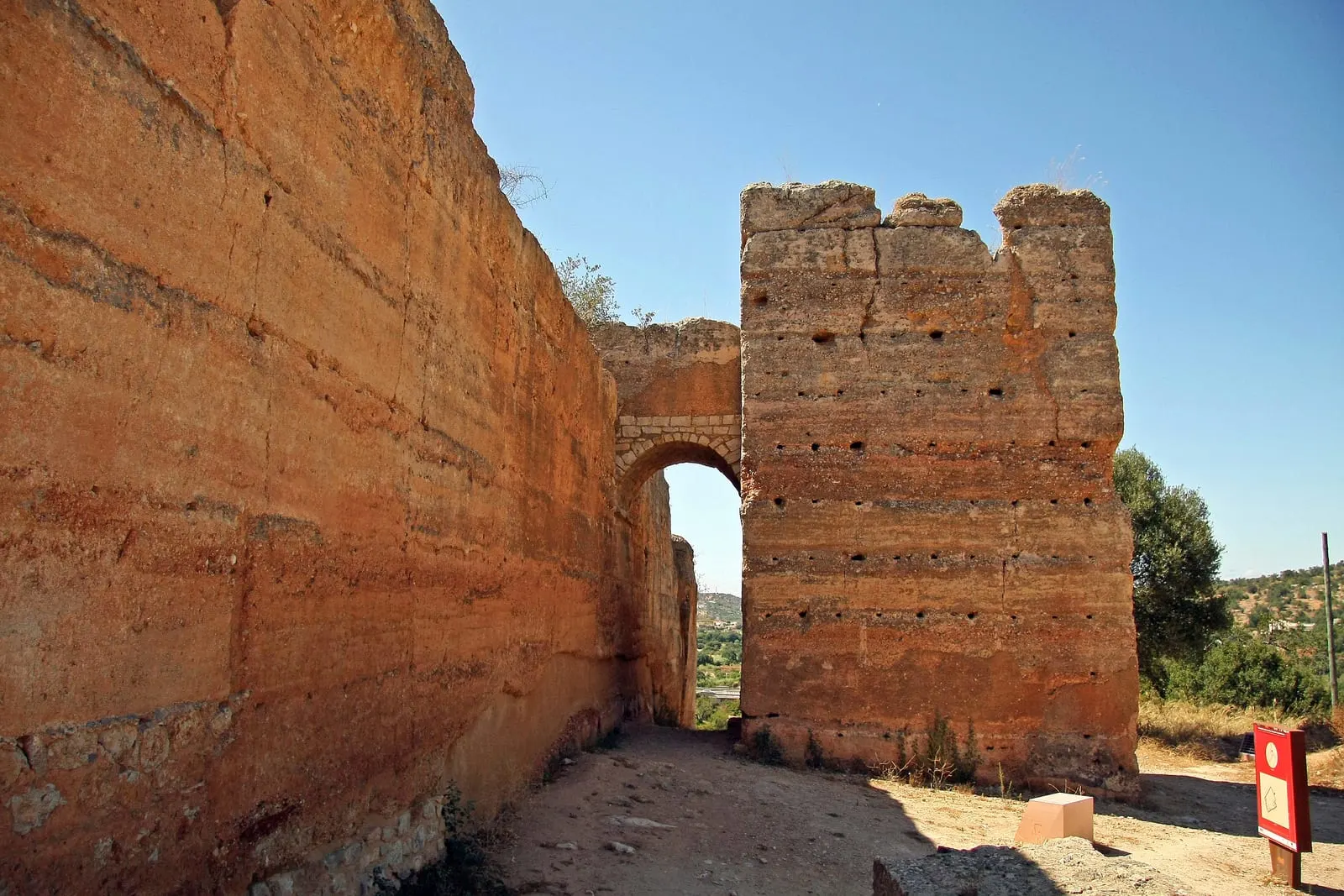
Castle of Paderne, in Albufeira: an Almohad rammed-earth fortress above the Quarteira stream, taken in 1248, Property of Public Interest, with an old bridge.
- Location
- Paderne, Albufeira, Faro
- Built
- 2.ª metade do séc. XII – inícios do séc. XIII
Anyone travelling along the Via do Infante sees, south of the road, the reddish ruins of the Castle of Paderne, on a hill above the left bank of the Quarteira stream, about 2 km south of the village of Paderne, in the municipality of Albufeira. The castle is one of the best examples of rural Islamic fortification in rammed earth in southern Portugal. Its plan, its towers and its elbow-shaped gateway show how Muslim Algarve defended itself against the Christian advance.
An Almohad rammed-earth fortress
The national register places the construction in a late phase of Islamic presence in the Algarve, in the 11th century or already in the 12th century. The Geoparque Algarvensis is more precise: it points to the Almohad era, between the second half of the 12th century and the first decades of the 13th century. In this period, defence was no longer concentrated only in the coastal cities. A second line of medium-sized fortresses formed in the Barrocal and the Serra, clearly rural in character. Paderne is one of the most important witnesses to this network.
The building technique is rammed earth (taipa): earth compacted within formwork, in successive layers that can still be read in the walls. In the gateways and foundations, irregularly dressed stone appears. The plan is irregular trapezoidal and adapts to the relief. The entrance is protected by an albarrã tower, and access is made through an elbow-shaped gateway, which forced those entering to change direction. Helena Catarino, whose studies the national register cites, identifies these elements as typical of the Almohad fortifications of the inland Algarve. To place the technique in context, see Islamic art in Portugal.
A planned town within the walls
The enclosure was not merely military. The Geoparque describes a small settlement planned from the outset, with narrow streets laid out on an orthogonal grid and a drainage system that carried waste and rainwater out beyond the wall. The blocks were formed by houses around a central courtyard. Among the ruins of the dwellings, two cisterns bear witness to the two main periods of occupation, the Islamic and the Christian.
Conquest, the Order of Avis and abandonment
The Geoparque Algarvensis indicates that the Christian conquest took place in 1248, by D. Paio Peres Correia. Other publications give different dates, and the national register does not fix a year. After the conquest, the new occupants adapted the Islamic urban model. In the reign of D. Dinis, an attempt was made to give the castle an administrative territory, through its grant to the Order of Avis.
Buildings within the enclosure date from the 14th century, and may correspond to the first phase of the chapel of Nossa Senhora da Assunção, beside the gateway and now in ruins. With defence concentrated on the coast, the castle lost its importance. The population moved to the present village of Paderne in the 16th century, but, according to the Geoparque, pilgrimages to the site continued until the 19th century.
Restoration and protection
The castle is a Property of Public Interest under Decree No. 516/71, published in the Diário do Governo on 22 November 1971. Its special protection zone was set by Ordinance No. 978/99, of 14 September 1999. The national register brings together photographs of the rammed-earth wall after restoration, in 2007, and of the chapel after consolidation, in 2014. The same register notes that archaeological interventions have not been systematic. It is not part of any UNESCO inscription. The castle lies, however, within the territory of the Geoparque Algarvensis, recognised by UNESCO as a geopark.
The old bridge and the surroundings
Southwest of the castle, over the Quarteira stream, stands the old bridge of Paderne, which formed part of the link between Loulé and Silves. The Geoparque classifies it as medieval, but an inscription on the central arch bears the date 1771, which the same text gives as the date of construction. It retains three arches, two triangular-prism cutwaters and sections of the original paving. The PR1 walking trail, which passes the Quarteira Stream Biodiversity Station, allows one to link the bridge with the castle.
Planning the visit
When consulted on 5 November 2026, the Geoparque Algarvensis listed the castle as open to visitors on Wednesdays and Fridays, with no hours published. It also indicated access on foot, by bicycle or by car, with accessibility for reduced mobility on site. The municipal page on the castle was not available at that consultation. Confirm the days, hours and any works with the Albufeira Municipal Council or on the Geopark’s page.
To continue through Islamic Algarve, compare Paderne with the Castle of Silves, also of reddish rammed earth, and with the Moorish and Islamic heritage of the region. The regional itinerary is at Algarve and the national network at castles of Portugal.
Photograph by Vitor Oliveira, dated 19 April 2011. Original on Wikimedia Commons, under CC BY-SA 2.0; resized and compressed for the web, without altering the composition.
Frequently asked questions
- From what period is the Castle of Paderne?
- It is a fortress of the Islamic period. The Geoparque Algarvensis dates it to the Almohad era, between the second half of the 12th century and the first decades of the 13th century; the national register admits construction begun in the 11th century or already in the 12th century.
- When was it conquered by the Christians?
- The Geoparque Algarvensis indicates the Christian conquest in 1248, by D. Paio Peres Correia. Other publications give different dates, so the year should be treated with caution.
- Is the castle classified?
- Yes. It is a Property of Public Interest under Decree No. 516/71, of 22 November 1971, and has a special protection zone set by Ordinance No. 978/99, of 14 September 1999.
- When can it be visited?
- When consulted on 5 November 2026, the Geoparque Algarvensis listed the castle as open to visitors on Wednesdays and Fridays, with no hours published. Confirm with the Albufeira Municipal Council before going.
Sources
- Património Cultural, I.P. — Castelo de Paderne (74129)
- Património Cultural, I.P. — Atlas do Património Classificado, Castelo de Paderne (NINV 2817)
- Diário do Governo — Decreto n.º 516/71, de 22 de novembro
- Geoparque Algarvensis — Castelo de Paderne
- Geoparque Algarvensis — Ponte do Castelo
- Wikidata — Castelo de Paderne (Q8342497)
Keep exploring
Heritage nearby
More places to discover from here. Approximate straight-line distances, within 50 km.