Monuments
Valongo Castle
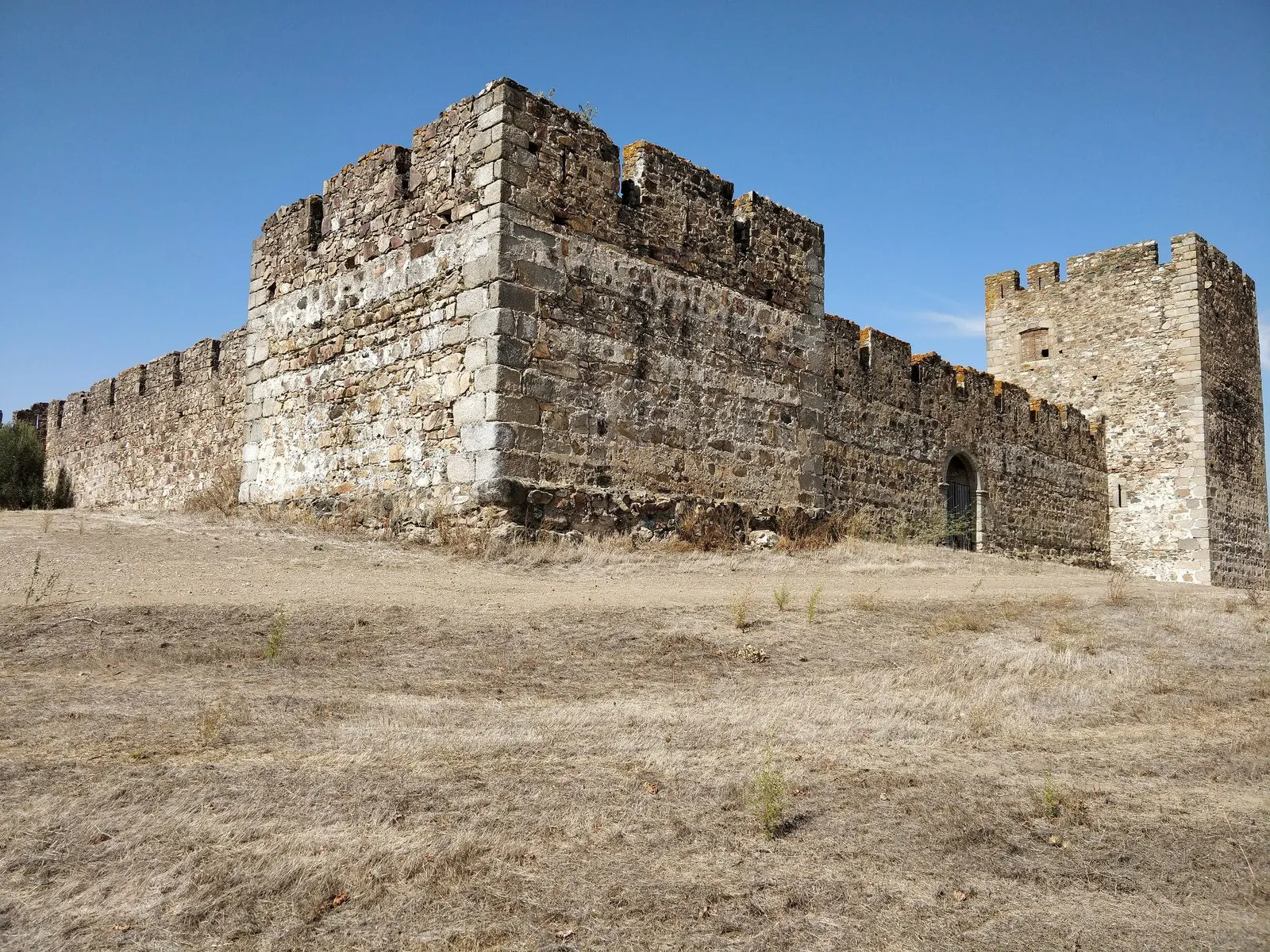
Valongo Castle in Évora is a square 14th-century castle with four towers, built over a Muslim fortification. It has been a National Monument since 1910.
- Location
- Nossa Senhora de Machede, Évora, Évora
- Built
- Séc. XIV, sobre uma fortificação muçulmana; fase de reconstrução nos séc. XIV–XV
The Castelo de Valongo (Valongo Castle) is a small, isolated medieval castle in the Alentejo countryside, in the civil parish of Nossa Senhora de Machede, municipality of Évora. It stands on the Herdade da Grã, beside the municipal road between Montoito and Valongo, about 4 km from Montoito. It should not be confused with Valongo, in the district of Porto. It is a castle with a square plan, with towers at all four corners, classified as a national monument since 1910.
A castle over a Muslim fortification
The national register of Cultural Heritage, I.P. describes the castle as a medieval construction of the 14th century, built over a Muslim fortification. This claim rests on an article by António Rei published in the journal Cidade de Évora. The register adds that there are some Islamic inscriptions inside the castle.
The arrow slits, of medieval typology, indicate a phase of reconstruction in the 14th and 15th centuries.
Architecture
According to the register, the castle has a square plan, reinforced at the corners by four towers. The wall walk is protected by solid merlons, also of square section.
The keep, facing west, has three storeys supported by brick ribbed vaults with pointed arches. Leaning against it is another, smaller tower, in which a side entrance opens.
Valongo and Montoito
The history of the castle has often been mixed up with that of the village of Montoito, about 6 km away. A preliminary study from 2021, by José Figueira, who presents himself as someone not trained as a historian, draws attention to this confusion and notes that documents about the castle are scarce, which has led different authors to propose different dates of construction. It recalls that the charter of foral granted to Montoito by Pedro Anes in 1270, according to Father Júlio César Batista (1976), mentions the «Herdade de Montouto ou Valongo», but does not refer to the castle. The same study uses the designation Castelo Real de Valongo. Without direct documents, the relationship between the castle and the village remains unclear.
Classification
The castle is a National Monument under the Decree of 16 June 1910, published in the Diário do Governo no. 136, of 23 June 1910, the decree that approved the general list of national monuments drawn up by the respective council.
In the 1910 list, the «Castello de Vallongo» appears in an unexpected section: that of the Lusitanian and Luso-Roman monuments, under the heading «Castello», alongside hillforts, bridges, milestones and the Roman Temple of Évora. The compilers of the list therefore attributed to it an ancient origin. The current, more recent register dates its construction to the 14th century.
The castle is not part of any UNESCO inscription.
Preparing a visit
The castle lies in a rural area, on an estate, about 4 km from Montoito. As of consultation on 5 November 2026, no official information on opening hours, tickets or visiting conditions was found, nor a clear indication of access to the interior. Before going, confirm with the Município de Évora or Património Cultural, I.P. whether visits are possible and under what conditions.
In the district of Évora there are other classified castles, such as the Castelo de Evoramonte and the Castelo de Viana do Alentejo. To continue, see the Alentejo guide or compare Valongo with other castles of Portugal.
Photograph by Roundtheworld, dated 12 October 2019. Original on Wikimedia Commons, under CC BY-SA 4.0; resized and compressed for the web, without altering the composition.
Frequently asked questions
- Where is Valongo Castle?
- In the civil parish of Nossa Senhora de Machede, municipality of Évora. The national register places it at Herdade da Grã, beside the municipal road between Montoito and Valongo, about 4 km from Montoito. It should not be confused with Valongo, in the district of Porto.
- How old is the castle?
- The national register of Cultural Heritage, I.P. describes it as a medieval construction of the 14th century, built over a Muslim fortification. The arrow slits indicate a phase of reconstruction in the 14th and 15th centuries.
- Is the castle classified?
- Yes. It is a National Monument under the Decree of 16 June 1910, published in the Diário do Governo no. 136, of 23 June 1910.
- Can it be visited?
- As of consultation on 5 November 2026, no official information on opening hours or visiting conditions was found. The castle lies in a rural area, on an estate; confirm access before going.
Sources
- Património Cultural, I.P. — Castelo de Valongo (70385)
- Património Cultural, I.P. — Atlas do Património Classificado, Castelo de Valongo (NINV 2708)
- Diário do Governo — Decreto de 16 de junho de 1910 (n.º 136, 23-06-1910)
- José Figueira — Castelo Real de Valongo: estudo preliminar da cronologia documental existente (2021)
- Wikidata — Castelo de Valongo (Q5049840)
Keep exploring
Heritage nearby
More places to discover from here. Approximate straight-line distances, within 50 km.