Monuments
Viana do Alentejo Castle
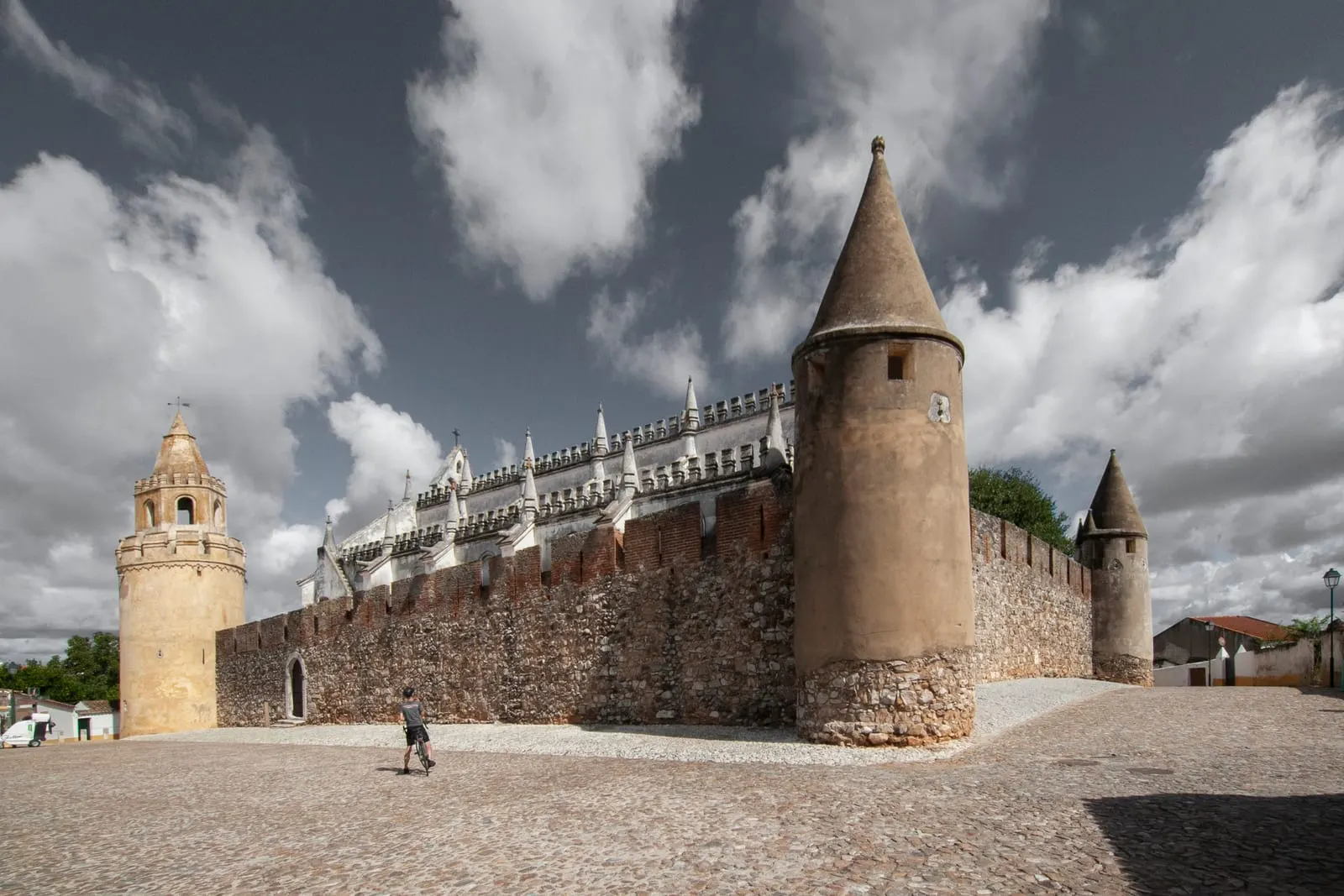
Castle of Viana do Alentejo, a National Monument: pentagonal walls, cylindrical towers and spires around the Manueline Mother Church and the Misericórdia.
- Location
- Viana do Alentejo, Évora
- Built
- Finais do séc. XV – inícios do séc. XVI
In the centre of Viana do Alentejo, south of Évora, the Castle of Viana do Alentejo is a monumental enclosure rather than a fortress. The walls, cylindrical towers and conical roofs surround a courtyard containing the parish church, the Misericórdia church and the former town hall. Together they bring defence, worship and local government of an Alentejo town into one place at the start of the 16th century.
King Dinis’s wall and the castle seen today
In 1313, when he granted a charter to Viana, King Dinis ordered a “wall of four hundred fathoms”, with three gates, and gave a thousand pounds towards the work. Tradition therefore attributes the castle to his reign. The national register of Cultural Heritage, I.P., citing Pais (2004), is more cautious. The fortification standing today does not correspond to the royal intention. The most recent research even admits that the Dionysian wall may never have been built. The castle seen today may be a work of the late 15th or early 16th century. The municipal page follows the same line: some sources place its origins in the time of King Dinis, but more recent studies point to a later construction.
According to the municipality, the enclosure housed the original parish church, dedicated to Santa Maria de Foxem, the first town hall and the town’s first cemetery. At the start of the 16th century it received a new campaign of works under Diogo de Arruda, a native of Évora, who in 1521 took up the post of master of works for the Comarca of Entre Tejo e Odiana.
Walls, towers and conical roofs
The castle has five curtain walls, which form a pentagonal enclosure. At the corners stand cylindrical towers capped by conical roofs, the coverings that give the complex its silhouette. The conical roof of the keep is taller than the others and houses a bell gable, with openings on every face.
The national register of the Castle of Alvito, a few kilometres away, cites Viana as a reference. Both are organised around a central courtyard and have cylindrical towers at the angles. They are two examples of how late 15th-century Alentejo architecture adapted military forms to civil and religious use.
A courtyard of churches
Around 1521, the parish church was built within the walls in Manueline style and attributed to Diogo de Arruda. On the opposite side of the enclosure stands the Misericórdia church, from the same period and likewise attributed to the same master. Beside it is the building where the town hall operated until the end of the 17th century. In the courtyard rises a Manueline cross. The municipal page adds the Chapel of Saint Anthony and the former chapel of Nossa Senhora da Assunção, now converted into an interpretation centre for the complex.
This concentration of buildings makes the castle a good starting point for exploring Manueline style in the Alentejo. The Misericórdia is also linked to the network of brotherhoods discussed in hospitals and misericórdias. In 2016, the municipality marked, with a 16th-century-style fair held at the castle, the 500 years of the Manueline charters of Viana do Alentejo and Aguiar and of the founding of the local Santa Casa da Misericórdia (1516–2016).
Conservation and classification
Between 2000 and 2005, the Project for the Conservation, Recovery and Enhancement of the Castle of Viana do Alentejo was carried out. It included archaeological excavations, which revealed a necropolis. It also included the consolidation, restoration and cleaning of the walls, the two churches and the cross.
The castle is a National Monument under the Decree of 16 June 1910, published in the Diário do Governo no. 136, of 23 June 1910. The special protection zone, with a non aedificandi zone, was set by the Ordinance of 25 May 1948, published in the Diário do Governo, II Series, no. 150, of 30 June 1948. According to the Atlas of Classified Heritage, the property falls under the Cultural Heritage, I.P. It is not part of any UNESCO inscription.
Preparing your visit
The castle is on Largo de São Luís, in the historic centre. The town’s tourist office operates from within the castle itself. When consulted on 5 November 2026, the office’s municipal page, last updated in September 2021, listed these hours:
- winter (1 October to 31 March): 9:30–13:00 and 14:00–17:30;
- summer (1 April to 30 September): 10:00–13:00 and 14:00–18:00;
- closed on 1 January, 13 January, 25 April, 1 May and 25 December.
These are the tourist office’s hours, not necessarily those of the churches. Please confirm them by telephone on 266 930 012 or on the municipal page.
The municipality has other reasons to visit. In Alcáçovas, the manufacture of chocalhos (bells for livestock) continues; it is inscribed by UNESCO on the List of Intangible Cultural Heritage in Need of Urgent Safeguarding. The town itself is one of the centres of traditional Portuguese pottery. To follow the castles of the region, see Alentejo and the castles of Portugal.
Photograph by Carlos Vieira Romão, 15 September 2022. Original on Wikimedia Commons, under CC BY-SA 4.0; resized and compressed for the web, without altering the composition.
Frequently asked questions
- Is the castle from the time of King Dinis?
- King Dinis ordered the town to be walled when he granted it a charter in 1313, but the national register notes that the most recent research admits this wall may never have been built. The castle standing today may be a work of the late 15th or early 16th century.
- What is inside the walls?
- The enclosure houses the parish church, in Manueline style and built around 1521, the Misericórdia church, the building of the former town hall (Paços do Concelho), and a Manueline cross. The municipality also mentions the Chapel of Saint Anthony and an interpretation centre in a former chapel.
- Is the castle listed?
- Yes. It is a National Monument under the Decree of 16 June 1910 (Diário do Governo no. 136, of 23 June 1910). It has a special protection zone, with a non aedificandi zone, set by ordinance of 25 May 1948.
- Where can I get information about visiting?
- The Viana do Alentejo tourist office is located in the castle. When consulted on 5 November 2026, the municipal page for the office, last updated in 2021, listed summer and winter opening hours and the telephone number 266 930 012; please confirm before going.
Sources
- Património Cultural, I.P. — Castelo de Viana do Alentejo (70379)
- Património Cultural, I.P. — Atlas do Património Classificado, Castelo de Viana do Alentejo (NINV 2804)
- Diário do Governo — Decreto de 16 de junho de 1910 (n.º 136, 23-06-1910)
- Município de Viana do Alentejo — Castelo de Viana do Alentejo
- Município de Viana do Alentejo — Posto de Turismo, Castelo de Viana do Alentejo
- Município de Viana do Alentejo — Castelo de Viana regressou ao período de 1500
- Wikidata — Castelo de Viana do Alentejo (Q5050437)
Keep exploring
Heritage nearby
More places to discover from here. Approximate straight-line distances, within 50 km.