Monuments
Chafariz dos Canos (Torres Vedras)
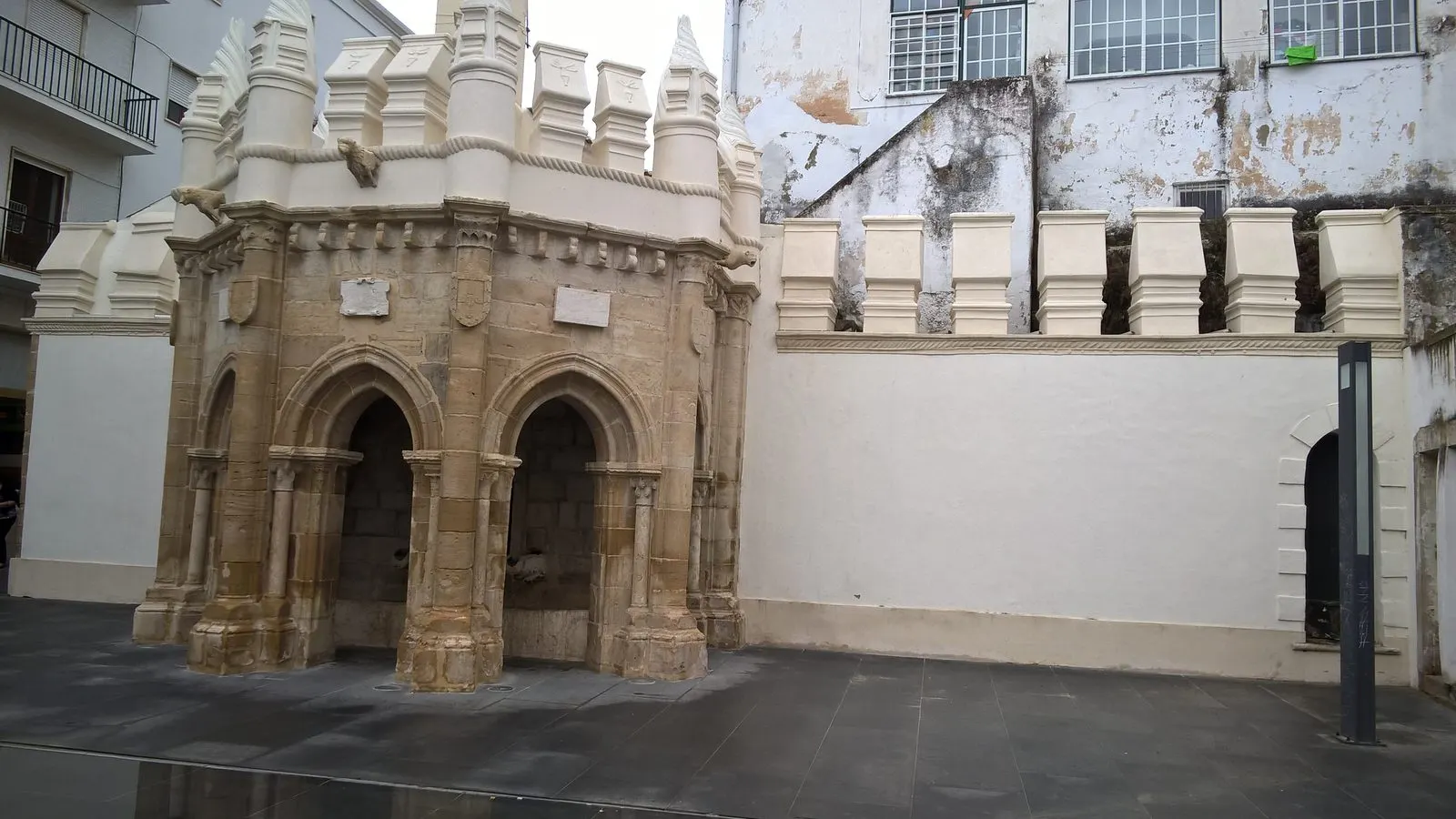
Chafariz dos Canos, Torres Vedras: Gothic hexagonal fountain first referred to in 1331, reworked in 1561 by D. Maria and classified a National Monument.
- Location
- Torres Vedras, Lisboa
- Built
- séc. XIV (primeira referência em 1331); reformado em 1561
The Chafariz dos Canos is the monumental fountain of the town of Torres Vedras. For the Património Cultural it is the most monumental Gothic fountain in the country that has survived to the present day. It has pointed arches, a basin with two spouts inside, and a crown of merlons and pinnacles that the 1561 reform added to the Gothic structure.
A reference from 1331
The earliest known reference to the fountain dates from 1331. The official record therefore concludes that the construction must have taken place still during the reign of D. Dinis, practically at the same time as another important Gothic fountain, that of Figueiras, in Santarém, was being built. The exact date of construction is not known: 1331 is the first documentary mention, not a foundation date.
The name comes from the «canos» (pipes) that carried the water. The fountain was fed by the aqueduct of Torres Vedras, also classified as a National Monument by the same 1910 decree, under the designation Aqueduto da Fonte dos Canos. This record deals only with the fountain.
A hexagonal pavilion
The comparison with Santarém helps to understand the idea behind the design. In Santarém the most common scheme was chosen, with a square plan, a porch with pointed arches and an attached basin. In Torres Vedras the model is different, conceived to reinforce monumentality: a centralised, hexagonal plan, whose largest face is set against a wall that delimits the square.
Each of the five free faces has its corners reinforced by buttresses formed by engaged columns, with foliate capitals in two tiers. The panels are opened by pointed arches of two orders of moulded voussoirs, and the crown displays the prow-shaped corbels typical of Gothic architecture. Inside there is a rectangular basin with two spouts and a small passage running around it, and the roof is a ribbed vault of pointed ogives resting on corbels with a conical profile.
The record also highlights the presence of plaques bearing the royal and municipal arms, a sign of the participation of both authorities in a work of great social and economic weight. This is a feature shared with the fountain at Santarém.
1561: the campaign of Infanta D. Maria
About two centuries later, the fountain was the object of a campaign sponsored by Infanta D. Maria, daughter of D. Manuel I, in 1561, probably prompted by repairs to the roof. The lower structure does not appear to have been altered. In the crown, heavy merlons and pinnacles in the Manueline style and gargoyles with fantastical animals were introduced. The undertaking served less to update the style than to reinforce the monumentality, giving greater height and visual impact.
In 1613 it is recorded that the fountain showed signs of deterioration, but the documentation only mentions a repair work in 1831, carried out on the initiative of the magistrate (corregedor) Pedro Quintela Emauz, who marked it with two Latin inscriptions. In the 20th century, the DGEMN carried out restorations in 1958 and 1966. In 2000, archaeological excavations revealed part of the city’s medieval wall, the area of the Porta da Corredoura, which ran alongside the fountain. A conservation company refers to a restoration project in 2012, with a colour study by architects from the Faculty of Architecture of the University of Lisbon.
Classification
The national register identifies the Chafariz dos Canos as a National Monument, by the Decree of 16 June 1910, published in the Diário do Governo no. 136, of 23 June 1910. The record indicates that it is covered by the protection zone of the Church of São Pedro. It should not be confused with the Lines of Torres Vedras, the fortifications of the Peninsular War, which belong to a different era and serve a different function.
How to visit
The official inventory gives the address as Rua Cândido dos Reis, in Torres Vedras, in the parish of Santa Maria, São Pedro e Matacães. The fountain is visible from public space, next to the historic centre. The Rede Histórica das Linhas de Torres describes it as the town’s fountain, classified as a National Monument, next to the former Porta da Corredoura. To find out whether the interior is accessible, whether water flows, or whether there are guided visits, please check with the municipality of Torres Vedras, since none of the sources consulted on 5 November 2026 gives opening times.
To place the fountain in the history of architecture, see also Gothic architecture in Portugal, and for the typology, the fountains and water fountains and the aqueducts.
Photograph by GualdimG, 19 October 2017. Original on Wikimedia Commons, under CC BY-SA 4.0; resized and compressed for the web, without altering the composition.
Frequently asked questions
- When did the Chafariz dos Canos appear?
- The earliest known reference dates from 1331, according to the official record, so the construction should be placed still within the reign of D. Dinis. The exact date of construction is not known.
- What changed in 1561?
- Infanta D. Maria, daughter of D. Manuel I, sponsored a campaign of works that added to the crown heavy merlons and pinnacles in the Manueline style, and gargoyles with fantastical animals. The lower structure does not appear to have been altered.
- Does the fountain still have water?
- The official record describes a rectangular basin with two spouts inside. The available information does not allow us to say whether water flows today; please confirm with the municipality.
- Is it classified?
- Yes, as a National Monument by decree of 16 June 1910, published in the Diário do Governo no. 136, of 23 June 1910.
Sources
- Património Cultural, I.P. — Chafariz dos Canos (registo 70374, NINV 3454), cópia arquivada de 2022
- Património Cultural, I.P. — Atlas do Património Classificado (NINV 3454 e 3449)
- Diário do Governo n.º 136, de 23 de junho de 1910
- Rede Histórica das Linhas de Torres — Chafariz dos Canos
- Nova Restauração — Chafariz dos Canos
- Wikidata — Chafariz dos Canos (Q9739319)
Keep exploring
Heritage nearby
More places to discover from here. Approximate straight-line distances, within 50 km.