Monuments
Varatojo Monastery
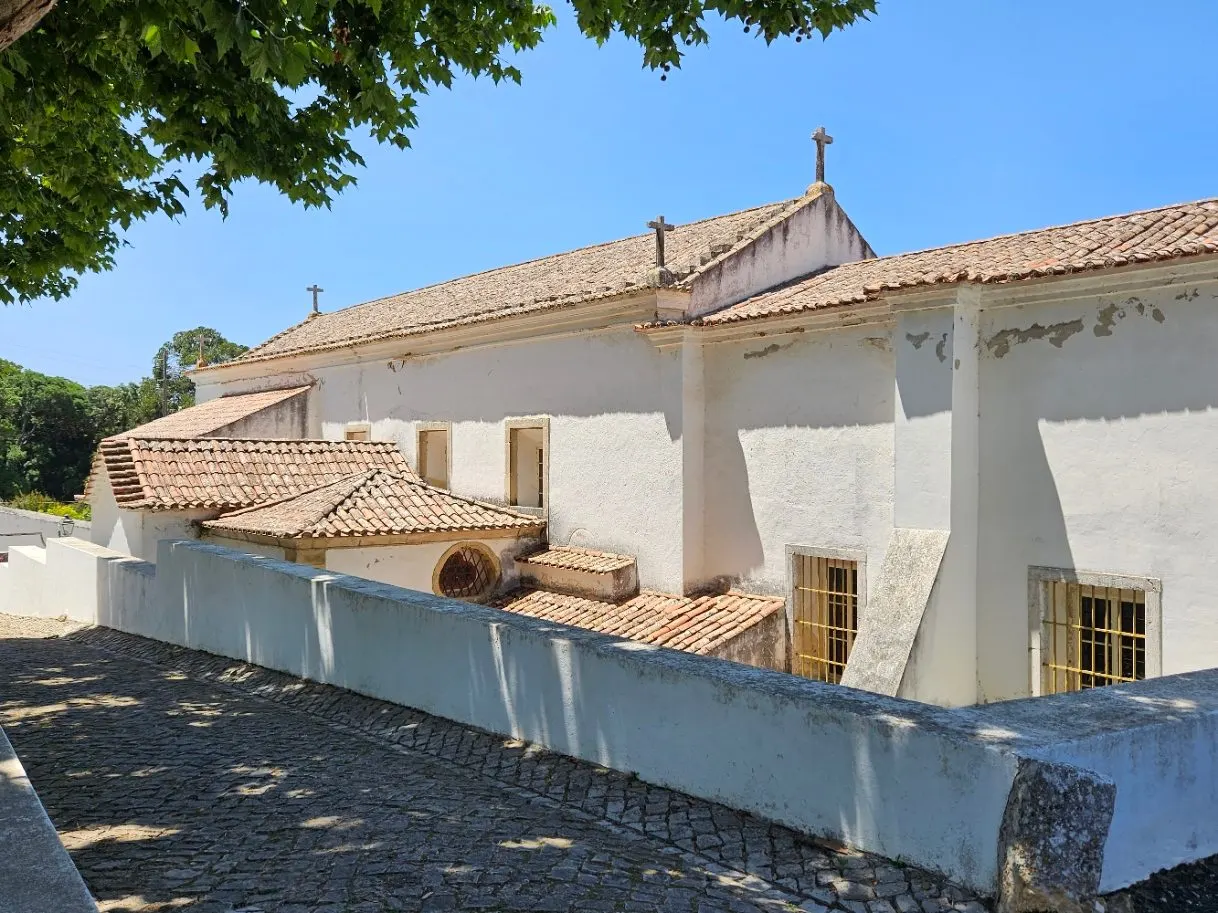
Mosteiro do Varatojo in Torres Vedras, a Franciscan house founded by Afonso V in 1470, with a 15th-century cloister, Mudejar ceiling, tiles and listed status.
- Location
- Varatojo, Torres Vedras, Lisboa
- Built
- 1470–1474; ampliações nos séculos XVI e XVIII
The Varatojo Monastery, or Monastery of Saint Anthony of Varatojo, stands near Torres Vedras, in territory that the Historic Route of the Torres Vedras Lines includes among its places to visit. It is a Franciscan house founded in the fifteenth century by a king who vowed to Saint Anthony to build it, and one of the rare ones that are still inhabited by friars. The building’s long life has left an eclectic ensemble, in which centuries of successive works can be read.
A vow by King Afonso V
According to the national heritage register, the monastery was founded by King Afonso V in 1470, in fulfilment of a vow to Saint Anthony: the king had asked him for help in the campaigns of North Africa. The monarch purchased the estate that would become the monastery’s grounds and gave it to a community of Franciscans from the Convent of São Francisco in Alenquer. By 1474 the works were almost finished, and in October of that year the friars inaugurated the site. Of the original construction, one of the dormitories remains, which leads into the choir.
The sixteenth to nineteenth centuries
In the mid-sixteenth century, possibly because of the damage caused by the earthquake of 1531, King João III ordered the dormitories to be rebuilt and enlarged. The infirmary and the main chapel of the church were built at the same time, the latter at the expense of Queen Catarina. In 1680 the College of Apostolic Missionaries was installed here, and around 1739 a storey was added to the dormitory area to house the college’s novitiate, which explains the missionary role the site played.
With the suppression of the religious orders, in 1834, the community dispersed. In 1845 the building was sold at public auction to the Baron of Torre de Moncorvo, and the Franciscans bought it back from the baron’s heir in 1861.
The twentieth century
After the establishment of the Republic, the religious were forced to leave the monastery as early as 1910, and the building became a home for the elderly. The Franciscan community only returned in 1928, when the Government handed the site over to the Portuguese Franciscan Missions, which, according to the national register, have maintained it to this day.
What to see
The national register describes an eclectic structure that incorporates models from several periods: a Gothic portal with bas-reliefs, the fifteenth-century cloister, the Mudéjar ceiling of the gatehouse and several Manueline portals in the cloister area. The church is Mannerist, and its interior preserves azulejo panels, both in the Mannerist taste and in pattern and figurative designs of Baroque taste, carved altarpieces in the national style and a painting by Bacarelli in the main chapel. The Historic Route of the Torres Vedras Lines summarises the ensemble as a small Franciscan monastery which, over the centuries, was restored and improved, combining Gothic, Mannerist and Baroque styles.
Those who know the Manueline style or gilded woodcarving will find modest examples here, in a house more austere than the great royal foundations. For the context of Franciscan life in Portugal, see also the Convento dos Capuchos, in Sintra, and the page on convents.
Classification and protection
Varatojo Monastery is classified as a National Monument under the Decree of 16 June 1910, published in the Diário do Governo no. 136, of 23 June 1910. The national register, which also includes the grounds (also known as the Cerca de Santo António), does not indicate a special protection zone. The property is not a World Heritage Site.
Planning your visit
The monastery is on Estrada da Vila de Torres, in Varatojo, in the civil parish of Santa Maria, São Pedro e Matacães, according to the national register. When consulted on 5 November 2026, we did not find visiting hours or admission prices in a current official source. The Historic Route of the Torres Vedras Lines refers visitors to its visitor centre; an unofficial source from 2021 mentions visits through the gatehouse on weekdays and Saturday mornings, but this information has not been confirmed. As this is a space of community life, it is advisable to contact the Franciscan community or the Municipality of Torres Vedras before going.
Varatojo lies within the region of Lisbon and Tagus Valley and forms part of the historical heritage of Torres Vedras; for other religious houses of a similar context, see monasteries.
Photograph by GualdimG, 1 July 2023. Original on Wikimedia Commons, under CC BY-SA 4.0; resized and compressed for the web, without altering the composition.
Frequently asked questions
- Who founded the Varatojo Monastery?
- King Afonso V, in 1470, in fulfilment of a vow made to Saint Anthony, whose help he had asked for the campaigns in North Africa. According to the national register, the works were almost complete by 1474, and the friars inaugurated the building in October of that year.
- Is the monastery still Franciscan?
- Yes. After the suppression of the religious orders, the sale of the building and the forced departure of the friars in 1910, the Franciscan community returned in 1928, when the Government handed the site over to the Portuguese Franciscan Missions, which, according to the national register, have maintained it to this day.
- What is its heritage status?
- National Monument, under the Decree of 16 June 1910 (Diário do Governo no. 136, of 23 June 1910). When consulted on 5 November 2026, the national register did not list a special protection zone.
- Can I visit it?
- When consulted on 5 November 2026, we did not find visiting hours in a current official source. An unofficial source from 2021 mentions visits through the gatehouse on weekdays and Saturday mornings, but this information is not confirmed. Please contact the community or the Municipality of Torres Vedras before going.
Sources
- Património Cultural, I.P. — Mosteiro do Varatojo (70223)
- Património Cultural, I.P. — Atlas do Património Classificado e em Vias de Classificação (NINV 3463)
- Diário do Governo — Decreto de 16 de junho de 1910 (n.º 136, 23-06-1910)
- Rota Histórica das Linhas de Torres — The Church and Monastery of St. Anthony of Varatojo
- Wikidata — Convento de Varatojo (Q17117713)
Keep exploring
Heritage nearby
More places to discover from here. Approximate straight-line distances, within 50 km.