Archaeology
Ermejeira Artificial Cave and Tholos do Barro
Ermejeira Artificial Cave and Tholos do Barro, in Torres Vedras: two distinct Chalcolithic National Monuments, with their history, classification and access.
- Location
- Ermejeira, Maxial e Monte Redondo, Torres Vedras, Lisboa
- Built
- Calcolítico (c. 3000–2000 a.C.)
The municipality of Torres Vedras has two funerary National Monuments of the Chalcolithic that the official register classifies as distinct properties: the Ermejeira artificial cave, cut into clay, and the Tholos do Barro, a false-vault chamber on Monte da Pena. They lie in different civil parishes, about ten kilometres apart in a straight line (calculated from the register’s coordinates). This page covers both and keeps the distinction the register makes. The name of the cave also appears written as Ermejeira, Ermigeira and Ermegeira.
Ermejeira Artificial Cave
The register places it in the civil parish of Maxial e Monte Redondo, on the Torres Vedras–Cadaval road, at the place known as Quinta de Entrecampos. It was discovered at the end of the 1930s and soon excavated by Manuel Heleno, director of the Ethnological Museum Dr. Leite de Vasconcelos, which received the materials; he published it in 1942 in the journal Ethnos. It is a hypogeum, or artificial cave, cut into compact clay for collective burial, with a chamber-and-passage morphology similar to other necropolises of the period.
Little of the monument survives: according to the register, only the vaulted chamber and the northern side wall, although traces on the ground allow speculation about an original passage. Among the finds, the register highlights fragments of Bell Beaker pottery and a pair of oval gold earrings, made from locally sourced alluvial gold sheet hammered thin; it describes them as displayed at the National Museum of Archaeology, a detail worth confirming before visiting the museum.
Tholos do Barro
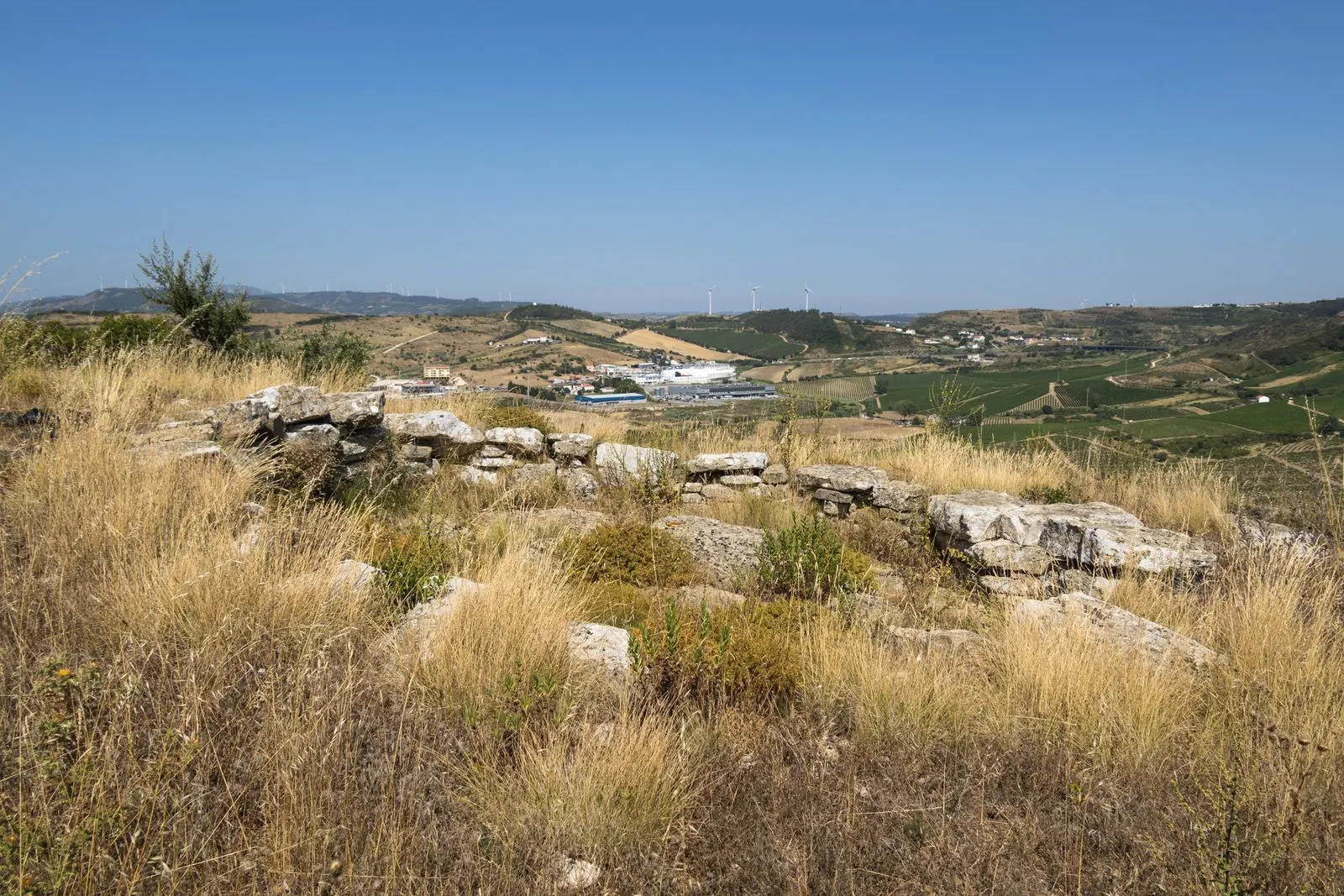
The monument, also called Tholos da Pena, lies in the civil parish of Santa Maria, São Pedro e Matacães, at the place called Barro, on the southern summit of Monte da Pena. It was identified after works in 1908 and excavated in 1909: the register attributes the excavation to Eugène Jalhay and Félix Alves Pereira; the National Museum of Archaeology and RTP refer to Paul Bovier-Lapierre and Alves Pereira. The sources agree that Félix Alves Pereira took part in the 1909 excavation and that the French priest Paul Bovier-Lapierre was involved in the discovery of the tholos; the register says it was he who surveyed the ground and found it.
The register describes a circular chamber about six metres in diameter, lined with overlapping blocks forming a false dome, a passage of about four metres and a stone mound roughly thirteen metres in diameter. The National Museum of Archaeology considers it the largest funerary chamber of this type known in the Iberian Peninsula. In 2021, a team from the Faculty of Letters of the University of Lisbon and the Leonel Trindade Municipal Museum returned to the site, fifty years after the last works, directed by Ana Catarina Sousa and Isabel Luna. RTP reports that the passage faces south, rather than east as in most contemporary monuments, and that the materials were to be dated by radiocarbon; the researcher notes that tholoi appear mainly from around 2900 BC onwards. The finds are divided between the National Museum of Archaeology and the Leonel Trindade Municipal Museum.
Classification
Both are National Monuments. According to the register, Decree No. 32 973, Diário do Governo, 1st series, No. 175, of 18 August 1943, is the current classification instrument for the cave and the tholos; earlier, a decree of 26 September 1940 (No. 30 762) and another of 1 November 1940 (No. 30 838) had dealt with them, the second suspending the former as regards privately owned properties. The Tholos do Barro was also classified as the «Pena funerary monument» by the Decree of 16 June 1910. Neither forms part of any UNESCO inscription. The general context is in Chalcolithic and megalithism; in the same municipality lies the fortified settlement of Castro do Zambujal.
Condition and Visiting
When consulted on 5 November 2026, we found no official information on opening hours, access or visiting conditions for either monument; the register does not state access conditions. RTP reported in 2021 that the Leonel Trindade Municipal Museum was leading school visits to the tholos and that the collapse of parts of the structure called for fencing, an information panel and visitor platforms; we have not confirmed that this project was completed. Before travelling, contact the Municipality of Torres Vedras.
Photograph: Alexkom000, 10 July 2026, 2026-07-10 Tholos do Barro, Torres Vedras.jpg, licence CC BY 4.0, resized and compressed for the web, composition unaltered. It shows the Tholos do Barro; no free-licence photograph of the Ermejeira cave exists.
Frequently asked questions
- Are the Ermejeira cave and the Tholos do Barro the same monument?
- No. They are two distinct National Monuments, with different inventory numbers (3459 and 3448), in different civil parishes of Torres Vedras. The first is an artificial cave cut into compact clay; the second is a tholos with a stone mound.
- What remains of the Ermejeira artificial cave?
- According to the Cultural Heritage register, only the vaulted chamber and the northern side wall. There are indications that allow speculation about an original passage.
- What is distinctive about the Tholos do Barro?
- The National Museum of Archaeology describes it as the largest funerary chamber of this type known in the Iberian Peninsula. The register indicates a circular chamber about six metres in diameter and a passage of about four metres.
- Can they be visited?
- When consulted on 5 November 2026, we found no official information on opening hours or visiting conditions for either monument. Please confirm with the Municipality of Torres Vedras.
Sources
- Património Cultural, I.P. — Gruta artificial da época calcolítica, aberta em argila compacta, existente no lugar de Ermejeira (70262)
- Património Cultural, I.P. — Monumento funerário eneolítico do Barro (70471)
- Património Cultural, I.P. — Atlas do Património Classificado (NINV 3459 e 3448)
- Museu Nacional de Arqueologia — Tholos do Barro (Município de Torres Vedras)
- Museu Nacional de Arqueologia — Tholos do Barro, Torres Vedras (escavações)
- RTP Notícias — Tholos do Barro. Valorizar sepultura megalítica com cinco mil anos
- Wikidata — Gruta artificial da época calcolítica, aberta em argila compacta, existente no lugar de Ermejeira (Q66814474)
Keep exploring
Heritage nearby
More places to discover from here. Approximate straight-line distances, within 50 km.