Monuments
Church of Santa Catarina (Paulistas), Lisbon
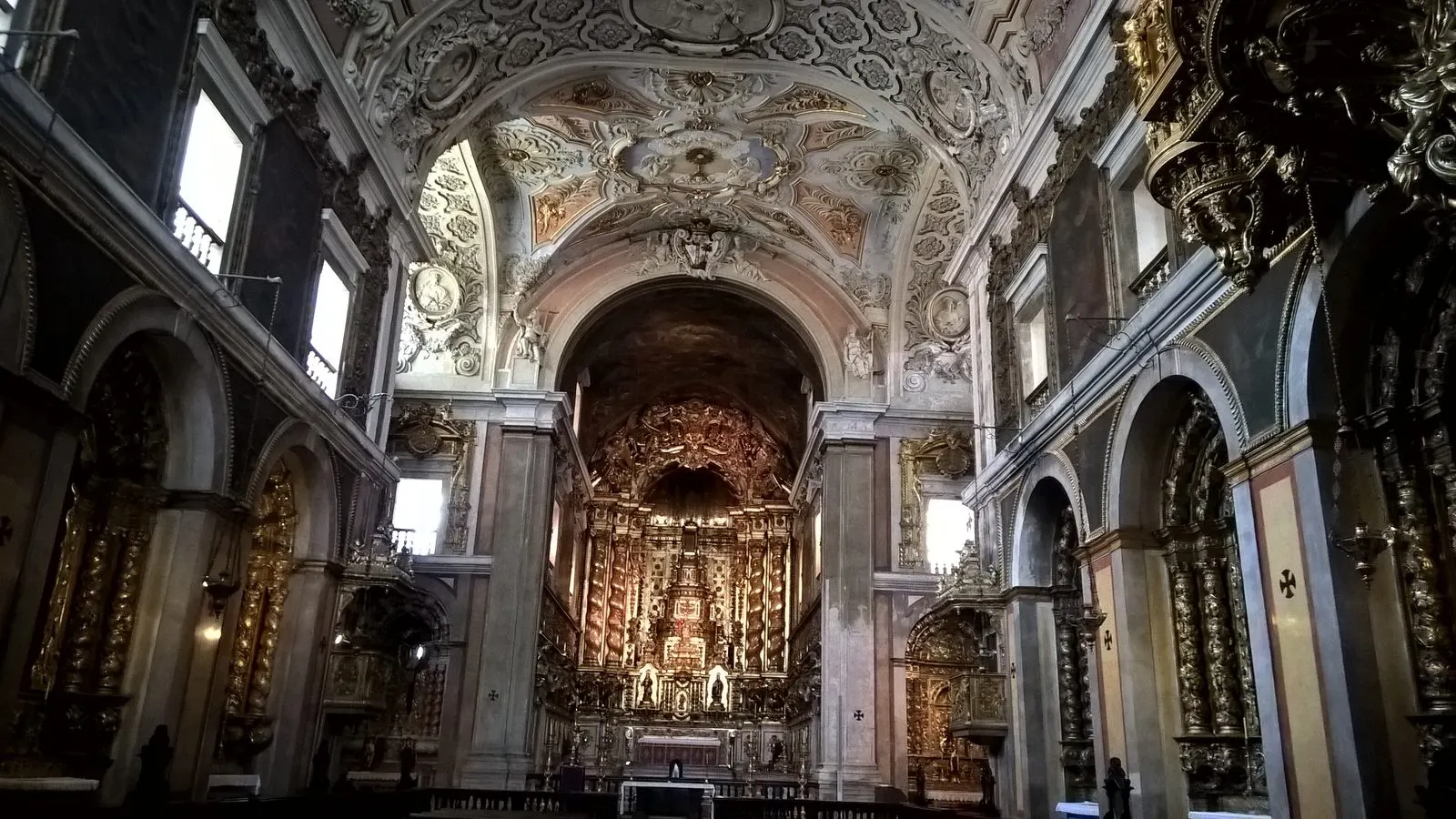
Church of Santa Catarina or dos Paulistas, in Lisbon: convent founded in 1647, church rebuilt after 1755, Joanine woodwork, stuccoes, organ. National Monument.
- Location
- Lisboa, Lisboa
- Built
- Convento de 1647; igreja de 1654, reconstruída após 1755 (concluída em 1763)
The Church of Santa Catarina, better known in Lisbon as the Church of the Paulistas, stands on Calçada do Combro, in the parish of Misericórdia, between Bairro Alto and Madragoa. Outside it is an urban three-part façade set against the street line; inside, it holds one of the richest ensembles of gilded woodwork and stucco in Lisbon rebuilt after the 1755 earthquake. It was the church of a hermit convent, and is today a parish church and a National Monument.
The Paulistas on Calçada do Combro
According to the text of the Centro Social Paroquial de Santa Catarina, the convent was founded in 1647 as a retreat for the hermits of the Order of Saint Paul the First Hermit, the Paulistas, with works directed by Friar Diogo da Ponte. The first friars settled in 1649, and the church, beside the convent, is dated 1654. The official register reflects this connection: the Atlas do Património Classificado designates the monument as Church of Santa Catarina, with a cross-reference to the Former Convent of the Hermits of São Paulo of Serra de Ossa (Paulistas), including its grounds.
The earthquake of 1 November 1755 destroyed the stone vault and damaged the convent. The reconstruction of the church was completed in 1763. In 1834, with the suppression of the religious orders, convent life came to an end; the conventual building was later adapted for courts and military services. In 1835 the church became a parish church under the dedication of Santa Catarina, a role it still holds.
Architecture
The façade has three sections, divided by paired pilasters; the central one, with two storeys, ends in a curved pediment decorated with a monstrance of the Blessed Sacrament, and two bell towers with balusters flank the ensemble. At ground level there is a three-arched galilee with round arches, and the central portal has a triangular pediment. The plan is a Latin cross, with a single nave, side chapels, a projecting transept and a deep chancel, and together with the convent it forms a U-shaped plan.
The Open House Lisboa listing associates the building with several names over time (seventeenth-century authors still unidentified, Joaquim de Oliveira in the eighteenth century and Valentim José Correia in the nineteenth) but does not detail their interventions; the parish text does not name an architect for the church. I have not found an accessible official source that clarifies this.
What to see inside
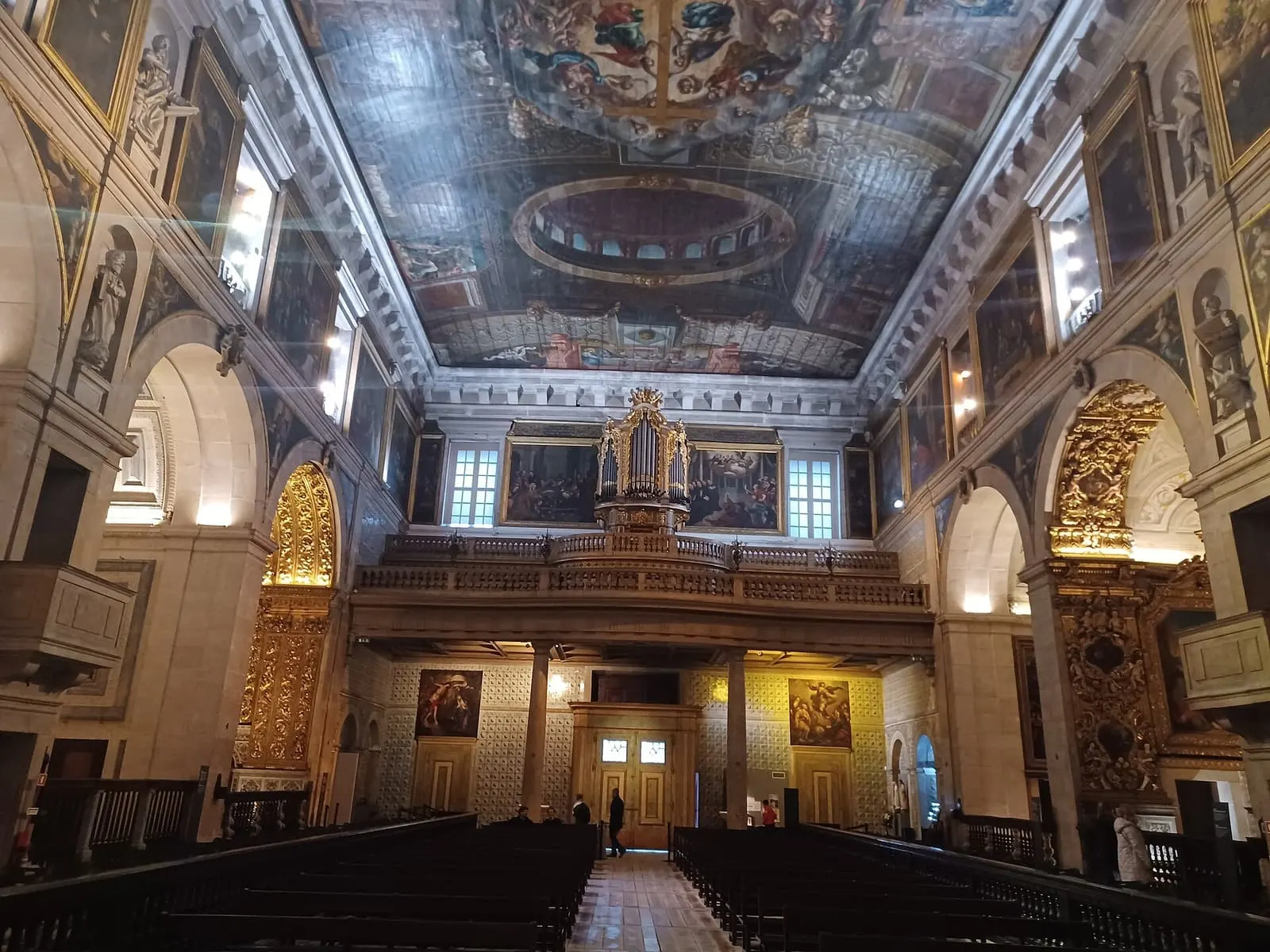
The parish text highlights the high altarpiece in Joanine woodwork, an example of the taste that the page on Joanine Baroque describes in general, and the nave vault, decorated with stuccoes of the third quarter of the eighteenth century, attributed to Giovanni Grossi (João Grossi), who is said to have worked with Toscanelli. The stucco therefore dates from the post-earthquake reconstruction and survives to this day.
The organ has a case in gilded woodwork and, according to the same text, was built in the early eighteenth century, probably between about 1710 and 1720, having survived 1755 and been modified in the nineteenth century; the undated text describes it as silent since the 1950s and calls for its restoration. For the context of historic instruments, see Portuguese historic organs.
As for azulejo, the parish source mentions only the seventeenth-century panels in the corridors of the former convent, not the interior of the church. For this reason, this page does not state that the nave has tile cladding.
Classification
The Atlas do Património Classificado records the monument as a National Monument, by Decree no. 5 046, Diário do Governo, I Series, no. 268, of 11 December 1918, the same instrument that classified other Lisbon buildings. The special protection zone appears in Portaria no. 398/2010 (Diário da República, 2nd series, no. 112, of 11 June 2010), with rectification notice no. 874/2011. It is not a UNESCO listing. For comparison with another Lisbon Baroque church of opulent interior, see the Church of São Roque.
Planning your visit
The church is at Calçada do Combro, 82. When consulted on 5 November 2026, the Centro Social Paroquial de Santa Catarina published only contact details (telephone 213 224 150 and 910 189 318), with no visiting hours or admission price. Open House Lisboa indicates reduced accessibility and that photography is permitted, without giving hours. The parish text further warns that the former convent houses GNR services, so access to that part of the building may be restricted. Please confirm everything directly with the parish before going.
Photograph by GualdimG, dated 23 March 2016. Original on Wikimedia Commons, under CC BY-SA 4.0; resized and compressed for the web, without altering the composition.
Frequently asked questions
- Why is it called the Church of the Paulistas?
- Because it belonged to the convent of the Hermits of São Paulo of Serra de Ossa, known as the Paulistas, who settled on Calçada do Combro in the mid-seventeenth century. The name Santa Catarina comes from the dedication adopted in 1835, when the church became a parish church.
- Is the church a National Monument?
- Yes. The Atlas do Património Classificado (Classified Heritage Atlas) records it as a National Monument by Decree no. 5 046, published in the Diário do Governo no. 268 of 11 December 1918, under a designation that also refers to the former convent and its grounds.
- What survived the 1755 earthquake?
- The tremor destroyed the stone vault and damaged the convent. The church was rebuilt and the works were completed in 1763; the nave stuccoes date from this period. The organ, from the early eighteenth century, is reported to have survived.
- Can I visit the interior?
- When consulted on 5 November 2026, the Centro Social Paroquial de Santa Catarina published only contact details, with no visiting hours. Please confirm by telephone or with the parish before going.
Sources
- Património Cultural, I.P. — Atlas do Património Classificado e em Vias de Classificação (NINV 3287)
- Diário do Governo — Decreto n.º 5 046, I Série, n.º 268, de 11 de dezembro de 1918
- Centro Social Paroquial Santa Catarina Lisboa — O Património (Igreja de Santa Catarina / Convento dos Paulistas)
- Trienal de Arquitectura de Lisboa / Open House Lisboa — Igreja de Santa Catarina
- Wikidata — Igreja de Santa Catarina (Q1657860)
Keep exploring
Heritage nearby
More places to discover from here. Approximate straight-line distances, within 50 km.