Monuments
Bica Funicular, Lisbon
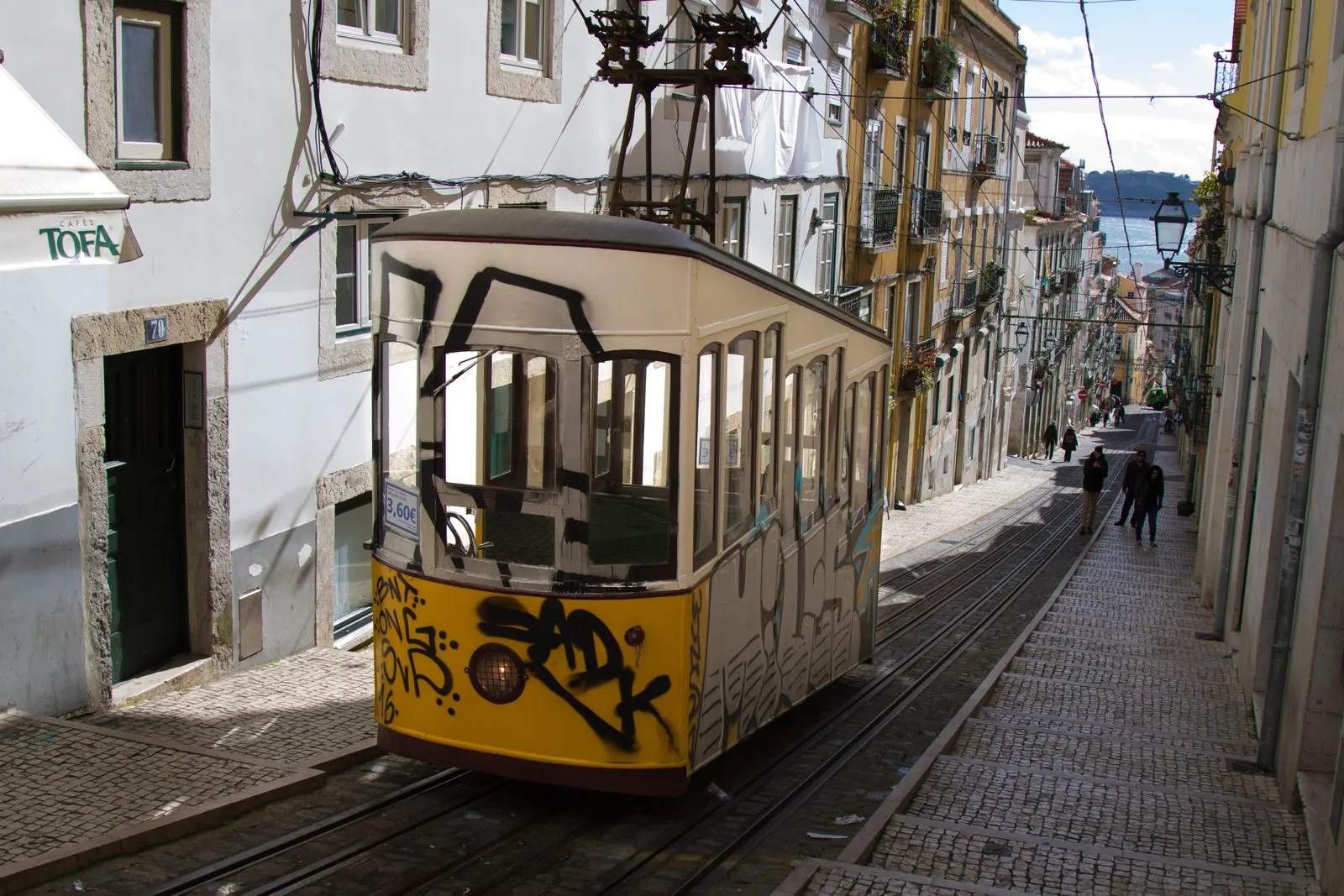
Bica Lift, in Lisbon: a funicular between Rua de São Paulo and Largo do Calhariz, designed by Raoul Mesnier du Ponsard and classified as a National Monument.
- Location
- Lisboa, Lisboa
- Built
- contrato de 1888
- Style
- Engenharia de transporte urbano do século XIX
The Bica Lift rises from Rua de São Paulo to Largo do Calhariz, crossing the Bica neighbourhood, in Lisbon. It is a National Monument under the same 2002 decree that classified the Glória and Lavra lifts and the Santa Justa Lift. The lower entrance is through the ground floor of a building on Rua de São Paulo. When consulted on 5 November 2026, it was not in service.
Origins
The historical note from Património Cultural, I.P. records that, in 1888, the Lisbon City Council and the Nova Companhia dos Ascensores signed a contract to install a lift between Rua de São Paulo and Largo do Calhariz. The design was entrusted to Raoul Mesnier du Ponsard, the same engineer behind the capital’s other lifts. The consulted record does not give an opening date, so this page does not mention one.
What can be seen
The system follows the model of the other Lisbon lifts: two cars that rise and descend alternately and simultaneously on two parallel tracks. The car has three compartments, with the operator’s area and the passenger area in the centre, where two benches face each other.
The upper access is by a ramp of five steps. At the bottom, passengers enter through a five-storey building, marked by five pilasters on the main façade, with wrought-iron doors. In the car circulation area, the walls are lined with azulejo tiles.
Classification
The Bica Lift is a National Monument under Decree no. 5/2002, Diário da República, I Série-B, no. 42, of 19 February 2002, without restrictions, under the designation Ascensor da Bica and the urban surroundings that frame it. The register recalls that the IPPC ordered the file to be opened on 20 December 1985, proposing in 1987 that the classification cover the urban surroundings. Carris submitted a new proposal on 1 August 1995, the City Council gave a favourable opinion on 7 October 1996, and the ministerial dispatch was issued on 9 April 1997.
The protection zone is the ZEP of Bairro Alto, set by Portaria no. 398/2010, of 11 June 2010, corrected by Declaração de retificação no. 874/2011. The register also mentions the Lisboa Pombalina, a site on Portugal’s Tentative List for UNESCO; a tentative list is not an inscription, and the lift is not a World Heritage Site.
Status and visiting
The lift is operated by Carris, which includes it, like the others, in the maintenance contract referred to in its October 2025 statement. When consulted on 5 November 2026, the Carris lifts page listed only the Glória and Lavra lifts, both temporarily closed, and did not show the Bica. RFM reported on 2 September 2026 that the service had been suspended as a precaution following the Glória accident and that there was no official reopening date.
Rua da Bica Duarte Belo, which the register gives as the location, can be walked, allowing a view of the tracks and the entrance on Rua de São Paulo. Please check the Carris website to see whether the service has resumed and under what conditions.
Photograph by Casperbakker, 5 March 2016. Original on Wikimedia Commons, under CC BY-SA 4.0; resized and compressed for the web, without altering the composition.
Frequently asked questions
- What route does the Bica Lift follow?
- The 1888 contract provided for a link between Rua de São Paulo and Largo do Calhariz. The lower access is through a five-storey building on Rua de São Paulo.
- Who designed it?
- According to the Cultural Heritage register, the design was entrusted to Raoul Mesnier du Ponsard, after the contract between the Lisbon City Council and the Nova Companhia dos Ascensores in 1888.
- Is it a National Monument?
- Yes. The official designation is Ascensor da Bica and the urban surroundings that frame it, classified by Decree no. 5/2002, published in the Diário da República on 19 February 2002.
- Is it in operation?
- When consulted on 5 November 2026, the Carris lifts page did not list it. RFM reported on 2 September 2026 that it was suspended with no official reopening date. Please check the Carris website.
Sources
- Património Cultural, I.P. — Ascensor da Bica e meio urbano que o envolve (70154)
- Património Cultural, I.P. — Atlas do Património Classificado, registo NINV 1119
- Carris — Ascensores
- Carris — Comunicado à imprensa sobre o Relatório Preliminar do GPIAAF (outubro de 2025)
- RFM — Glória, Bica, Lavra e Santa Justa: um ano depois do acidente (02-09-2026)
- Wikidata — Ascensor da Bica (Q99630)
Keep exploring
Heritage nearby
More places to discover from here. Approximate straight-line distances, within 50 km.