Monuments
Church of Santa Maria do Olival, Tomar
Santa Maria do Olival in Tomar: Templar masters' pantheon, Gothic nave from the mid-13th century, Diogo Pinheiro's tomb and a guide on how to visit.
- Location
- Tomar, Santarém
- Built
- século XII (igreja primitiva); igreja atual de meados do século XIII
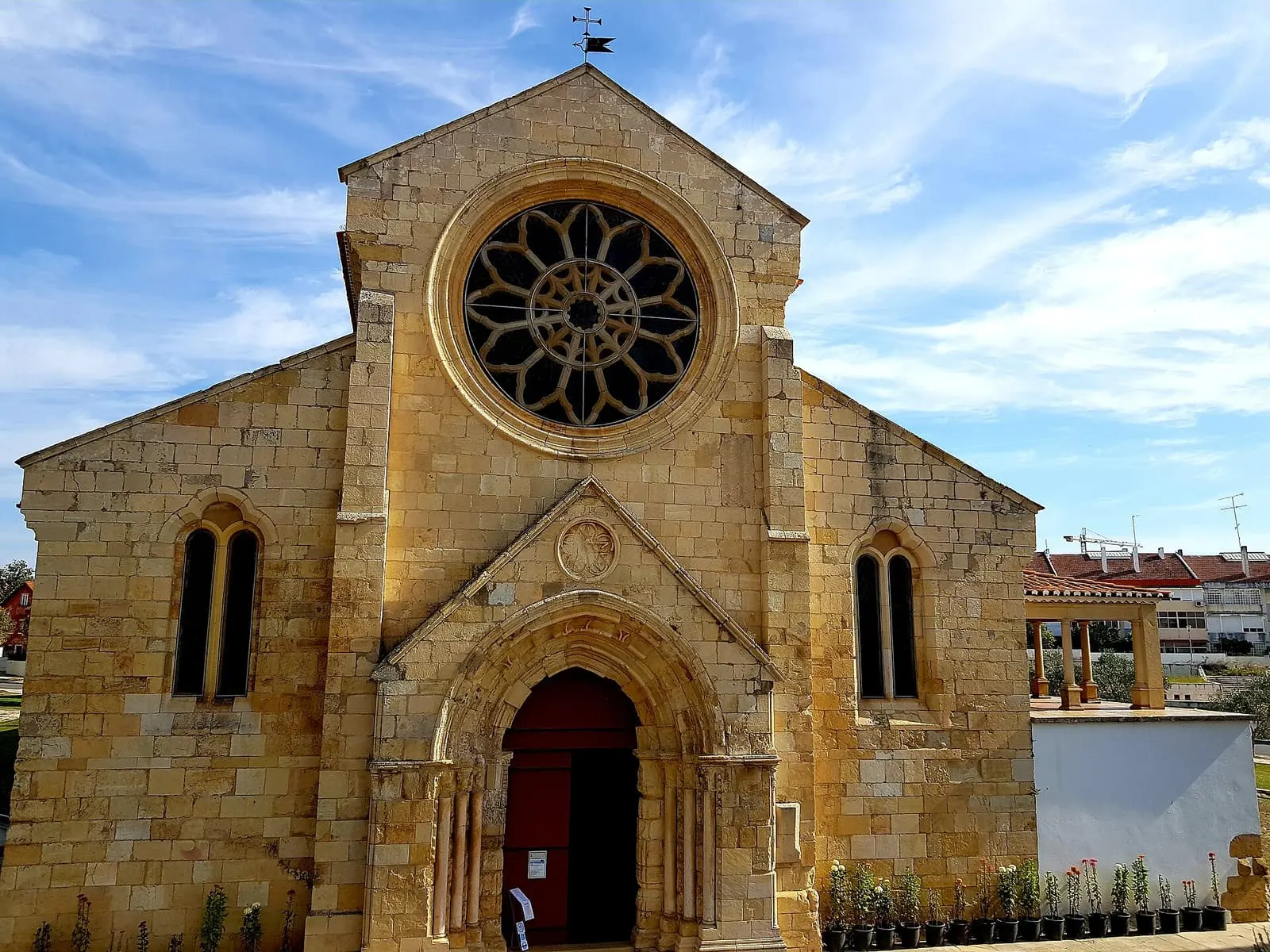
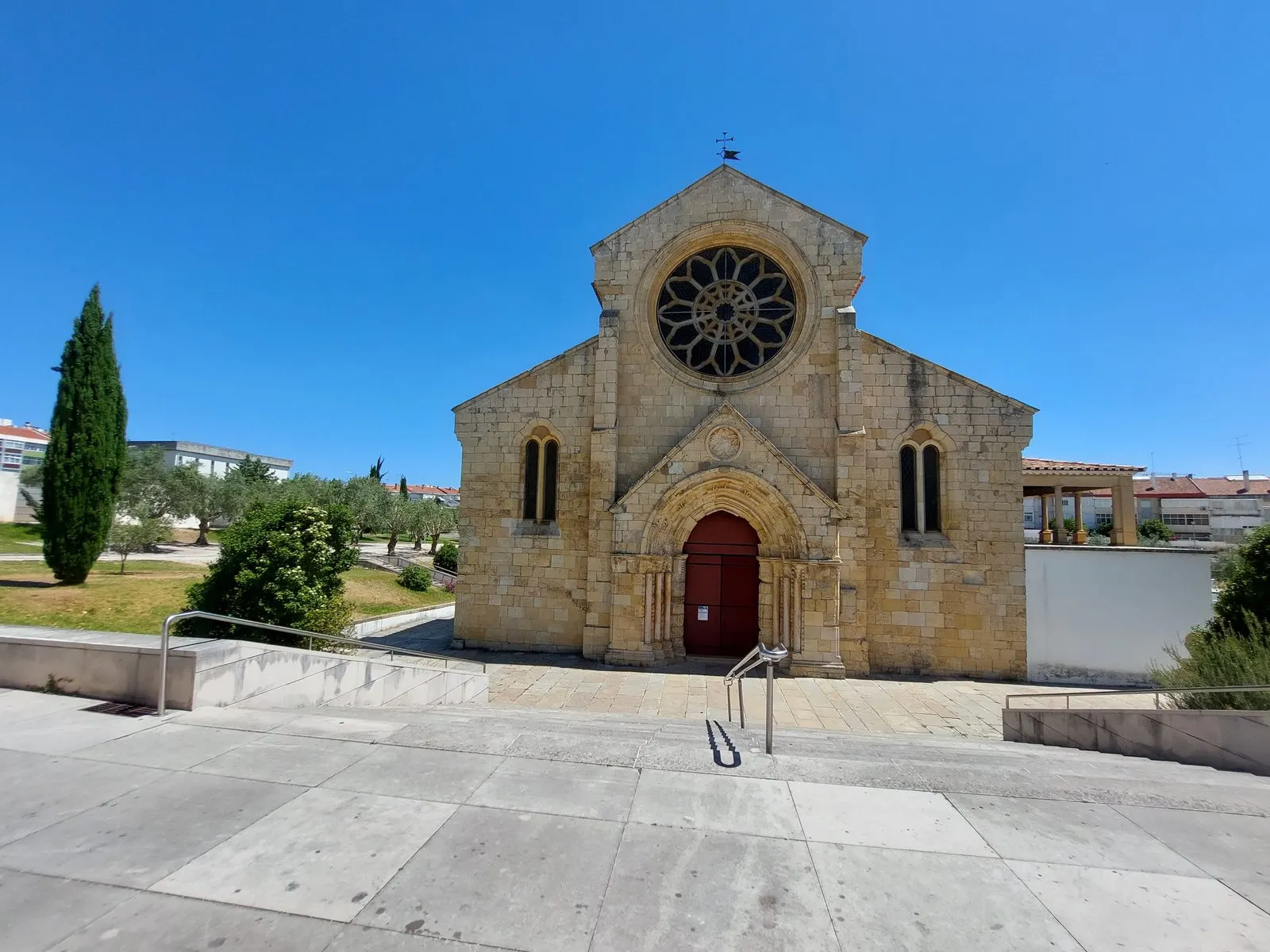
The Church of Santa Maria do Olival (also called Santa Maria dos Olivais) stands on a hill east of the centre of Tomar, beside the road to Marmelais de Baixo. It is a Gothic church of pale stone, with a large rose window on the façade, and in the Middle Ages it was where the masters of the Order of the Temple chose to be buried. This funerary role links it to the Convent of Christ, on the other side of the town, and to the network of the Order’s monuments in Tomar.
A cemetery for the friars
According to the Património Cultural, I.P. register, the church stands on a plot of the Roman city of Sellium: excavations uncovered Roman foundations, later reused as walls of an extensive medieval necropolis associated with the temple. The register records burials between the fifth and sixteenth centuries, but notes that a rigorous monographic archaeological study is still lacking, so these figures should be read with caution.
The original church is said to have been built in the twelfth century, on the initiative of D. Gualdim Pais, Master of the Order of the Temple, as a cemetery for the friars. Gualdim Pais himself was buried inside; of his tomb remains the funerary inscription, dated 1195. The municipality of Tomar adds that Master D. Gil Martins, first master of the new Order of Christ, and Master Lourenço Martins were also buried there, and that Gualdim Pais’s slab is now on the wall of the second chapel, to which the remains were transferred after the tombs were removed by order of D. João III. How that early temple looked, and what relation it bore to the Romanesque charola of the Convent of Christ, is not known.
The idea of a “Templar pantheon” thus has documentary basis, but it should be separated from the building seen today. The pantheon is the function; the present construction is later.
The Gothic church of the mid-thirteenth century
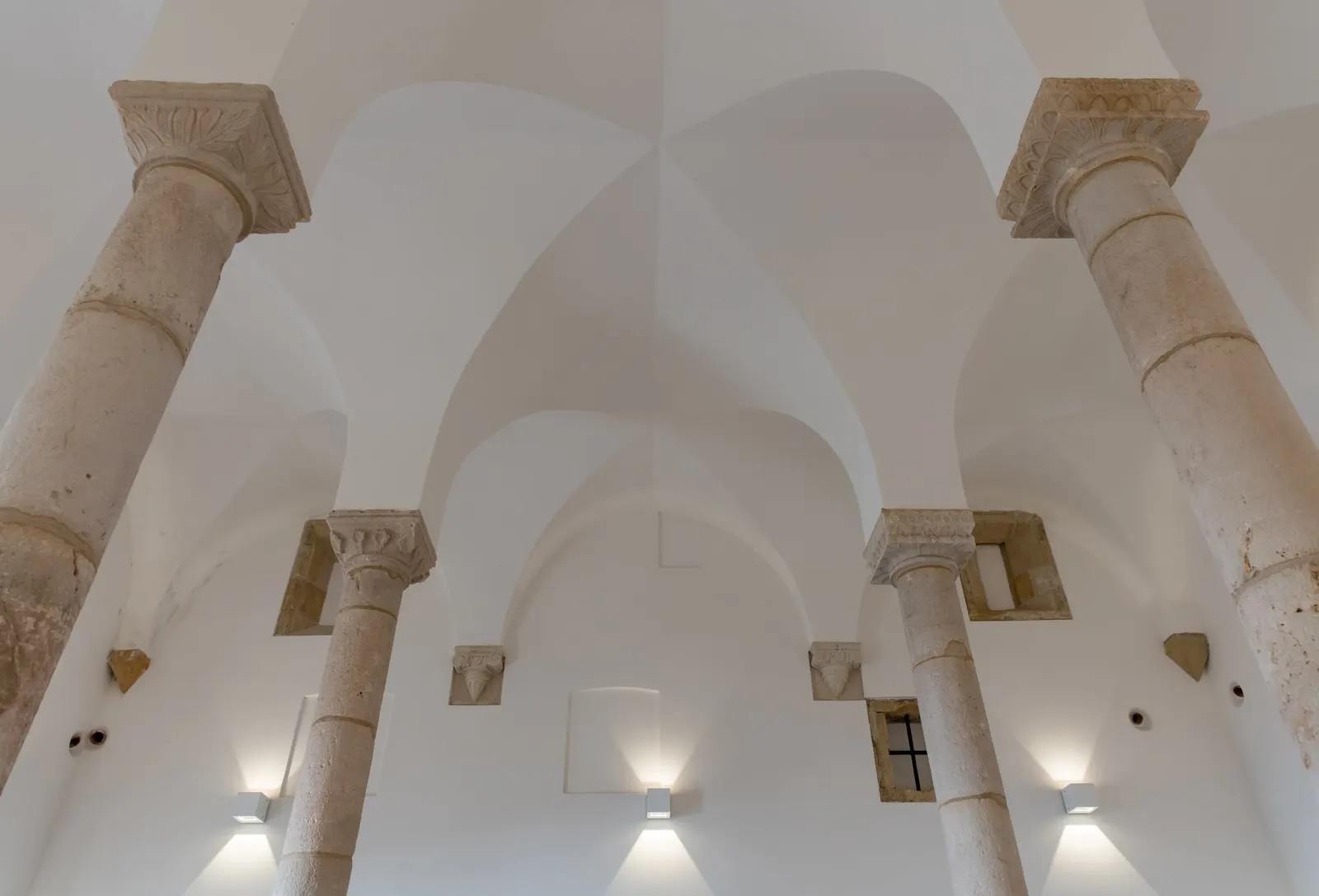
The present church began to be built around the middle of the thirteenth century, presumably during the reign of D. Afonso III, and soon established itself as an emblematic work of national Gothic architecture. The national register describes a building of three naves of differing heights, the central one the tallest, divided into five bays, with a timber roof and no transept. The chancel is the only vaulted part: a two-bay main chapel, the last bay of seven sides, flanked by two rectangular apsidioles.
The model was widely repeated. The register cites Paulo Pereira in calling it a “long-lived typology”, followed in parish, cathedral and conventual churches from north to south of the kingdom. The municipality, for its part, notes that the spatial organisation served as a model for the Church of São João Baptista, also in Tomar. It is debated whether the plan evolved from Romanesque models (Paulo Pereira) or not (Pedro Dias); most authors place the building within the great workshop of Alcobaça, completed around that time.
The main façade has three bays and follows the scheme known as ad triangulum: the side bays join obliquely to the central one. On the central bay, of two storeys, opens a pointed-arch portal with archivolts and a gable; on the upper storey, a rose window filters light into the nave. The municipality also points out the watchtower adapted as a belfry and the lateral loggia. According to the same source, the rose window above the high altar, bearing Solomon’s seal, is recent, having been introduced in the great restoration of 1940.
Chapels, tombs and the bishop of Funchal
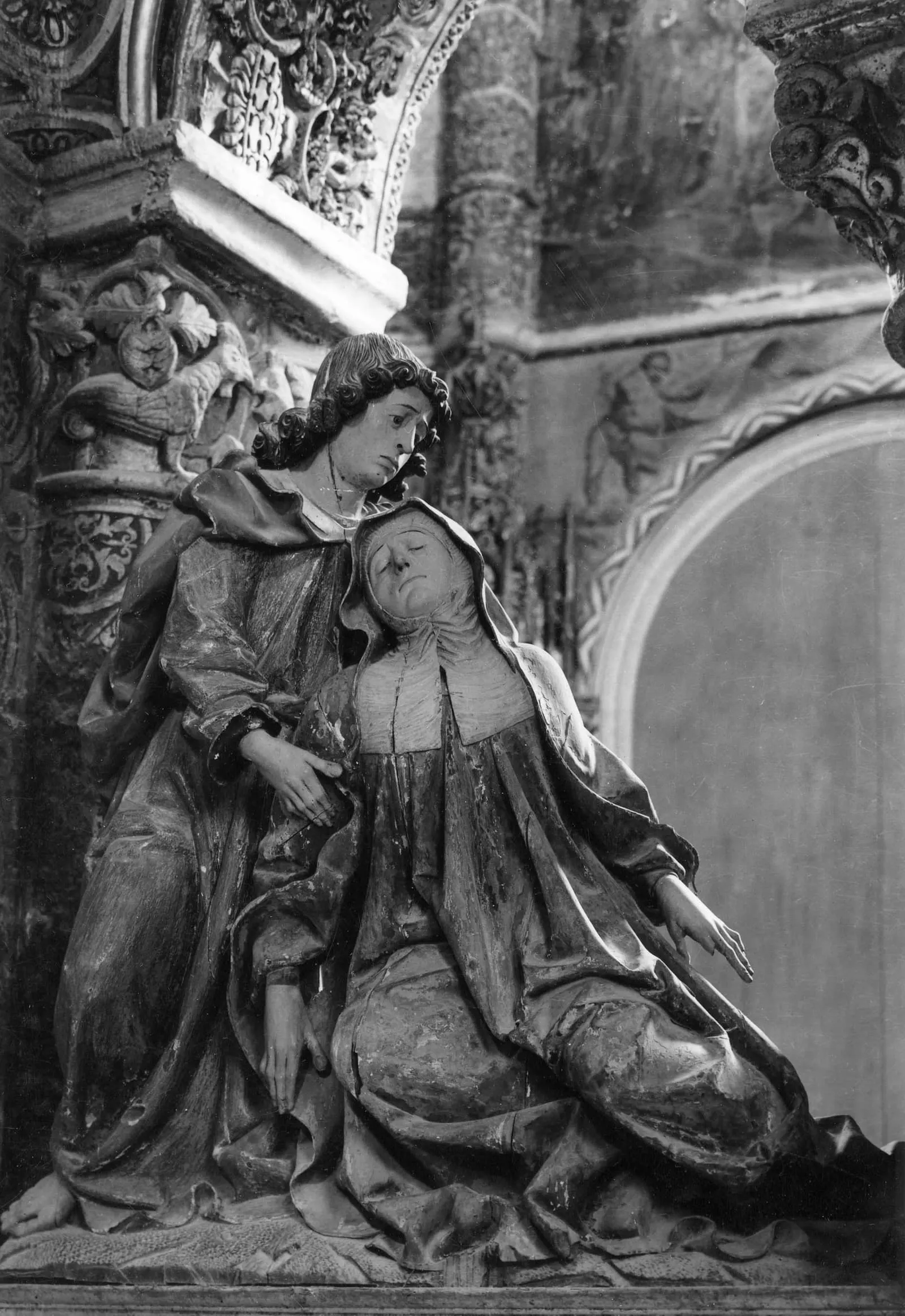
In the following centuries the church kept its role as a mausoleum, and in the sixteenth century several private chapels in a Mannerist style were added on the south side. Shortly before, between 1525 and 1528, D. Diogo Pinheiro, first bishop of Funchal, was buried in the main chapel, in a richly decorated Renaissance tomb from the workshop of João de Ruão. The municipality attributes the work to Diogo Pires-o-Moço; this attribution differs from that of the national register, which points to João de Ruão’s workshop. This tomb gives its name to the official designation of the classified monument.
The municipality also mentions a sixteenth-century image of Our Lady of the Milk (Nossa Senhora do Leite) in the main chapel, and the importance the church held in the time of the Order of Christ: according to the bull of 13 March 1455, it was the mother church with jurisdiction over the churches of the overseas territories. This is information from the municipality, not from the national register, and should be read as such. Opposite the building stands a tower of which it is said a tunnel once led to the Templar castle; this is a belief, not a proven fact. For the castle, see the Castle of Tomar.
Classification
The church is a National Monument by decree of 16 June 1910 (Diário do Governo no. 136, of 23 June 1910), under the designation «Igreja de Santa Maria do Olival, compreendendo os túmulos, designadamente o de D. Diogo Pinheiro, 1.º bispo do Funchal». The special protection zone, with a non aedificandi zone, was fixed by ordinance of 30 August 1946. It has no separate UNESCO inscription. The Convent of Christ, which visitors naturally associate with this church, is a World Heritage site, but UNESCO does not include Olival in that inscription, so the church should not be presented as part of it. For other pages on Tomar, see also the Synagogue of Tomar.
Planning the visit
The address given by the municipality is Rua Aquiles da Mota Lima, Tomar. When consulted on 5 November 2026, the Tomar Tourism office published the following hours:
- April to September: Tuesday to Sunday, 10:00–13:00 and 14:00–18:00;
- October to March: Tuesday to Sunday, 10:00–12:00 and 14:00–17:00;
- closed on 1 January, 1 May and 25 December.
The same page gives the telephone number +351 249 329 823 for booking visits and +351 249 312 611 for masses and other celebrations. The church is a parish church, so access may vary on days of worship. Always confirm on the municipal page before travelling; we did not find an entrance fee published, if one exists.
Photograph by Threeohsix, dated 6 August 2023. Original on Wikimedia Commons, under CC BY-SA 4.0; resized and compressed for the web, without altering the composition.
Frequently asked questions
- Was the Church of Santa Maria do Olival a Templar pantheon?
- Yes, according to the Património Cultural, I.P. register and the municipality of Tomar: the original twelfth-century church is said to have been built on the initiative of D. Gualdim Pais, Master of the Temple, as a cemetery for the friars, and Gualdim Pais himself was buried there (funerary inscription dated 1195). The form of this first church is unknown.
- Is the present building from the Templar period?
- No. The present church began to be built around the middle of the thirteenth century, presumably during the reign of D. Afonso III, and is a Gothic work; the form of the twelfth-century church is not known.
- Is the church a National Monument?
- Yes. It is classified as a National Monument by decree of 16 June 1910 (Diário do Governo no. 136, of 23 June 1910), under the designation «Igreja de Santa Maria do Olival, compreendendo os túmulos, designadamente o de D. Diogo Pinheiro, 1.º bispo do Funchal» (Church of Santa Maria do Olival, including its tombs, notably that of D. Diogo Pinheiro, first bishop of Funchal). It is not a UNESCO inscription; the Convent of Christ, in Tomar, is the World Heritage site.
- How do I arrange a visit?
- When consulted on 5 November 2026, the Tomar Tourism office gave the telephone number +351 249 329 823 for booking visits and published opening hours from Tuesday to Sunday, closed on 1 January, 1 May and 25 December. Please check the municipal page before travelling.
Sources
- Património Cultural, I.P. — Igreja de Santa Maria do Olival, compreendendo os túmulos, designadamente o de D. Diogo Pinheiro (70610)
- Património Cultural, I.P. — Atlas do Património Classificado e em Vias de Classificação (NINV 3972)
- Diário do Governo — Decreto de 16 de junho de 1910 (n.º 136, 23-06-1910)
- Município de Tomar / Turismo de Tomar — Igreja de Santa Maria do Olival
- Wikidata — Igreja de Santa Maria dos Olivais (Q267013)
Keep exploring
Heritage nearby
More places to discover from here. Approximate straight-line distances, within 50 km.