Monuments
Church of São Domingos (Lisbon)
Church of São Domingos, beside the Rossio: a medieval Dominican convent, the 1506 massacre, reconstruction after 1755 and the interior marked by the 1959 fire.
- Location
- Lisboa, Lisboa
- Built
- 1241 (fundação); reconstruída após 1755
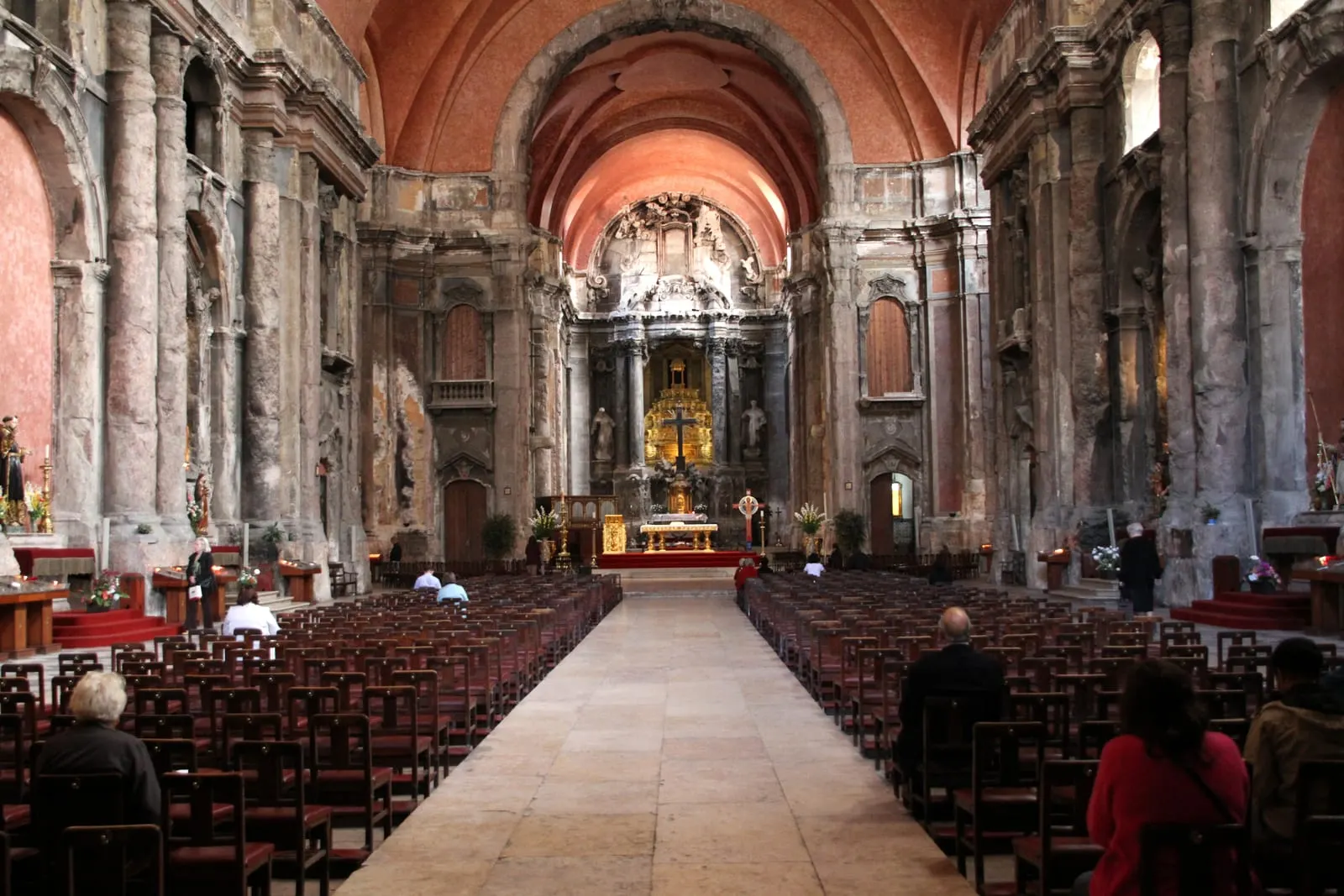
The Church of São Domingos stands in the square of the same name, between the Rossio and Praça da Figueira, in central Lisbon. It was the church of the city’s main Dominican convent and is today a parish church. Visitors enter a large-scale Baroque nave with chipped columns and darkened stone: the marks of the 1959 fire were left visible on purpose. Few buildings in Lisbon hold so many layers of difficult history in one place.
A medieval convent rebuilt many times
According to the Portuguese Cultural Heritage register (Património Cultural, I.P.), the first stone was laid in 1241. Turismo de Lisboa attributes the foundation to an order under King D. Sancho II. The medieval building was altered and extended through successive building campaigns, so that little of the original construction survives today.
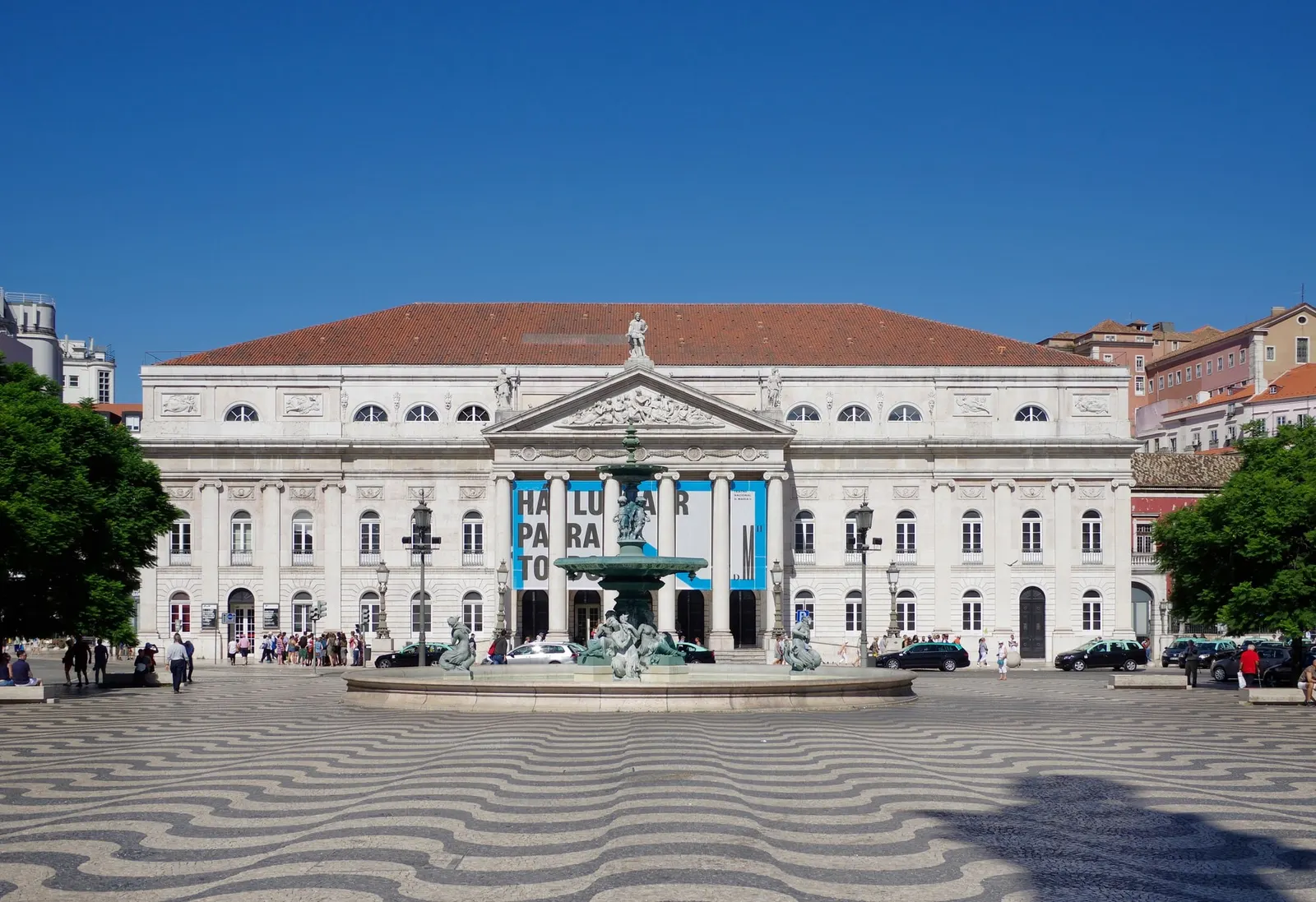
Over the centuries, the church hosted ceremonies of court and city, from funeral rites to baptisms and weddings. Turismo de Lisboa also notes the darker side of this centrality: the church stood beside the Inquisition palace, from which those condemned for heresy were led to public execution in the Rossio. That palace, the Estaus, gave way to the Teatro Nacional D. Maria II.
The massacre of April 1506
The so-called Lisbon Massacre began in this church. On 19 April 1506, during a period of plague and scarcity, the faithful gathered in the chapel of Jesus reported seeing a miraculous light come from the crucifix. A New Christian, that is, a Jew forcibly converted at the end of the previous century, reportedly cast doubt on the miracle. He was dragged out of the church and killed. From then on, groups of townspeople, incited by Dominican friars, hunted down and killed New Christians across the city over several days.
The number of victims is not known precisely. In a study published in 2018, Rita Ribeiro Voss compares the contemporary sources. The chronicler Solomon ibn Verga speaks of about three thousand dead. A German witness present in Lisbon estimated that there were no more than one thousand to one thousand two hundred. The Jewish representatives who brought the case to the pope cited four thousand. The same German witness reports that the king ordered the friars expelled and the church and convent closed.
In Largo de São Domingos, the Memorial to the Victims of the 1506 Massacre commemorates the event. It is a 2008 work by Graça Bachmann, commissioned at the proposal of the Jewish Community: a truncated stone sphere with a Star of David and a line from the Book of Job. By the church door there is another marker, linked to the request for forgiveness for the Inquisitorial persecution made in 2000 by Cardinal-Patriarch D. José Policarpo. To place this story within the Jewish presence in the country, continue at judiarias e sinagogas.
Earthquake, reconstruction and fire
In 1748, the architect João Frederico Ludovice remodelled the high chapel. It was the only part of the church spared by the 1755 earthquake. Reconstruction was then entrusted to Manuel Caetano de Sousa. He reused the portal and the balcony above it, which came from the Royal Chapel of the Ribeira Palace, also ruined by the tremor. The result is a Baroque church with a Latin cross plan and a single nave, with a plainly lined exterior.
On the night of 13 August 1959, a fire devastated the interior. According to the report published in Observador, about 300 firefighters fought the flames and two sappers died. The roof, gilded woodwork, images and paintings were lost. The national register dates this fire to 1954, but the other sources consulted point to 1959.
Recovery work went on for decades. The same Observador article states that the church reopened in 1994. In the restoration, the scars of the fire were kept visible rather than reconstructing the lost decoration.
What to look for
The nave is rhythmed by side altars under round arches, separated by pairs of composite columns, with galleries and windows above. Note the stone of the columns and walls, cracked and stained by heat, and the false barrel vault. The Cultural Heritage register describes it as decorated in manganese and ochre using the sponged technique. Ludovice’s high chapel, divided in the middle by double columns, retains its retable with throne.
Of the former sculptural group of the retable only traces remain, and much of the marble and painting highlighted by the national register no longer exists. The sacristy and the porch still preserve Mannerist traces, such as azulejo wall panels with a diamond-point motif.
Classification and protection
The church is classified as a National Monument under Decree No. 5 046 of 11 December 1918, according to the Portuguese Cultural Heritage register (Património Cultural, I.P.). The same register links it to Pombaline Lisbon, which appears on Portugal’s Tentative List for UNESCO. This does not make the church a World Heritage Site: the Tentative List is an intention to nominate, not an inscription.
Planning the visit
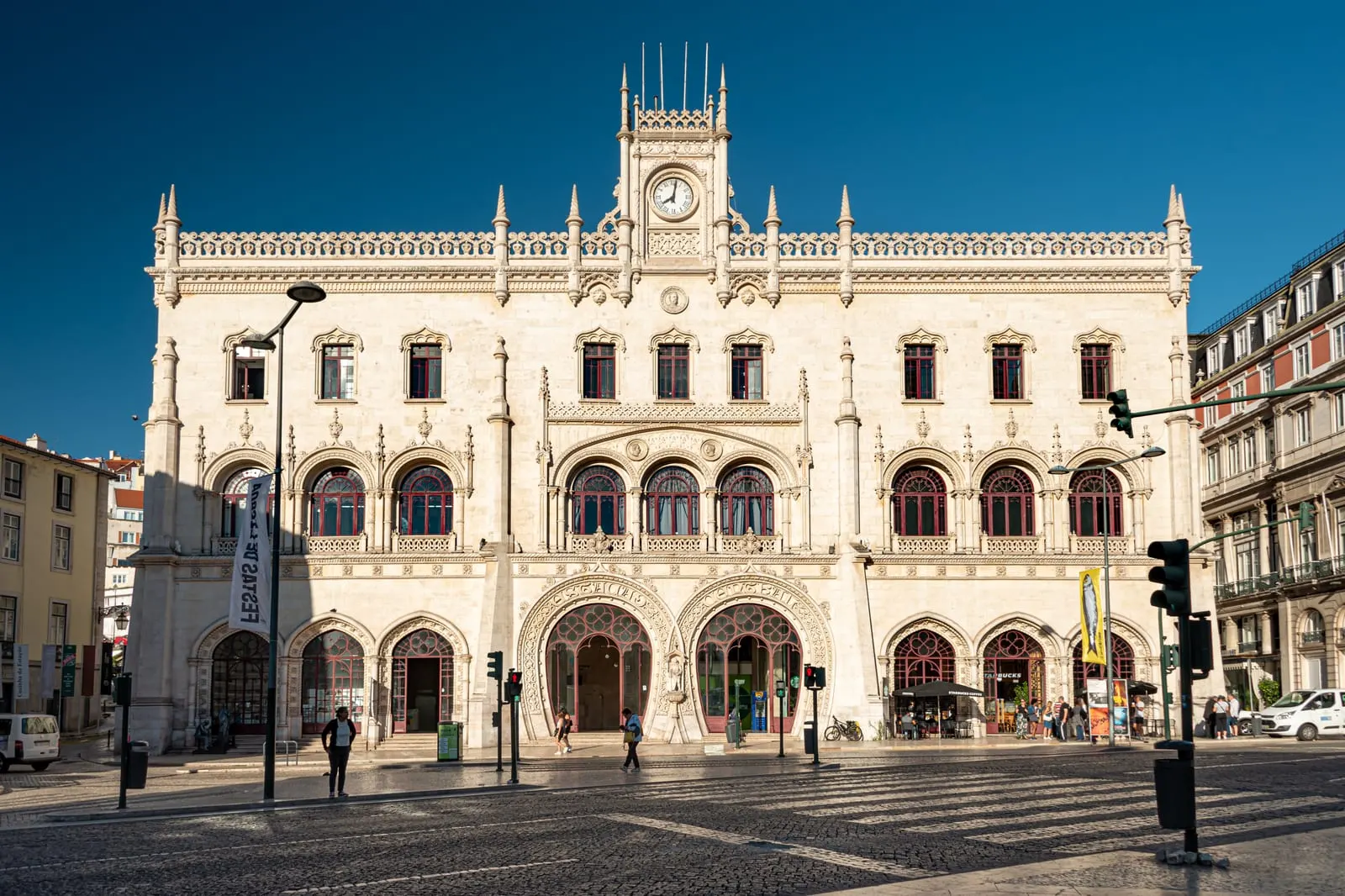
The church is a few steps from the Rossio and the Rossio station. It functions as a parish church, so avoid moving around during celebrations. When consulted on 5 November 2026, none of the official sources checked published opening hours. Turismo de Lisboa listed the address Largo de São Domingos, 1150-320 Lisboa, the telephone number +351 213 428 275 and a link to the Patriarchate of Lisbon. Confirm hours and any restrictions on the Turismo de Lisboa page or by phone before going.
The visit pairs well with the Carmo Convent, another major conventual church in Lisbon marked by the earthquake, but which was left in ruins.
Photograph by Gerd Eichmann, 7 June 2011. Original on Wikimedia Commons, under CC BY-SA 4.0; resized and compressed for the web, without altering the composition.
Frequently asked questions
- Why does the interior of the Church of São Domingos look burnt?
- On the night of 13 August 1959, a fire destroyed the church's interior, including woodwork, images and paintings. In the restoration, the traces of fire on the columns and walls were deliberately left visible.
- What is the church's connection to the 1506 massacre?
- The violence against Lisbon's New Christians began in this conventual church on 19 April 1506 and spread through the city over several days. The death toll is not known precisely: contemporary sources range from about one thousand to four thousand. A memorial to the victims stands in the square in front.
- Is the church a National Monument?
- Yes. The Portuguese Cultural Heritage register (Património Cultural, I.P.) classifies the Church of São Domingos as a National Monument under Decree No. 5 046 of 11 December 1918.
- Is the Church of São Domingos a World Heritage Site?
- No. The national register links it to the Pombaline Lisbon ensemble, which appears only on Portugal's Tentative List for UNESCO. A tentative list entry is a possible nomination, not an inscription.
Sources
- Património Cultural, I.P. — Igreja de São Domingos (70368)
- Património Cultural, I.P. — Atlas do Património Classificado e em Vias de Classificação (NINV 3294)
- Diário do Governo — Decreto n.º 5 046, de 11 de dezembro de 1918
- Turismo de Lisboa — Igreja de São Domingos
- Revista Lusófona de Ciência das Religiões — Rita Ribeiro Voss, Uma narrativa sobre o Massacre de Lisboa (n.º 21, 2018)
- Caminhos da Fé — Memorial às Vítimas do Massacre de 1506
- Observador — André Gomes Luís, Os 300 de São Domingos (16-08-2026)
- Diário de Notícias — Comunidade judaica portuguesa recorda massacre anti-semita de 1506
- Wikidata — Igreja de São Domingos (Q1977280)
Keep exploring
Heritage nearby
More places to discover from here. Approximate straight-line distances, within 50 km.