Monuments
Palace of the Counts of Almada
Palace of the Counts of Almada, or Independence Palace, in Lisbon: founded in 1467, site of the 1640 conspiracy, a National Monument since 1910, home of SHIP.
- Location
- Lisboa, Lisboa
- Built
- Fundado em 1467; obras até ao século XX
- Style
- Elementos manuelinos e maneiristas
The Palace of the Counts of Almada, better known as the Palace of Independence, stands on the Largo de São Domingos, beside the Rossio, in Lisbon. It has been the home of the Almada family since the 15th century and, according to the Sociedade Histórica da Independência de Portugal (SHIP), it was in a space of its garden that some of the conspirators of the 1640 Restoration met. It has been a National Monument since 1910, both for its artistic value and for its historical and political memory.
Two registers, two palaces
The national register lists two Almada buildings in Lisbon that may be confused. The Palace of the Counts of Almada (NINV 3326, register 70366), «comprising the commemorative monuments of the 1640 conspiracy», also called the Palace of Independence, stands on the Largo de São Domingos, in the parish of Santa Maria Maior. It is the building of this guide. The Palace that belonged to the Almadas, Provedores of the Casa da Índia, or Almada-Carvalhais Palace (NINV 3330, register 70251) is a different property, at Largo do Conde Barão, no. 50, in the parish of Misericórdia, listed by decree of 27 December 1919. The register attributes it to Rui or Rodrigo Fernandes de Almada, in the mid-16th century, and explains that the name Almada-Carvalhais comes from an heir named Count of Carvalhais in 1824. The coordinates of the two entries are about 1.2 km apart. This guide uses the first.
From foundation to 1940
The register and the SHIP agree that the palace was founded by D. Fernando de Almada in 1467. Of the successive works that altered the original design, the register states that four doorways and two chimneys survive, similar to those of the Palace of the Town of Sintra. The SHIP adds that, during the 1940 works directed by the architect Raul Lino, two Manueline doorways were unblocked, and it describes the 16th-century chimneys as truncated octagonal pyramids crowned with merlons. The register summarises the building’s language as the result of Manueline and Mannerist interventions, and describes a rectangular plan around a courtyard designed for the movement of carriages, and a two-storey façade with many windows and almost no ornamentation. For the stylistic context, see Manueline style.
The SHIP’s chronology shows a palace with many uses. In 1755 it suffered little damage in the earthquake and sheltered patients from the Hospital de Todos-os-Santos. Then, by order of the Marquis of Pombal, the archive of the Senate of the Municipal Council was installed there, in 1758 it housed the Tribunal da Relação and, between 1758 and 1766, it was the seat of the Municipal Senate. In 1833 the family withdrew and, in 1834, Almeida Garrett lived there briefly. Later it housed the French Lycée and the headquarters of the 1st Division (1866–1876), state services and various tenants.
In May 1939, a decree authorised the acquisition of the palace by the Direção-Geral da Fazenda Pública for the Portuguese Colony of Brazil, which would donate it to the State. Major works followed under the direction of Raul Lino. It was handed over to the SHIP in a public ceremony at the Praça do Comércio on 24 November 1940, and effective possession took place on 1 December. In 1983, by order of the Secretary of State for Finance, it was ceded in full to the SHIP; the departure of the Association of Disabled Armed Forces Veterans, in 1993, left it with sole possession of the building. The text of the register gives different dates for some of these phases, so the SHIP’s dates are followed here, as it is the occupant of the palace.
The garden and the azulejos
The garden, raised above the main body of the building, has box parterres around a polylobed basin and, to the north, adjoins a stretch of the Cerca Fernandina. The SHIP describes a vaulted grotto with embrechados and the Sala dos Conjurados, where in 1640 noblemen such as D. Antão de Almada met to plan the conspiracy that led to the Restoration of Independence on 1 December. Beside the Manueline fountain there are azulejo panels with three compositions alluding to the Restoration, in rococo frames that the SHIP dates to 1774 and attributes, as probable, to Francisco de Paula e Oliveira, at the Fábrica do Rato. The register also highlights, inside, Baroque azulejo panels, of albarradas and historiated panels from the reign of John V.
Classification
The palace is a National Monument by decree of 16 June 1910, published in the Diário do Governo no. 136, of 23 June 1910. The official designation includes the «commemorative monuments of the 1640 conspiracy». The register also links it to the Pombaline Lisbon ensemble, included in the Portuguese UNESCO Tentative List; a tentative list is not an inscription, and the palace is not a World Heritage Site. For an overview of noble residences, see manor houses and seigneurial residences and urban palaces.
Planning your visit
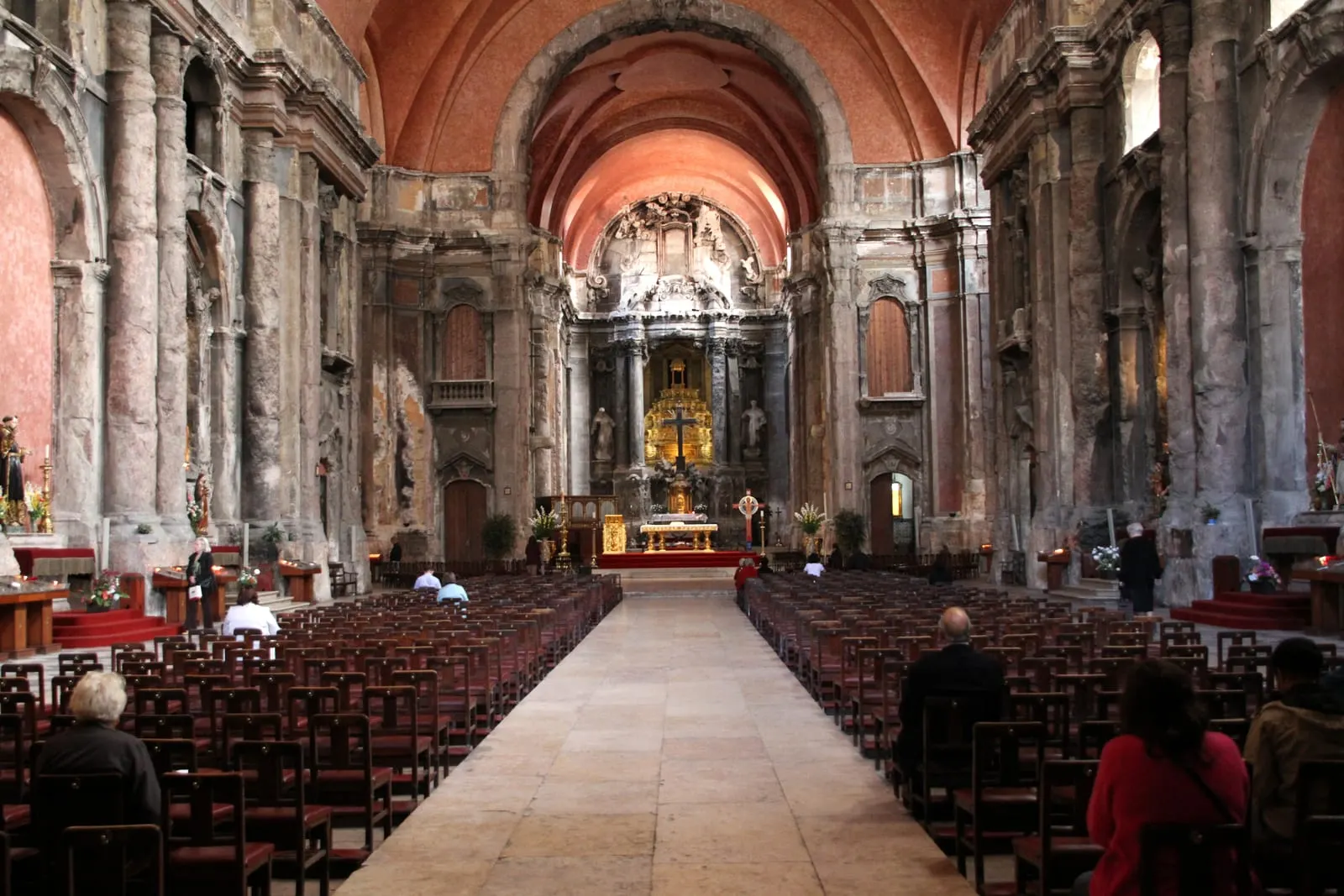
The palace is the seat of the SHIP, which uses it for conferences, exhibitions and other events. When consulted on 5 November 2026, the Society’s website indicated hours from Monday to Friday, 9:00 to 13:00 and 14:00 to 18:00, closed at weekends, and guided visits by appointment. The contact is telephone +351 213 241 470, during office hours, or the form on the website. Confirm the hours and conditions at sociedadehistorica.pt and check whether there are events that alter access. The Convent and Church of São Domingos is in the same square.
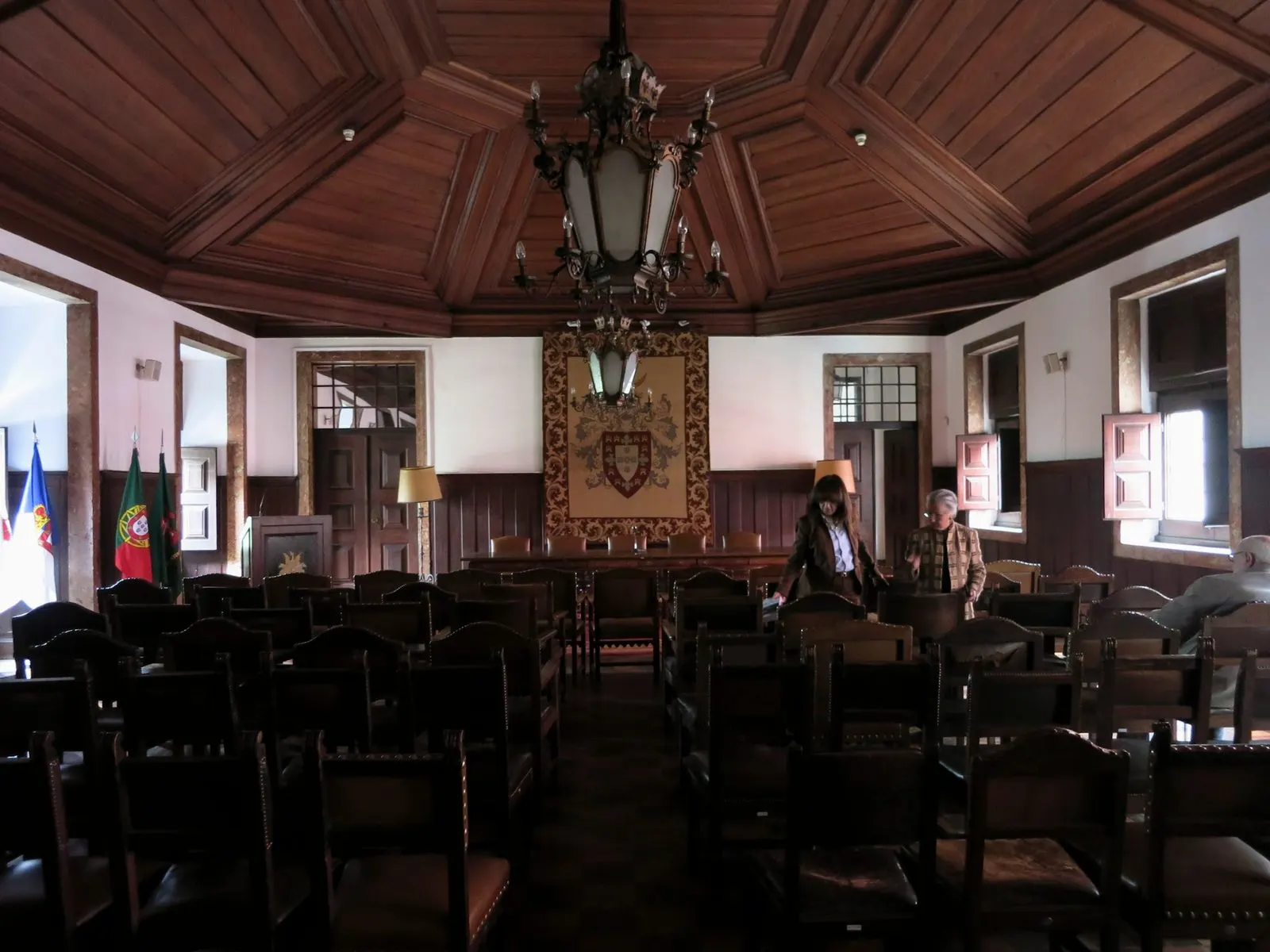
Photograph by Manuelvbotelho, dated 9 April 2014, of the main hall. Original on Wikimedia Commons, under CC BY-SA 3.0; resized and compressed for the web, without altering the composition.
Frequently asked questions
- Is the Palace of the Counts of Almada the same as the Palace of Independence?
- Yes. The national register (code 70366) uses both designations for the same building, on the Largo de São Domingos, next to the Rossio. It is different from the Almada-Carvalhais Palace, on the Largo do Conde Barão, which has its own entry.
- Why is it called the Palace of Independence?
- Because, according to the Sociedade Histórica da Independência de Portugal, some of the conspirators who prepared the 1 December 1640 uprising met in an outbuilding of the garden, among them D. Antão de Almada, owner of the palace.
- Is it listed?
- Yes, as a National Monument, by decree of 16 June 1910, published in the Diário do Governo no. 136, of 23 June 1910.
- Can it be visited?
- When consulted on 5 November 2026, the website of the Sociedade Histórica indicated opening hours from Monday to Friday, 9:00 to 13:00 and 14:00 to 18:00, and guided visits by appointment.
Sources
- Património Cultural, I.P. — Palácio dos Condes de Almada, compreendendo os padrões comemorativos da conjuração de 1640 (70366)
- Património Cultural, I.P. — Palácio que pertenceu aos Almadas, Provedores da Casa da Índia, ou Palácio Almada-Carvalhais (70251)
- Património Cultural, I.P. — Atlas do Património Classificado, registos NINV 3326 e 3330
- Diário do Governo n.º 136, de 23-06-1910 (decreto de 16-06-1910)
- Sociedade Histórica da Independência de Portugal — História do Palácio
- Sociedade Histórica da Independência de Portugal — Espaços Exteriores
- Sociedade Histórica da Independência de Portugal — Contactos
- Wikidata — Palácio dos Condes de Almada (Q7220201)
Keep exploring
Heritage nearby
More places to discover from here. Approximate straight-line distances, within 50 km.