Monuments
Rossio Station
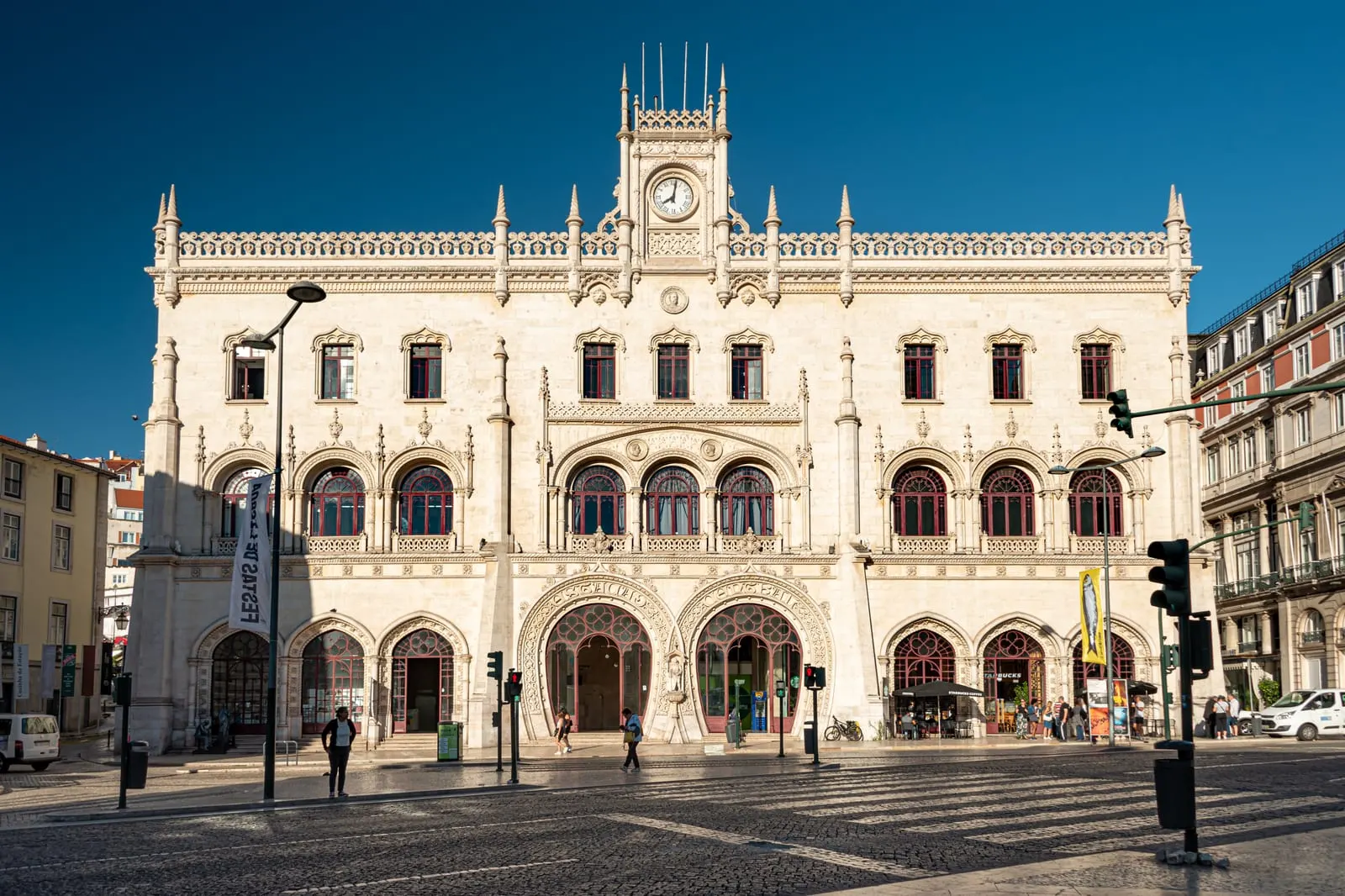
Rossio Station in Lisbon: neo-Manueline façade by José Luís Monteiro, opened with the tunnel in 1890, a Property of Public Interest on the Sintra Line.
- Location
- Lisboa, Lisboa
- Built
- c. 1887–1890
- Style
- Neomanuelino
Rossio Station, between Rossio and Restauradores, is the best-known public work in the neo-Manueline style in Lisbon. Behind a limestone façade that resembles a palace, a railway station operates, with the platform hall on an elevated level and a tunnel that crosses the city towards Campolide. It was conceived as the central station of the capital and is today the departure point of the Sintra Line.
A central station in the heart of the Baixa
A royal decree of 1888 authorised the Companhia Real dos Caminhos de Ferro Portugueses to build the Central Station of Lisbon and the branch line linking it to the network through the Rossio Tunnel. The works were entrusted to the French firm Duparchy & Bartissol. Sources from Infraestruturas de Portugal itself do not agree on the year work began: a 2018 note gives 1886, and a 2025 note gives 1888. The national register dates the design to 1887.
The opening date is more secure. The official inauguration took place on 11 June 1890, when the station and the tunnel entered service. The building was initially called the Avenida Station; in 2016, the Diário de Notícias drew attention to the inscription «Estação Central» on the arches of the façade.
The façade by José Luís Monteiro
The design is largely the work of the architect José Luís Monteiro, professor of Architecture at the Escola de Belas-Artes de Lisboa. Monteiro also designed the neighbouring Hotel Avenida Palace, built at the same time and in a classical idiom. Seeing the two buildings side by side helps to understand that the neo-Manueline was a deliberate choice for the station, not the only language available to the architect.
The main façade is entirely in limestone. The national register highlights the several tiers of openings separated by buttresses, the openwork balustrade, and the clock tower at the centre. On the ground floor, two large arched portals occupy the axis of the composition, flanked by smaller entrances. The pinnacles and the ornamentation inspired by the Manueline style give the ensemble its “national” reading. The context for this choice lies in Romanticism and revivalisms.
Inside, the logic is industrial. The national register describes an L-shaped plan with a long nave on the upper level, where the platforms are. The double-pitched roof rests on steel trusses and cast-iron columns. This separation between the historic façade and the metal structure is discussed in iron architecture. According to the Diário de Notícias, access to the elevated platform was by ramps and hydraulic lifts.
A tunnel and several transformations
The tunnel was decisive in bringing the train into the city centre. According to Infraestruturas de Portugal, the station went through several phases:
- 1934–1948: interior remodelling in a modernist idiom, designed by Cotinelli Telmo.
- 1955: completion of the electrification of the tunnel; long-distance traffic moved to Santa Apolónia.
- 1976–1994: a shopping centre and a cinema operated in the building.
- 1993–1996: modernisation works, including a direct link to the Restauradores metro station.
- 2004–2008: structural rehabilitation of the tunnel and installation of new safety systems.
Alongside the platforms are twentieth-century azulejo panels. On the north side are the panels by Lucien Donnat and Rogério Amaral on Portuguese products, installed in the 1950s. On the south side are the panels by Lima de Freitas on the myths and legends of Lisbon, from the mid-1990s. On the intermediate floor, the King’s Room (Sala do Rei) was used to receive distinguished passengers. In 2016, the Diário de Notícias described it as a space usually closed to the public.
Listing and protection
The building is classified as a Property of Public Interest under Decree No. 516/71 of 22 November, which includes it in the list for the municipality of Lisbon as the «Edifício da Estação dos Caminhos de Ferro do Rossio». The national register also places it within the special protection zone of the listed buildings of Avenida da Liberdade and its surrounding area (Portaria No. 529/96). In 2018, Infraestruturas de Portugal announced the rehabilitation of the stone façades, damaged by pollution, and the preservation of the clock tower.
Visiting and using the station
Rossio Station is a station in full operation. In 2025, Infraestruturas de Portugal reported about 15 million passengers per year. CP trains run along the Sintra Line, with connections to the Cintura Line at Campolide and to the Oeste Line via Cacém and Meleças. It is a direct way to travel from central Lisbon to Sintra.
When consulted on 5 November 2026, CP’s ticket office hours, in force since 8 October 2026, indicated 07:30–20:00 for Rossio on weekdays, weekends and public holidays. The customer support office operated from 08:00 to 17:00 on weekdays. Please confirm timetables and services on the CP website before travelling. To compare with other historic stations, such as São Bento Station in Porto, see railway stations.
Photograph by Jorge Franganillo, dated 23 June 2024. Original on Wikimedia Commons, under CC BY 2.0; resized and compressed for the web, without altering the composition.
Frequently asked questions
- Who designed Rossio Station?
- The architect José Luís Monteiro, commissioned by the Companhia Real dos Caminhos de Ferro Portugueses. The national register dates the design to 1887. The same architect designed the neighbouring Hotel Avenida Palace, in a classical idiom.
- When was it built and opened?
- A royal decree (alvará) of 1888 authorised the construction of the station and the tunnel. Infraestruturas de Portugal gives 1886 in one note and 1888 in another for the start of works. The official opening was on 11 June 1890, when the station and the tunnel entered service.
- Is Rossio Station listed?
- Yes. The building is a Property of Public Interest under Decree No. 516/71 of 22 November 1971. It also falls within the special protection zone of Avenida da Liberdade and its surrounding area (Portaria No. 529/96).
- Which trains depart from Rossio?
- The station is the departure point of the Sintra Line. CP trains link central Lisbon with Sintra, with connections to the Cintura Line at Campolide and to the Oeste Line via Cacém and Meleças.
Sources
- Património Cultural, I.P. — Edifício da Estação dos Caminhos de Ferro do Rossio (71830)
- Património Cultural, I.P. — Atlas do Património Classificado e em Vias de Classificação (NINV 3240)
- Diário do Governo — Decreto n.º 516/71, de 22 de novembro
- Infraestruturas de Portugal — Estação ferroviária do Rossio celebra 135 anos ao serviço da mobilidade em Lisboa (11-06-2025)
- Infraestruturas de Portugal — Estação do Rossio: reabilitação das fachadas (13-12-2018)
- Diário de Notícias — Há muito para ver na Estação do Rossio para além do D. Sebastião (15-05-2016)
- CP — Horário de bilheteiras, Linhas de Sintra e Azambuja (em vigor a 8 de outubro de 2026)
- Wikidata — Estação Ferroviária do Rossio (Q431458)
Keep exploring
Heritage nearby
More places to discover from here. Approximate straight-line distances, within 50 km.