Monuments
D. Maria II National Theatre
Discover Lisbon’s D. Maria II Theatre: Lodi’s architecture, fire and reconstruction, its 2026 reopening, guided visits and links to theatrical archives.
- Location
- Lisboa, Lisboa
- Built
- 1842–1846
- Style
- Neoclassical
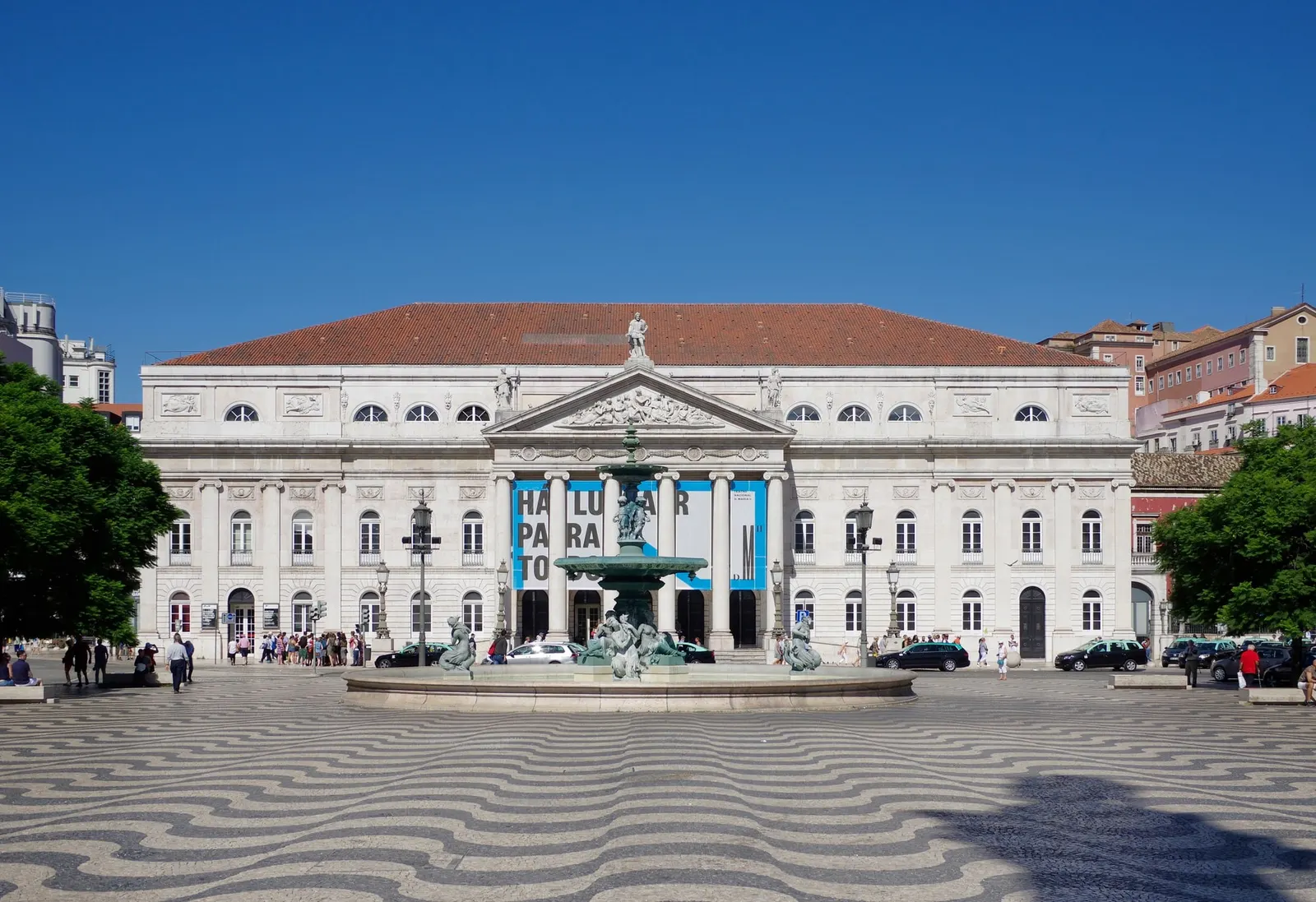
D. Maria II National Theatre, on the north side of Rossio, connects Lisbon’s monumental landscape with Portuguese-language theatre. Fortunato Lodi’s façade identifies the building; the institution, reconstructed interiors and archive have different timelines.
A project of 1836, a building of 1846
In 1836, Passos Manuel commissioned Almeida Garrett to develop a national-theatre project. Its permanent home replaced the Palácio dos Estaus, a former Inquisition headquarters destroyed by fire that year. Construction took place in 1842–1846, with the official opening on 13 April 1846. Institutional foundation and completion of the building are separate events.
Reading the façade and interiors
Look for symmetry, six Ionic columns, the sculpted pediment and the statue of Gil Vicente. Neoclassicism gives the theatre a public presence facing the square. The Italian-style auditorium linked stage, tiers of boxes and spaces for social encounters.
The 1964 fire destroyed much of the interior. Reconstruction preserved the exterior image while reorganising spaces; the theatre reopened on 11 May 1978. Sala Garrett, Salão Nobre and Sala Estúdio reflect successive interventions rather than an untouched interior from 1846.
Classification and documentary memory
The official heritage record lists public-interest classification in 1928 as Teatro Nacional de Almeida Garrett, and reclassification as a National Monument in 2012. Read the record and legal instruments to understand the protected subject.
The Library and Archive preserves scripts, programmes, photographs and other performing-arts records. Digital collections offer a starting point without implying that every holding is digitised. Confirm arrangements with the service for an in-person research visit.
Visiting after the reopening
Information checked on 2 October 2026: the operator reports a September 2026 reopening following refurbishment. Its guided-visit page advertises sessions from 19 October to 28 December 2026. Check dates, languages and reservations; a backstage visit differs from a performance ticket.
Compare this drama theatre with the opera house of São Carlos and São João in Porto through the theatres and opera houses guide.
Frequently asked questions
- When did D. Maria II National Theatre open?
- The institutional project began in 1836. The Rossio building was constructed in 1842–1846 and officially opened on 13 April 1846. It reopened in 1978 after the 1964 fire.
- Has it reopened after the recent works?
- The operator reports that the building reopened in September 2026. On 2 October 2026, its programme advertises guided visits from 19 October. Check current sessions and reservations before travelling.
- Is it a National Monument?
- Yes. The official record lists reclassification as a National Monument by Decree 16/2012 of 10 July, following public-interest classification in 1928 under the name Teatro Nacional de Almeida Garrett.
Sources
Keep exploring
Heritage nearby
More places to discover from here. Approximate straight-line distances, within 50 km.