Monuments
Church of São Vicente de Sousa
Romanesque National Monument consecrated in 1214: Igreja de São Vicente de Sousa, Felgueiras, with a four-archivolt portal and a ceiling painted in 1693.
- Location
- Sousa, Torrados e Sousa, Felgueiras, Porto
- Built
- Consagrada em 1214; transformada nos séculos XVII e XVIII
The Church of São Vicente de Sousa stands in the locality of Sousa, in the civil parish of Torrados e Sousa, in the municipality of Felgueiras. It is one of the Romanesque churches of the Sousa river valley and is part of the Rota do Românico. It bears a clearly marked date on its façade, 1214, and a portal that dominates the whole. The body of the church is simple; what distinguishes it is the portal sculpture, the medieval inscriptions and the painted ceiling of the chancel, made in the seventeenth century.
Origins and dates
The register of the Património Cultural, I.P. states that the building was consecrated in 1214. The Rota do Românico specifies that the façade bears two inscriptions: one of 1162, marking the construction of an arcosolium (a niche with a tomb recessed into the wall), and another of 1214, commemorating the dedication of the church by the Archbishop of Braga, D. Estêvão Soares da Silva. The Rota’s chronology adds that the original transept was already built by 1162. This means that the church seen today results from more than one medieval campaign, and that the date 1214 does not mark a construction carried out all at once.
In the seventeenth and eighteenth centuries the building was renovated, including the reconstruction of the apse, according to the Rota.
What to see outside
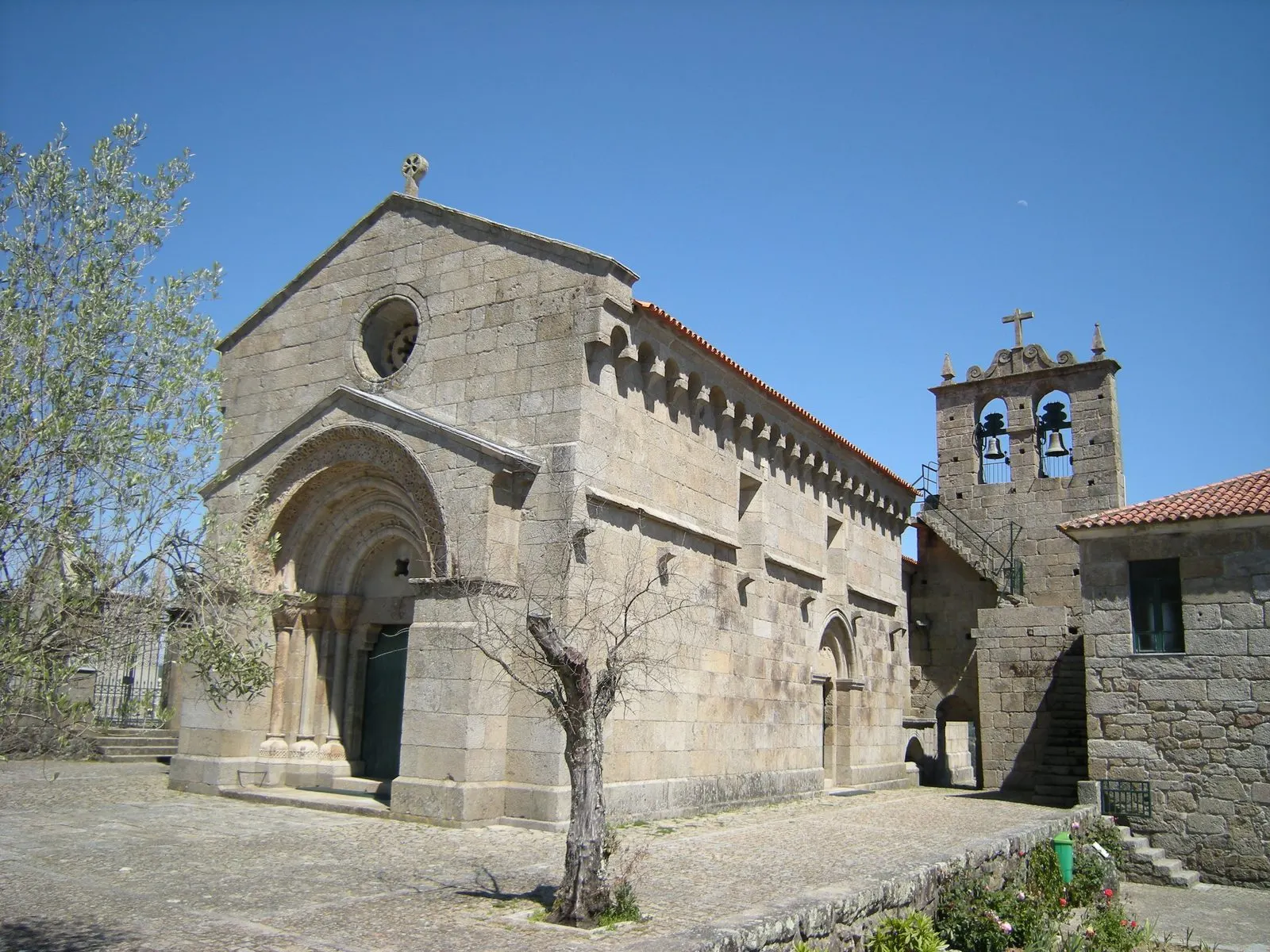
The church rises on a hillside, in a small forecourt bounded by a granite wall. The register describes a simple plan, with a single nave and chancel, and a bell tower set against the side façade, in the area of the chancel.
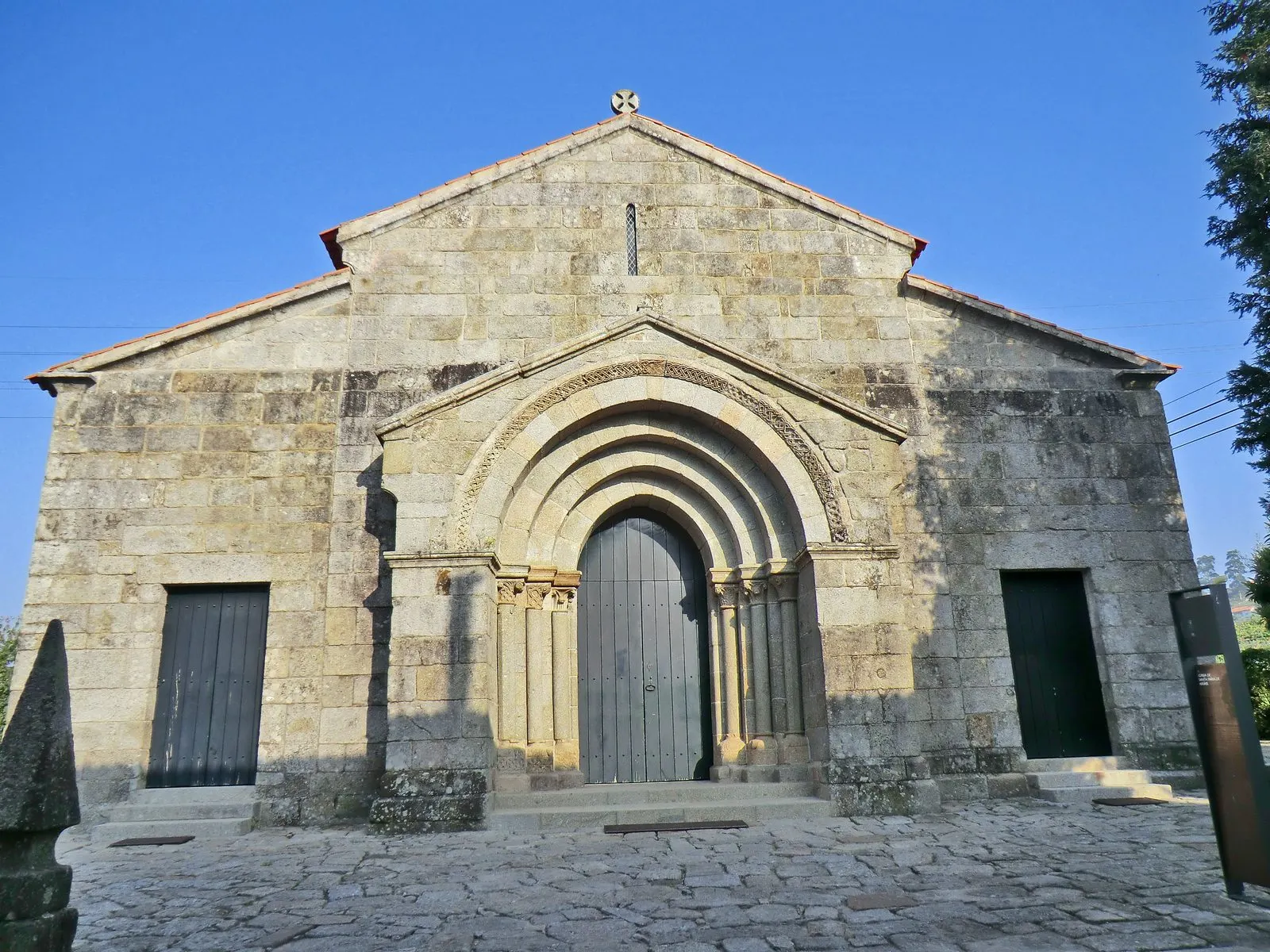
The main façade ends in a gable and has a portal of four archivolts in a round arch, resting on columns with bases and capitals richly decorated with geometric and vegetal motifs. The tympanum displays a carved Maltese cross and, above it, opens a rose window of multilobed circles. The Rota stresses that the portal projects from the façade as a structure with a pentagonal plan, giving it greater volume and symbolic force. On the side façades, the roof rests on a corbel table of plain modillions, as in other Romanesque churches of the Tâmega and Sousa region. On the south façade, a cornice on corbels occupies half the wall surface, which suggests, according to the Rota, that a porch or cloister may once have stood there. On the north façade there is an arcosolium with a tomb chest.
Interior
The single nave is separated from the chancel by a large triumphal arch. The register highlights the gilded wood retable of the triumphal arch, the coffered painted ceiling of the chancel and the polychrome wooden roof over the rest of the body. There are two further retables, resulting largely from seventeenth-century interventions and eighteenth-century Baroque works. For the context of these retables, see the page on gilded woodcarving.
The paintings on the chancel ceiling depict episodes from the life and martyrdom of Saint Vincent and were completed in 1693 by Manuel Freitas Padrão, one of the founders of the Guild of Saint Luke of Guimarães, according to the Rota do Românico. The Rota also mentions modern sculptures and paintings of Saint Vincent, Saint Joseph and the Mysteries of the Rosary.
Classification and restorations
The church is a National Monument under Decree No. 129/77, published in the Diário da República, Series I, No. 226, of 29 September 1977. The special protection zone, without restrictions, was set by Ordinance No. 452/2014 (Diário da República, Series 2, No. 113, of 16 June 2014). The church is not part of any UNESCO inscription.
The Rota’s chronology records conservation works in 1980 (under the technical guidance of the DGEMN), in 1989 and 1992, the church’s inclusion in the Rota do Românico do Vale do Sousa in 1998, interventions in 2004, 2005 and 2012–2013, the requalification of the forecourt in 2015 and, when consulted on 5 November 2026, conservation works on roofs, walls, ceilings, openings, bell tower and cross scheduled for 2026. It is therefore advisable to check the state of the works before visiting.
Planning a visit
The church is on Rua da Igreja, in Sousa. When consulted on 5 November 2026, the Rota do Românico indicated visits by appointment, Mass on Sundays at 9:30 a.m. and on Thursdays at 8:30 p.m., and full or partial accessibility for people with reduced mobility. Bookings are made through the Rota do Românico (rotadoromanico.com), which publishes contact details and any changes. The patron saint, São Vicente, is celebrated on 22 January.
To place the church within the region’s Romanesque heritage, see also the Mosteiro de Pombeiro, in the same municipality, the Mosteiro de Paço de Sousa, and the page on Romanesque architecture in Portugal. The region is covered on the Norte page.
Photograph by José Antonio Gil Martínez, 1 May 2009. Original on Wikimedia Commons, under CC BY 2.0; resized and compressed for the web, without altering the composition.
Frequently asked questions
- When was the Church of São Vicente de Sousa built?
- The firmest date is 1214, the year in which, according to the Rota do Românico, an inscription on the façade commemorates the dedication of the church by the Archbishop of Braga, D. Estêvão Soares da Silva. Another inscription, dated 1162, marks the construction of an arcosolium, which shows that earlier work already existed. The Cultural Heritage register gives the consecration as 1214.
- Is the church part of the Rota do Românico?
- Yes. When consulted on 5 November 2026, the Rota do Românico website included it among its monuments in the Sousa Valley and indicated that the church joined the route in 1998.
- Can the interior be visited?
- According to the Rota do Românico, visits are by appointment. The Masses listed were on Sundays at 9:30 a.m. and on Thursdays at 8:30 p.m. Always confirm with the Rota before going.
- What is its classification?
- National Monument, under Decree No. 129/77, published in the Diário da República, Series I, No. 226, of 29 September 1977. The special protection zone was set by Ordinance No. 452/2014.
Sources
- Património Cultural, I.P. — Igreja de São Vicente de Sousa (71124)
- Património Cultural, I.P. — Atlas do Património Classificado e em Vias de Classificação (NINV 3625)
- Diário da República — Decreto n.º 129/77, de 29 de setembro de 1977 (I série, n.º 226)
- Rota do Românico — Igreja de São Vicente de Sousa
- Wikidata — Igreja de São Vicente de Sousa (Q5994314)
Keep exploring
Heritage nearby
More places to discover from here. Approximate straight-line distances, within 50 km.