Monuments
Romanesque Church of Adeganha (Santiago Maior)
Romanesque church in Adeganha, Torre de Moncorvo: Santiago Maior, pointed-arch portal, sculpted corbels, 16th-century murals and protected heritage status.
- Location
- Adeganha, Torre de Moncorvo, Bragança
- Built
- Românico tardio, séc. XII ou XIII (datação discutida); pinturas murais dos séculos XV–XVI
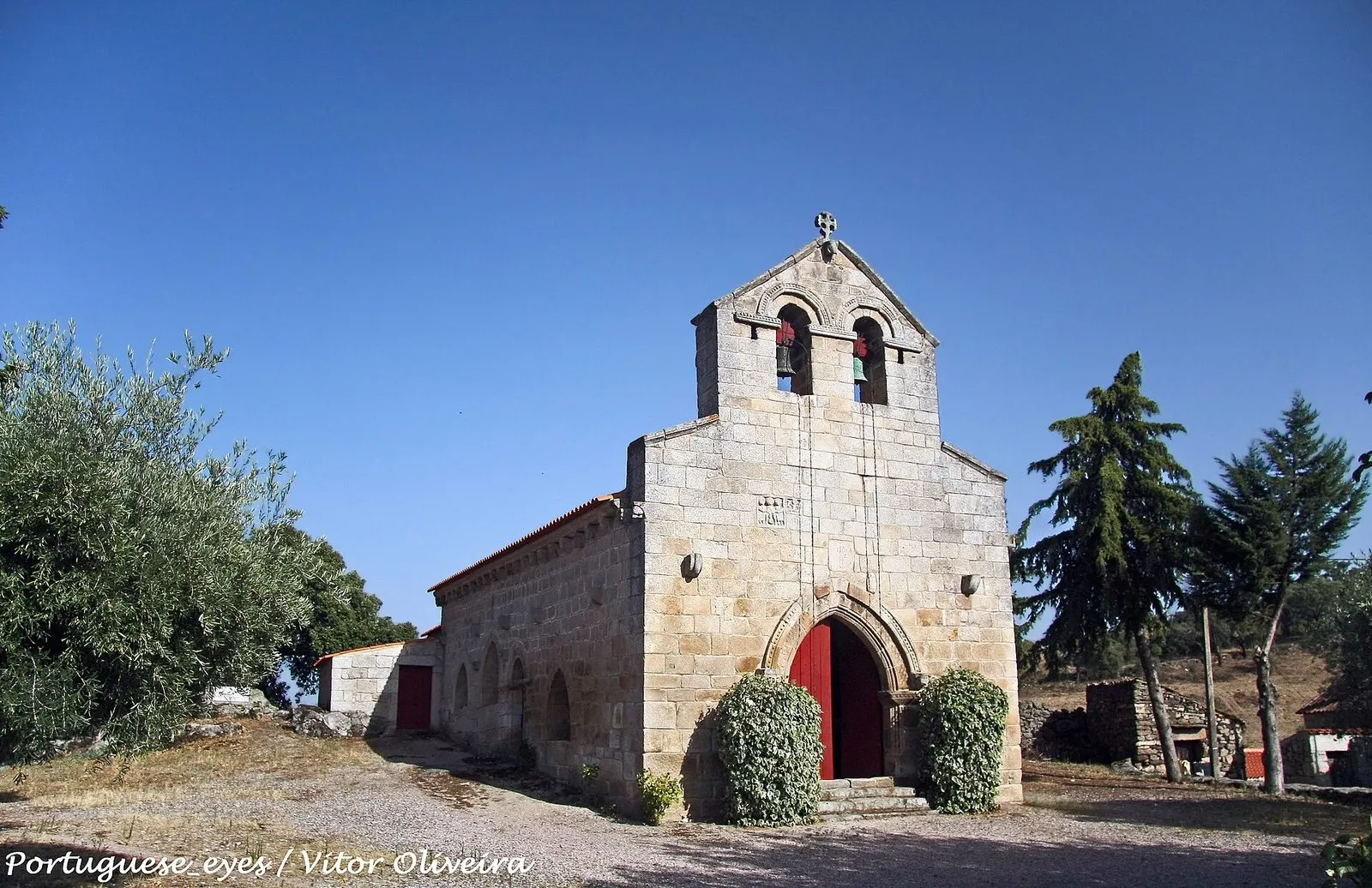
The Romanesque Church of Adeganha, the village’s parish church, is dedicated to Santiago Maior (Saint James the Greater) and lies in the civil parish of Adeganha e Cardanha, in the municipality of Torre de Moncorvo, district of Bragança. It is a small granite building with an elongated rectangular plan and a single nave, its gable crowned by a two-opening bell-cote. Those who arrive by the road see a modest church; those who enter find walls covered in fifteenth- and sixteenth-century paintings and a portal whose carved details make it a temple worth knowing in the North of the country.
Origin and dating
The date of construction is uncertain. A popular account cites the Abade de Baçal for the 12th century, while other sources prefer the 13th century, and the e-cultura record classifies it as 12th-century Romanesque. A summary of the historical and artistic note in the national register, which we accessed only indirectly, links the church to the charter (carta de foral) of 1259, granted by King Afonso III, and allows that it may date from then, possibly raised over an earlier oratory, with the typology of late Romanesque. This uncertainty is common in rural Romanesque architecture of the North, where churches rarely have documented dates.
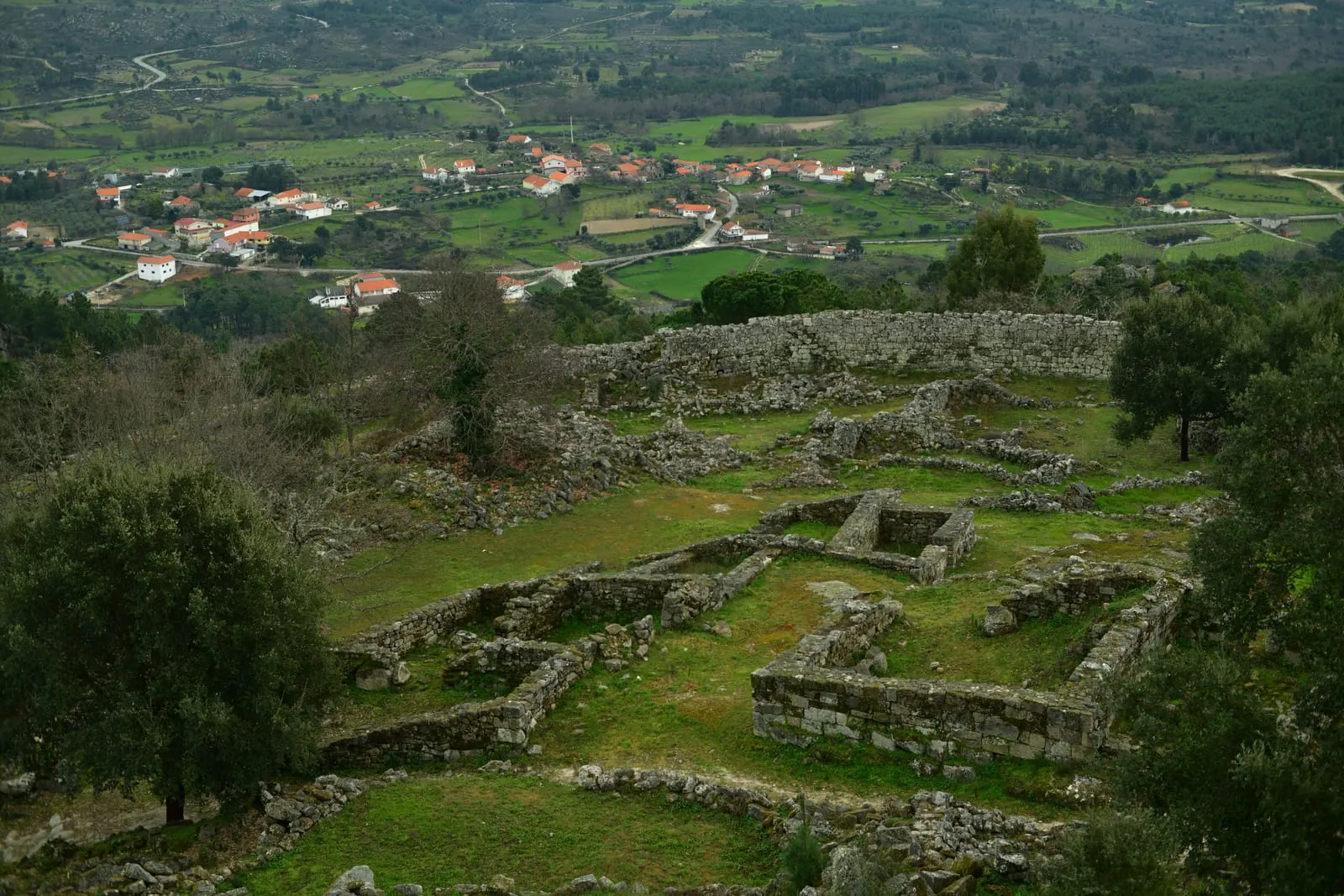
The site is tied to the history of the Vilariça valley. In the same parish stands the Vila Velha de Santa Cruz da Vilariça, a medieval town abandoned around 1300, which gives Adeganha a rare historical context: on one side, the ruins of a thirteenth-century municipality; on the other, the church that remained in use.
Exterior architecture
The main façade, facing west, has a pointed-arch portal, already showing the transition towards Gothic. The descriptions diverge in detail: the register summary speaks of three archivolts decorated with chevron and bead motifs, while a popular account mentions two, with foliate decoration over pedestals of human heads. Examination on site should settle the matter.
What all sources highlight is the decorative sculpture. There is a corbel table of historiated modillions, with zoomorphic and other motifs, and figures carved into the walls. The most discussed is the Pedra das Três Marias (Stone of the Three Marys), a bas-relief of three female figures, whose interpretation varies between the Nativity and symbols of fertility. There are also arcosolium tombs on the exterior. A local legend, recorded by Portugal Notável, derives the village’s name from a phrase (Arde e ganha!, “Burn and win!”) attributed to shepherdesses who supposedly burned a sister suspected of witchcraft; it is popular etymology with no historical basis.
Interior
The interior is a single nave, with a triumphal arch opening onto the chancel. The national register summary indicates that the nave retains elements of four campaigns of mural painting, datable between the late 15th century and the late 1530s. The frescoes were covered in lime and were uncovered in the twentieth century; interventions by the DGEMN, one of them in 1955, and works from 2001 to 2003 exposed the ensemble. A popular account points to a large Saint Christopher and scenes from the life of Christ and the Virgin. In the chancel stands a Baroque altarpiece of gilded woodwork with sixteenth-century panels of Saint Martin and Saint Lawrence, attributed by the same account to the Masters of Sardoal; the attribution has not been confirmed in an institutional source.
Classification and protection
The church is a National Monument under Decree No. 33 587 of 27 March 1944 (Diário do Governo, 1st series, No. 63), which, in the district of Bragança, classified the «Igreja românica de Adeganha», in the municipality of Moncorvo. The same decree classified other properties in other districts, among them the Chapel of São Frutuoso, in Braga. The Atlas of Classified Heritage records the alternative designation «Igreja de Santiago Maior». It is not a World Heritage Site.
Planning a visit
The church lies in the village of Adeganha, about 19 km from Torre de Moncorvo, according to a tourist catalogue. When we consulted sources on 5 November 2026, we did not find opening hours or access conditions published in any source we could read. The Municipality of Torre de Moncorvo maintains a page about the monument (the link returned a certificate error during our check), and the church belongs to the Diocese of Bragança-Miranda. Confirm before going, with the municipality or the parish. A popular account notes that the building stood on one of the routes of Santiago; for the wider context, see the Portuguese Camino de Santiago routes.
Photograph by Vitor Oliveira (Portuguese_eyes), dated 6 December 2013; the image carries the author’s signature. Original on Wikimedia Commons, under CC BY-SA 2.0; resized and compressed for the web, without altering the composition.
Frequently asked questions
- What is the date of the Church of Adeganha?
- The dating is debated: one source cites the Abade de Baçal for the 12th century, while others point to the 13th century. The summary of the national register we consulted links the construction to the 1259 charter (foral) granted by King Afonso III, and describes the building as late Romanesque.
- What is its classification?
- National Monument, by Decree No. 33 587 of 27 March 1944 (Diário do Governo, 1st series, No. 63), under the designation «Igreja românica de Adeganha».
- What is special about the interior?
- Mural paintings from at least four campaigns, dating between the late 15th century and the late 1530s, uncovered during works from 2001 to 2003, and a Baroque high altarpiece with sixteenth-century panels.
- Can I visit the church?
- When we consulted sources on 5 November 2026, we did not find opening hours or access conditions in any source we could read. The Municipality of Torre de Moncorvo has a page about the monument; please confirm there or with the parish.
Sources
- Património Cultural, I.P. — Igreja românica de Adeganha (70571)
- Património Cultural, I.P. — Atlas do Património Classificado (NINV 2437)
- Diário do Governo — Decreto n.º 33 587, de 27 de março de 1944 (1.ª série, n.º 63)
- Município de Torre de Moncorvo — Igreja de Santiago Maior, Adeganha
- e-cultura — Igreja de Santiago Maior, matriz de Adeganha (6785)
- Portugal Notável — Igreja Românica de Santiago Maior na Adeganha
- Wikidata — Igreja Matriz de Adeganha (Q66813510)
Keep exploring
Heritage nearby
More places to discover from here. Approximate straight-line distances, within 50 km.