Monuments
São João National Theatre, Porto
Discover Porto’s São João Theatre: Marques da Silva’s 1920 building, its 1798 predecessor, National Monument status, guided visits and documentation.
- Location
- Porto, Porto
- Built
- 1920 (present building; predecessor of 1798)
- Style
- Eclectic / Beaux-Arts
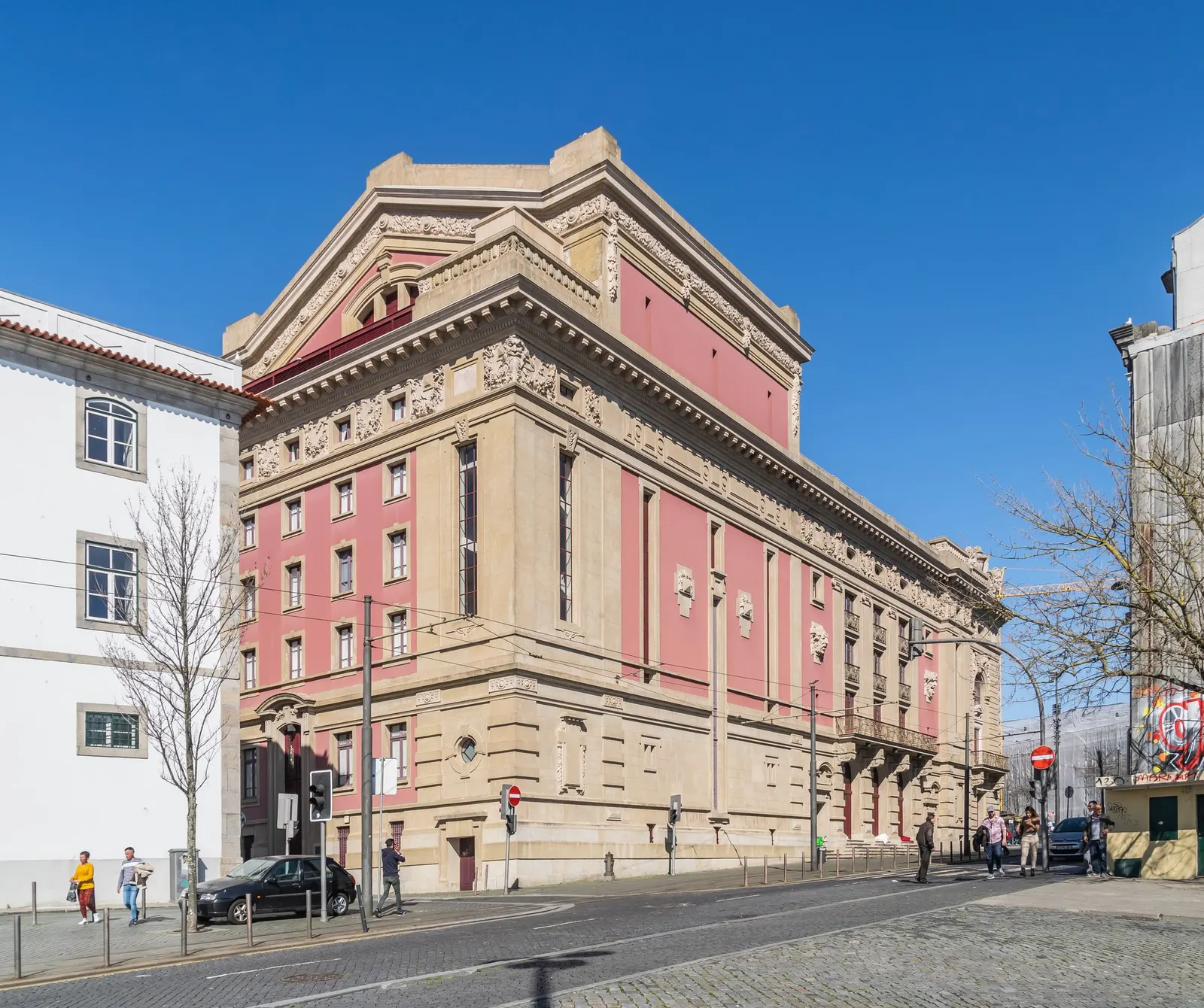
São João National Theatre, south of Praça da Batalha, offers a way to read Porto through performance architecture. Three moments matter: the royal theatre of 1798, Marques da Silva’s building opened in 1920, and the national institution established in 1992.
From the royal theatre to Marques da Silva
The Royal São João Theatre, designed by Vicente Mazzoneschi, opened on 13 May 1798. Fire destroyed it on the night of 11–12 April 1908. Today’s building occupies the same site, but is not simply the preserved eighteenth-century theatre.
José Marques da Silva won the reconstruction competition launched in 1909. The new theatre opened on 7 March 1920. His Beaux-Arts training and the use of concrete combined monumental spatial organisation with twentieth-century construction techniques.
Architecture and changing uses
Read the route through entrance, foyer, stairways and horseshoe auditorium. Decoration extends beyond the façade: painted ceiling, sculpture and reception spaces shape the experience of entering a theatre. Compare this relationship with the audience at São Carlos and D. Maria II.
In 1932, São João Cine shifted towards cinema. After State acquisition, it reopened as São João National Theatre on 28 November 1992, followed by works in 1993–1995. The present national role dates from neither 1798 nor 1920.
A monument within a wider institution
The official record lists reclassification as a National Monument by Decree 16/2012 of 10 July, following classification in 1982. This guide concerns the Batalha building. Teatro Carlos Alberto and São Bento da Vitória Monastery are other institutional venues with their own identities.
The Documentation Centre, founded in 2000, preserves performing-arts memory. It is based in the monastery and provides Cinfo research access; consulting the archive differs from visiting the auditorium.
Visits and performances
Information checked on 2 October 2026: the operator advertises guided visits to São João, subject to compatibility with theatre activity. The same page reports monastery visits temporarily suspended. Check the building, ticket and availability before booking.
Continue with the theatres and opera houses guide and the National Theatre and Dance Museum.
Frequently asked questions
- Is today’s building the theatre of 1798?
- No. The Royal São João Theatre opened in 1798 and was destroyed by fire in 1908. The present building, designed by José Marques da Silva, opened on 7 March 1920.
- When did it become a national theatre?
- After acquisition by the State, it was reopened as São João National Theatre on 28 November 1992. That institutional change is later than the building’s 1920 opening.
- Does the theatre visit include São Bento da Vitória Monastery?
- They are separate buildings and visits. On 2 October 2026, the operator advertises theatre visits and reports that monastery visits are temporarily suspended. Check availability and booking for each venue.
Sources
Keep exploring
Heritage nearby
More places to discover from here. Approximate straight-line distances, within 50 km.