Monuments
São Bento railway station
São Bento station in Porto: by Marques da Silva, opened in 1916, with some 20,000 Jorge Colaço azulejos in the concourse. A Property of Public Interest.
- Location
- Porto, Porto
- Built
- 1900–1916 (edifício atual; estação provisória de 1896)
- Style
- Beaux-Arts / ecletismo
The São Bento railway station occupies the site of a former convent in the centre of Porto, next to Praça de Almeida Garrett. It is a working station and, at the same time, one of the most visited azulejo ensembles in the country. Its history brings together three moments that are worth distinguishing: the arrival of the railway in 1896, the construction of José Marques da Silva’s building between 1900 and 1916, and the large azulejo cladding by Jorge Colaço in the concourse.
From convent to temporary station
The national heritage register indicates that the site was occupied from the 16th century by the convent of the Benedictine nuns of São Bento de Avé-Maria. The monastery was expropriated by the Municipal Council in 1887, when the railway connection from Campanhã to the city centre was being prepared.
Before the present building existed, trains already ran to São Bento. The temporary station, built of timber sheds, opened on 7 November 1896. The inaugural train stopped beside the convent church, which was still standing at the time. Part of the monastery had already been demolished to make way for these facilities; the demolition of the church and the rest of the convent only began in 1900.
Marques da Silva’s building
The design was entrusted to the Porto-born architect José Marques da Silva (1869–1947), who had trained in Paris. Between 1896 and 1900 he revised the proposal several times, partly because of the uncertainty of the brief, which at one point included the postal and telegraph services. The foundation stone was laid by King D. Carlos and Queen D. Amélia on 22 October 1900, at the corner of Rua da Madeira.
The works dragged on for years. The official opening took place on 5 October 1916, during the celebrations of the sixth anniversary of the Republic. The national register describes a train hall with eight terminal tracks and five platforms, and an exterior in late neoclassical style, marked by the architect’s Beaux-Arts training. The metal train shed and the tunnel portal are part of the classification and connect the building to the history of iron architecture.
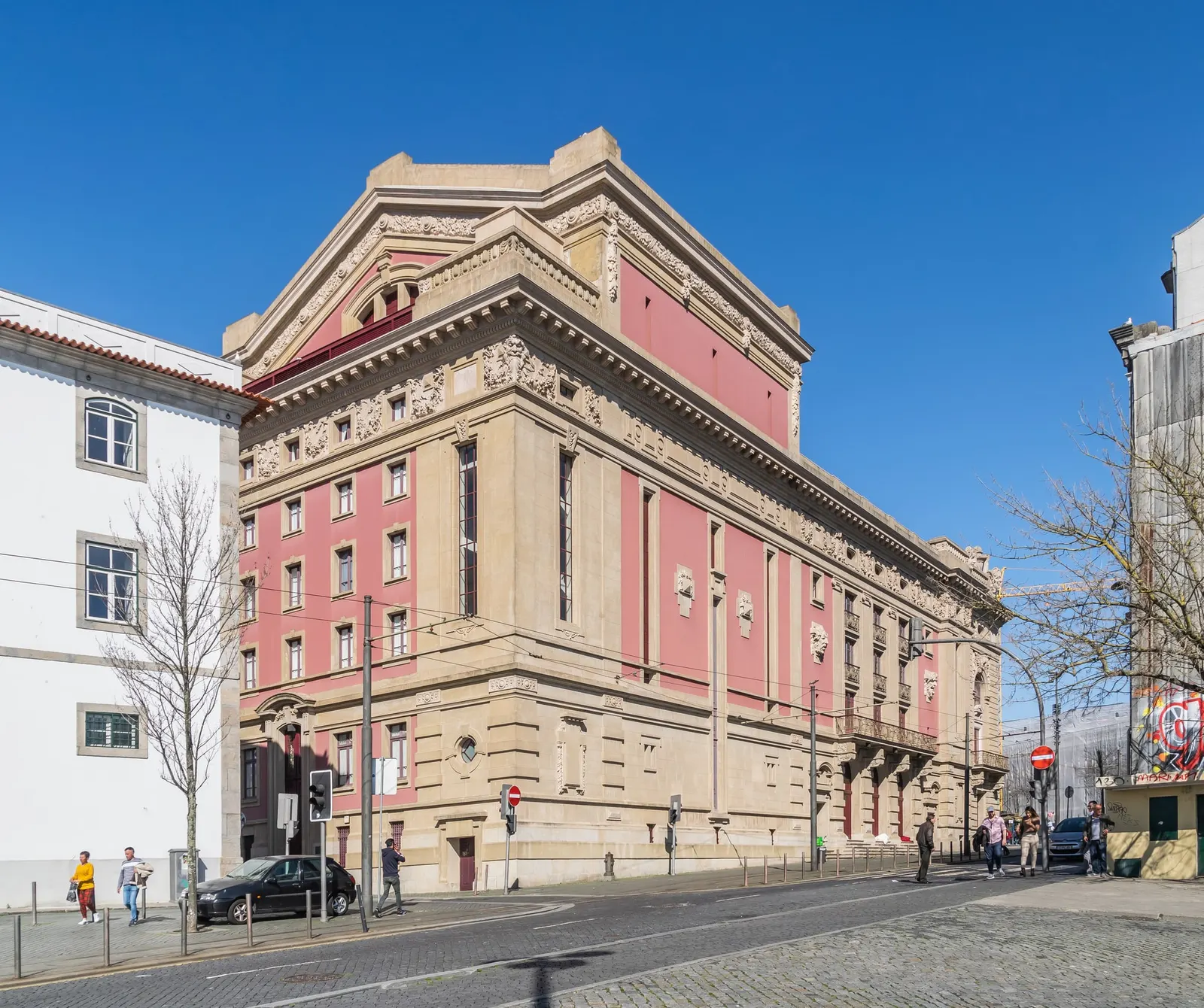
Marques da Silva is also the author of the Teatro Nacional São João, opened in 1920, a few minutes’ walk away. The two buildings show the same academic training applied to different programmes.
Jorge Colaço’s azulejos
The concourse is the best-known part of the station. The painter Jorge Colaço presented the plan on 31 July 1905. The board of directors approved it in principle on 23 August, and an ordinance of 4 November 1905 sanctioned the expenditure. The commission was contracted on 10 January 1906, for a surface of 551 m². The panels were painted before the concourse was ready and were only installed in 1915. For this reason, the 1905–1916 date range that often appears describes the period between the plan and the opening; the painting took place within that interval, before the installation of 1915.
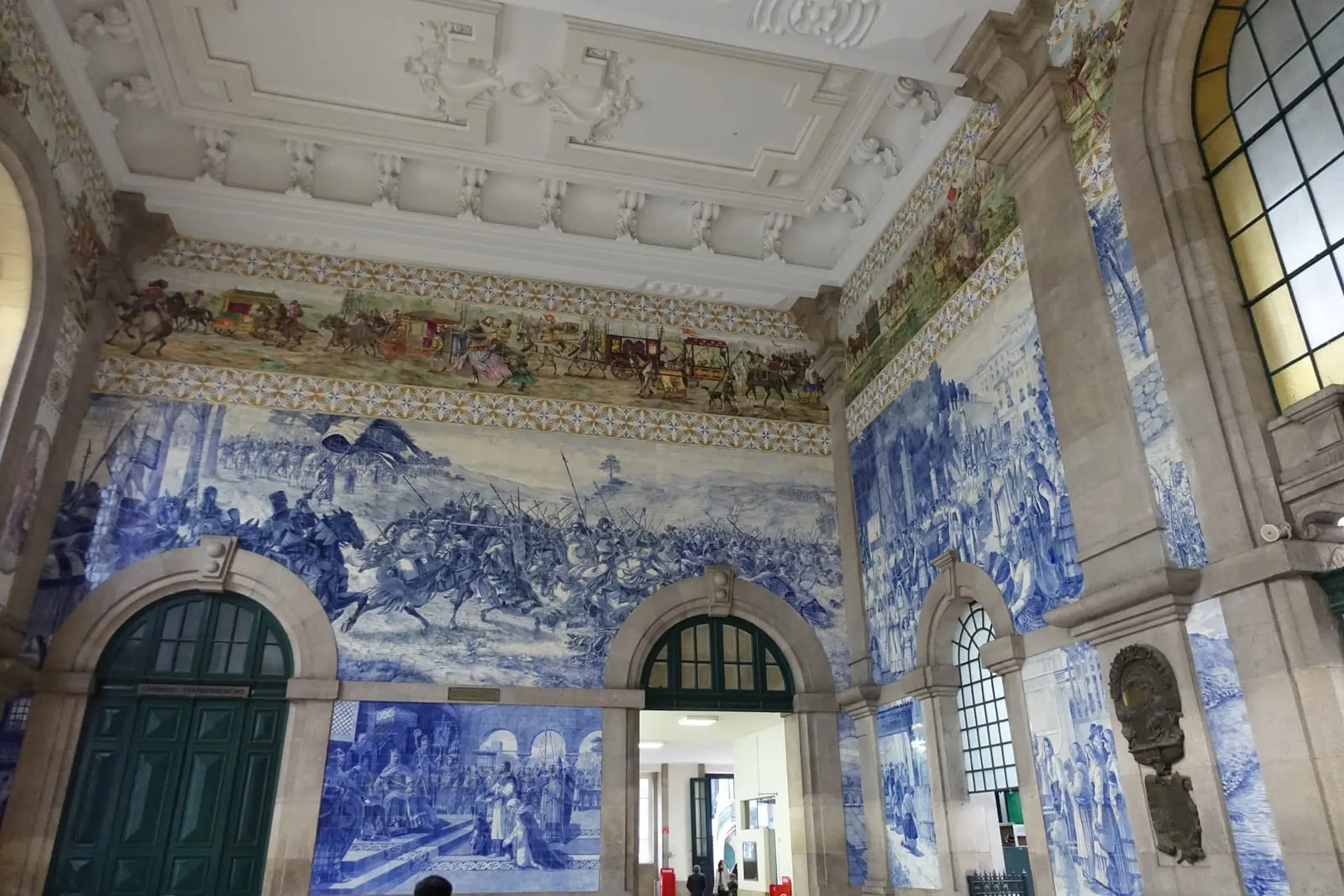
About 20,000 azulejos cover the walls between the granite stonework. The large panels are blue and white, and above them runs a polychrome frieze on the evolution of transport. The initial idea of 1905 envisaged landscapes of the region, popular customs and episodes of regional history.
The study of the panels carried out at the University of Porto identifies:
- historical scenes: the Meeting of Valdevez, the Surrender of Egas Moniz, the marriage of D. João I to D. Filipa of Lancaster, and the Conquest of Ceuta;
- religious and popular scenes: the Pilgrimage of São Torcato and the procession of Our Lady of Remedies;
- allegories of the four seasons;
- the transport frieze: from the procession of coaches and carts to the arrival of the first train in Minho, in 1875.
On the left of someone entering, on the Rua da Madeira side, the Meeting of Valdevez occupies the upper panel, with the Surrender of Egas Moniz below it. Not all the azulejos visible today are original: the same research notes tiles replaced during repairs. To place the work within early twentieth-century azulejo production, read the article on Art Nouveau and Modernist azulejo. Here, unlike the façade azulejo of Porto’s buildings, the cladding is inside.
Protection and World Heritage
The station is classified as a Property of Public Interest under Decree No. 67/97 of 31 December. The decree expressly includes the metal train shed, the azulejo panels and the tunnel portal. The same decree also classified the historic area of Porto.
The station has no separate inscription on the World Heritage List. The Statement of Outstanding Universal Value of the Historic Centre of Porto, Luiz I Bridge and the Monastery of Serra do Pilar mentions São Bento railway station (1900–1916) among the most recent constructions in that historic centre. The national register also associates the property with that inscription. It is, therefore, a building referred to within the inscribed property, not an independent World Heritage site.
Visiting and using the station
The station continues to serve CP trains and is part of the national rail network. In September 2020, Infraestruturas de Portugal announced conservation works on the concourse ceiling. When consulted on 5 November 2026, the CP ticket office hours, in force since 2 November 2026, showed for Porto São Bento 07:00–20:00 on weekdays, weekends and public holidays. Confirm train times and services on the CP website.
The concourse is a passenger thoroughfare: look at the panels without blocking the access doors to the station, especially at busy times. To continue your visit, the station is close to the Church of Santo Ildefonso and the São João Theatre. Other historic stations are gathered under railway stations.
Photograph by Joseolgon, dated 7 February 2016. Original on Wikimedia Commons, under CC BY-SA 4.0; resized and compressed for the web, without altering the composition.
Frequently asked questions
- Who designed São Bento railway station and when did it open?
- The building is by the Porto-born architect José Marques da Silva. The foundation stone was laid on 22 October 1900, and the official opening took place on 5 October 1916. Trains had been arriving at the site since 7 November 1896, at a temporary station.
- How many azulejos are in the concourse, and who painted them?
- The concourse is clad in about 20,000 azulejos by Jorge Colaço, covering a surface of 551 m². The plan was approved in 1905, and the panels were installed in 1915. Some tiles have since been replaced during repairs.
- Is São Bento railway station listed?
- Yes. It is a Property of Public Interest under Decree No. 67/97 of 31 December 1997. The classification covers the metal train shed, the azulejo panels and the tunnel portal.
- Is the station part of the World Heritage List?
- It has no separate inscription. The Statement of Outstanding Universal Value of the Historic Centre of Porto, Luiz I Bridge and the Monastery of Serra do Pilar mentions the station among the most recent constructions in that historic centre.
Sources
- Património Cultural, I.P. — Estação dos Caminhos de Ferro de São Bento (72342)
- Património Cultural, I.P. — Atlas do Património Classificado e em Vias de Classificação (NINV 4948)
- Diário da República — Decreto n.º 67/97, de 31 de dezembro
- UNESCO — Historic Centre of Oporto, Luiz I Bridge and Monastery of Serra do Pilar (755)
- Universidade do Porto — Ednilson Fernandes, Os painéis de azulejo da Estação de S. Bento: história, contexto e iconografia (2010)
- Infraestruturas de Portugal — Estação de São Bento: preservação do património
- CP — Horário de bilheteiras, Linhas do Minho e Douro (em vigor a 2 de novembro de 2026)
- Wikidata — Estação Ferroviária de Porto — São Bento (Q579250)
Keep exploring
Heritage nearby
More places to discover from here. Approximate straight-line distances, within 50 km.