Archaeology
Lagar Velho Rock Shelter
Lagar Velho Rock Shelter, Lapedo Valley (Leiria): the Lapedo Child's burial, the debate over how to read and classify it, and how to visit CIALV.
- Location
- Vale do Lapedo, Santa Eufémia e Boa Vista, Leiria, Leiria
- Built
- Paleolítico Superior (c. 30 000–20 000 anos atrás)
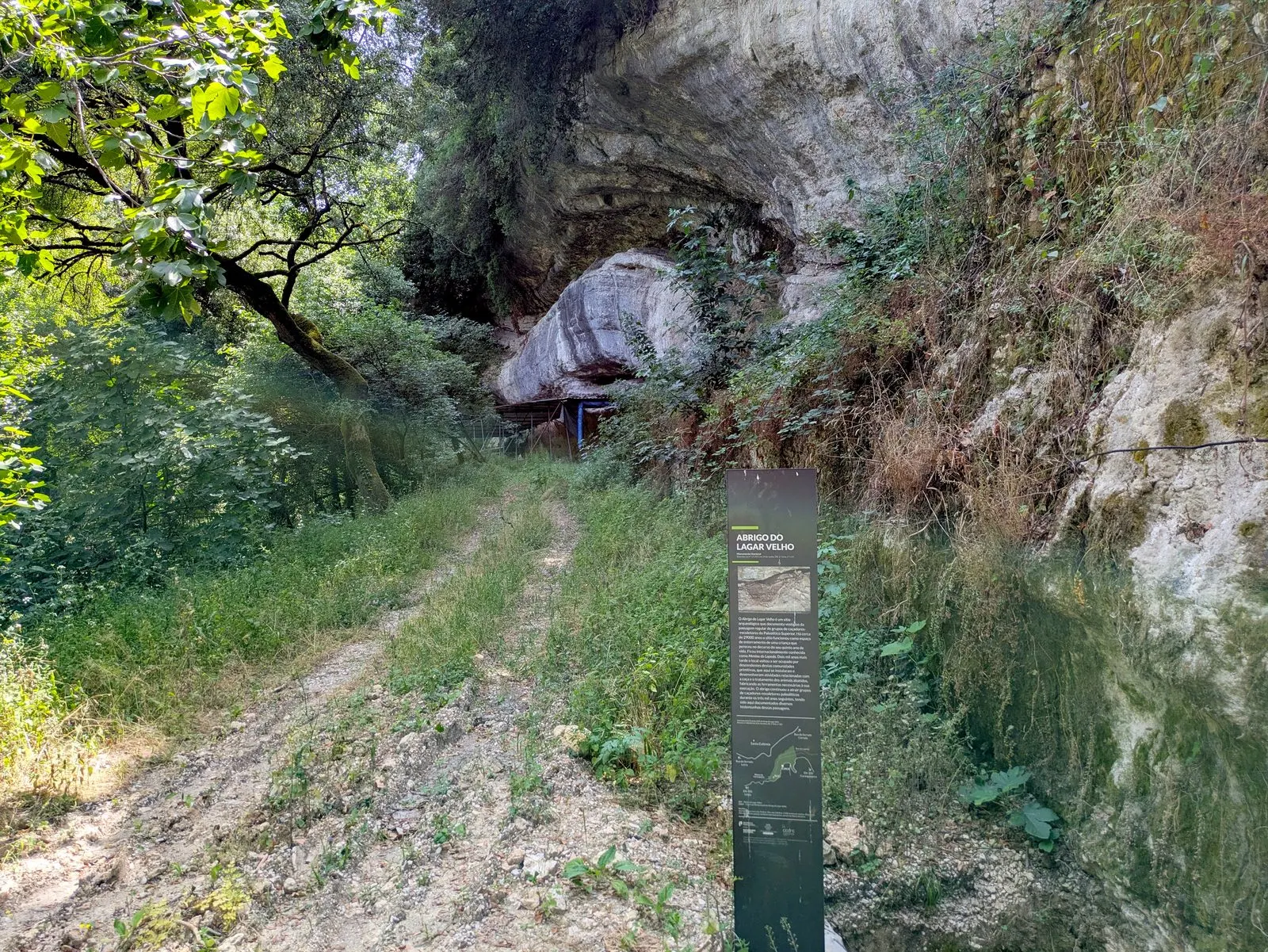
The Abrigo do Lagar Velho is a rock shelter on the left bank of the Caranguejeira stream, in the Lapedo Valley, in Santa Eufémia e Boa Vista, municipality of Leiria. It is known worldwide for the Lapedo Child, a child burial discovered in 1998. This page summarises what is known about the site, presents the scientific debate over the skeleton with the sources that support it, and explains how to visit the valley.
The site
According to the register of the Património Cultural, I.P., the shelter preserves a sequence of Upper Palaeolithic occupations between about 30,000 and 20,000 years ago, with lithic industries, faunal remains and hearths. Between about 27,000 and 24,000 years ago, hunter-gatherer groups used it repeatedly for shelter, hunting and stone working. The register considers the valley, of karstic morphology, a geomonument.
The shelter was identified in November 1998 by members of the Sociedade Torrejana de Espeleologia e Arqueologia. The register names Pedro Souto and João Maurício and gives 28 November as the date; a text by Cidália Duarte published by the National Archaeology Museum also mentions the student Pedro Ferreira and places the discovery in December. The site had already been partly destroyed by mechanical means in 1994. The first excavation took place between late December 1998 and January 1999, directed by João Zilhão and Cidália Duarte.
The burial
The child was laid in a recess in the back wall. According to the Municipality of Leiria, the burial included a pit where a sprig of Scots pine was burned, a shroud dyed with red ochre, and deer bones near the feet. The National Archaeology Museum describes a headdress decorated with four deer canines and a necklace with two shells of Littorina obtusata. The 1999 scientific article estimated the age at death at about four years; later texts speak of the fifth year of life. The official register considers it the only known Upper Palaeolithic human burial in the whole Iberian Peninsula.
Two dates are in circulation. The 1999 article gives about 24,500 years BP by radiocarbon, with the burial between 24,000 and 25,000 years BP. The Património Cultural, the Municipality of Leiria and the National Archaeology Museum today indicate about 29,000 years. In the sources we have read, we did not find an explanation of the difference; to cite a date, consult the bibliography of the register.
What the skeleton means: a debate
In 1999, a team of seven authors, with Cidália Duarte as first author and João Zilhão and Erik Trinkaus among the others, described the skeleton in the Proceedings of the National Academy of Sciences. They concluded that it shows a mosaic: the chin and tooth proportions align it with modern humans; the proportions of the lower limbs, the robustness of the bones and the receding symphysis of the mandible bring it closer to Neanderthals. For the authors, this indicated interbreeding between local Neanderthals and modern humans advancing through the south of the Peninsula. As the burial is several millennia after the probable transition (28,000 to 30,000 years BP, in the article), they argued that the child came from extensively mixed populations, rather than from a rare crossing.
In the same issue, Ian Tattersall and Jeffrey Schwartz published a critical commentary. They described the interpretation as brave and imaginative («brave and imaginative»), but considered it unlikely that most palaeoanthropologists would see it as proven: the limb indices would be unreliable for distinguishing populations, the teeth have modern morphology, and the context is that of a typical Gravettian burial. It could be, they wrote, a robust Gravettian child.
Since then, genetics has changed the overall picture. In 2010, Richard Green’s team showed that Neanderthals share more genetic variants with present-day Eurasian humans than with those of sub-Saharan Africa, indicating gene flow into the ancestors of non-Africans. The Património Cultural register writes that the hypothesis of admixture «would come to be confirmed» by sequencing the Neanderthal genome, and the National Archaeology Museum says that sequencing «would ultimately confirm» the archaic traits of the skeleton. It is worth separating the questions: the genome demonstrates interbreeding between populations, but that study, as we read it, does not test the morphology of this skeleton. As consulted on 5 November 2026, we found no published ancient DNA from the child in the sources we have read.
Classification and protection
The Abrigo do Lagar Velho is a National Monument under Decree No. 17/2013, Diário da República, 1st series, No. 119, of 24 June 2013; the special protection zone was set by Ordinance No. 630/2013, of 20 September. Decree No. 14/2021, of 7 June, classified the skeleton and associated artefacts as assets of national interest under the designation «national treasure», the first skeleton so classified, according to the Government. In January 2024, the Government announced €900,000 from the PRR, contracted with the Municipality of Leiria, to consolidate the shelter’s rock face. The site is not part of any UNESCO inscription.
Preparing the visit
The reception point is the CIALV, Centro de Interpretação do Abrigo do Lagar Velho, opened on 5 January 2008 at Carrasqueira, on land overlooking the valley. It displays the results of the research and a replica of the child, made by the Polytechnic of Leiria; the original skeleton is on deposit at the National Archaeology Museum. As consulted on 5 November 2026, the municipality published the timetable as Friday to Sunday and public holidays, 9:30–12:30 and 14:00–17:30, with free admission, and asked for prior contact for guided visits: telephone 244 839 677. The page does not say whether the shelter can be visited independently; ask beforehand. Confirm everything on the municipal CIALV page. For Palaeolithic context, see Palaeolithic rock art and Escoural Cave.
Photograph: J iglar, 20 June 2025, Abrigo do Lagar Velho.jpg, licence CC BY-SA 4.0, resized and compressed for the web, composition unchanged.
Frequently asked questions
- What is the Lapedo Child?
- It is the skeleton of a child buried in the Abrigo do Lagar Velho. The Portuguese Cultural Heritage register dates it to about 29,000 years ago and describes it as the only known Upper Palaeolithic human burial in the Iberian Peninsula.
- Was the Lapedo Child a hybrid of Neanderthal and Homo sapiens?
- The team that studied it argued in 1999 that the skeleton shows a mosaic of features and indicates interbreeding between the two populations. Other researchers, in the same issue of the journal, considered the interpretation unproven. The topic has been presented as controversial from the outset.
- Can I see the original skeleton?
- Not in Leiria. According to the Municipality of Leiria, the skeleton is kept in a location that ensures its preservation, and the Interpretation Centre of the Abrigo do Lagar Velho displays a life-size replica. The National Archaeology Museum is the institution responsible for its permanent conservation.
- How do I visit the Lapedo Valley?
- As consulted on 5 November 2026, the Interpretation Centre of the Abrigo do Lagar Velho (CIALV) was open Friday to Sunday and on public holidays, 9:30 to 12:30 and 14:00 to 17:30, with free admission. For guided visits, the municipality asks for prior contact.
Sources
- Património Cultural, I.P. — Abrigo do Lagar Velho (155684)
- Município de Leiria — CIALV, Centro de Interpretação do Abrigo do Lagar Velho
- Município de Leiria — Vale do Lapedo
- Museu Nacional de Arqueologia — Decreto n.º 14/2021, classifica Criança do Lapedo como «Tesouro Nacional»
- Museu Nacional de Arqueologia — Leiria aprova protocolo com DGPC para valorizar sítio da criança do Lapedo
- Governo de Portugal — PRR financia conservação do Abrigo do Lagar Velho nos 25 anos da descoberta da Criança do Lapedo (12 de janeiro de 2024)
- Duarte, C. et al. — The early Upper Paleolithic human skeleton from the Abrigo do Lagar Velho (Portugal) and modern human emergence in Iberia. Proceedings of the National Academy of Sciences 96 (13), 1999
- Tattersall, I. e Schwartz, J. H. — Hominids and hybrids: the place of Neanderthals in human evolution. Proceedings of the National Academy of Sciences 96 (13), 1999
- Green, R. E. et al. — A draft sequence of the Neandertal genome. Science 328, 2010
- Atlas do Património Classificado (NINV 69910)
- Wikidata — Abrigo do Lagar Velho (Q3311870)
Keep exploring
Heritage nearby
More places to discover from here. Approximate straight-line distances, within 50 km.