Archaeology
Megalithic Tombs of the Central Coast and Estremadura
The Dólmen das Pedras Grandes (Odivelas) and the dolmens of the Serra da Brenha (Figueira da Foz): National Monuments of the central coast and links to Sintra.
- Location
- Ramada e Caneças, Odivelas, Lisboa
- Style
- Megalítico (dólmenes de câmara poligonal)
Between the north bank of the Tagus, Estremadura and the Mondego estuary, dolmens are less numerous and more dispersed than in the Alentejo, and many survive only in part. This guide brings together two groups of National Monuments that did not have their own page: the Dólmen do Sítio das Pedras Grandes, in Odivelas, and the dolmens of the Serra da Brenha, in Figueira da Foz, among them the Dólmen dos Covões das Cavadas. In the final text, existing pages on Sintra and Torres Vedras are linked. For general context, see megalithism, Portuguese megalithic art and the Neolithic.
Dólmen do Sítio das Pedras Grandes (Odivelas)
The dolmen (Ramada e Caneças, Odivelas; code 70248; Atlas NINV 3359) is also called Dólmen das Pedras Grandes or Sítio da Anta das Pedras Grandes. According to the record, it was the engineer and researcher Carlos Ribeiro (1813-1882) who first recorded it, at the end of the third quarter of the 19th century. He found it already very ruined, through agricultural work over time and through the reuse of its slabs in domestic and agricultural buildings.
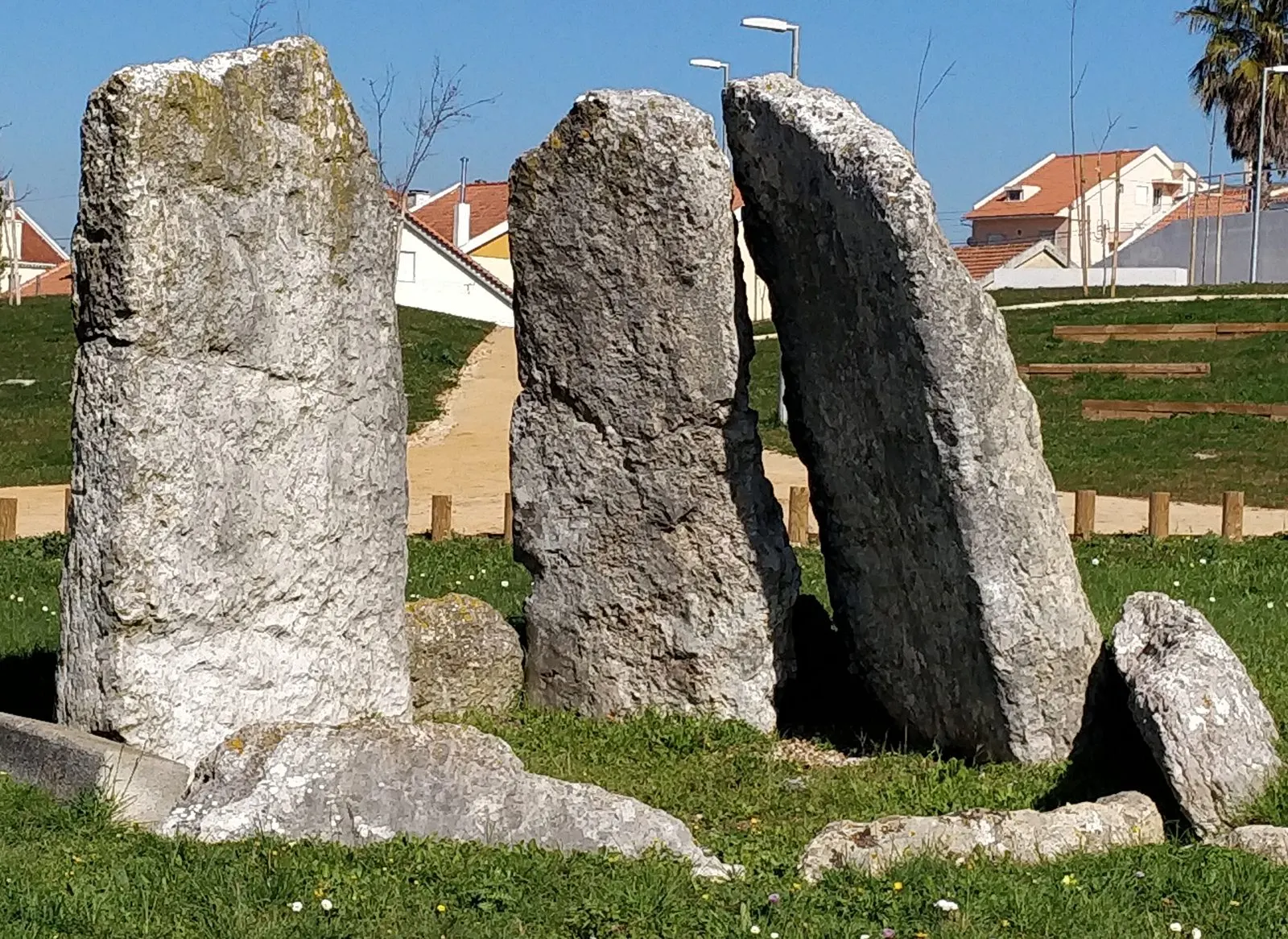
Some elements are still visible. The chamber is a composite polygon; two of the eight original uprights remain, fallen but intact, one upright on each side of the corridor, and traces of the burial mound, of predominantly clayey earth. The photograph in this guide shows the uprights in an urban green space, with houses in the background.
Decree No. 33 587, of 27 March 1944, classified two dolmens, the Pedras Grandes and the Sítio das Batalhas; Decree No. 37 450, of 16 June 1949, classified the Pedras Grandes again, this time individually. The coordinates of the record (38.8067 N, 9.2187 W) are the representative point of this guide.
Dolmens of the Serra da Brenha (Figueira da Foz)
In Figueira da Foz, the Atlas do Património Classificado groups, under inventory number 2582 and the designation “Monumentos da Serra da Brenha”, twelve entries, all with the decree of 16 June 1910: Dólmen dos Covões das Cavadas, Dólmen do Feital, Dólmen da Capela de Santo Amaro, a burial mound near the Capela de Santo Amaro, Dólmen da Mamoa do Furo, Dólmen da Estrumeira, Dólmenes das Carniçosas 1 and 2, Dólmen da Cabecinha, Dólmen da Cabecinha Grande, Dólmen do Facho and Dólmen de Santo Amaro da Serra. They are in the parishes of Quiaios, Alhadas and Maiorca.
It was not possible to consult the detailed record for this group: for number 2582, the Atlas does not indicate a link to a file with a description. For this reason, this guide does not describe dimensions, excavations or finds for any of them. What the Atlas allows us to state is that this is a set dispersed across three parishes, with the Covões das Cavadas in Quiaios, and that the classification dates back to the first major decree on national monuments.
Sintra and Torres Vedras
In the same region there are two groups with their own pages. The Sintra megalithic tombs (Belas, Adrenunes and Agualva) have been National Monuments since 1910, and the Ermejeira artificial cave and the Tholos do Barro, in Torres Vedras, are two distinct Chalcolithic monuments. The contrast with Odivelas lies in conservation: at Pedras Grandes only some uprights remain.
Reading the group
What unites them is early classification: 1910 in the Serra da Brenha and 1944-1949 in Odivelas. In Odivelas, the monument was reduced to a few uprights, today in an urban green space. For regions with more complete monuments, see the Castelo de Vide megalithic tombs and the megalithic tombs of the municipality of Évora.
How to visit
As consulted on 5 November 2026, the record for the Dólmen das Pedras Grandes did not indicate legal access restrictions or opening hours, and the photograph shows the monument in a green space. Confirm with the Câmara Municipal de Odivelas. For the dolmens of the Serra da Brenha, the sources consulted give no access information; confirm with the Câmara Municipal da Figueira da Foz and respect private property.
Photograph by Roundtheworld, 14 February 2019. Original on Wikimedia Commons, under CC BY-SA 4.0; resized and compressed for the web, without altering the composition.
Frequently asked questions
- Which dolmens in this guide are National Monuments?
- The Dólmen do Sítio das Pedras Grandes, in Odivelas, classified in 1944 and again, individually, in 1949, and the dolmens of the Serra da Brenha, in Figueira da Foz, classified by the decree of 16 June 1910, among them the Dólmen dos Covões das Cavadas.
- How many dolmens does the Serra da Brenha have in the Atlas?
- The Atlas do Património Classificado lists, in Figueira da Foz, twelve entries under the same inventory number (2582): Covões das Cavadas, Feital, Capela de Santo Amaro, a burial mound near the chapel, Mamoa do Furo, Estrumeira, Carniçosas 1 and 2, Cabecinha, Cabecinha Grande, Facho and Santo Amaro da Serra. The data are from the Atlas, consulted on 5 November 2026.
- What is the condition of the Dólmen das Pedras Grandes?
- The record states that it was very ruined when Carlos Ribeiro recorded it, at the end of the third quarter of the 19th century. Two of the eight chamber uprights remain, fallen but intact, one upright on each side of the corridor, and traces of the burial mound.
- Are there more megalithic tombs in the Lisbon region?
- Yes. The Sintra megalithic tombs and the Chalcolithic artificial cave of Torres Vedras have their own pages on this site, mentioned below.
Sources
Keep exploring
Heritage nearby
More places to discover from here. Approximate straight-line distances, within 50 km.