Monuments
Lavra Funicular, Lisbon
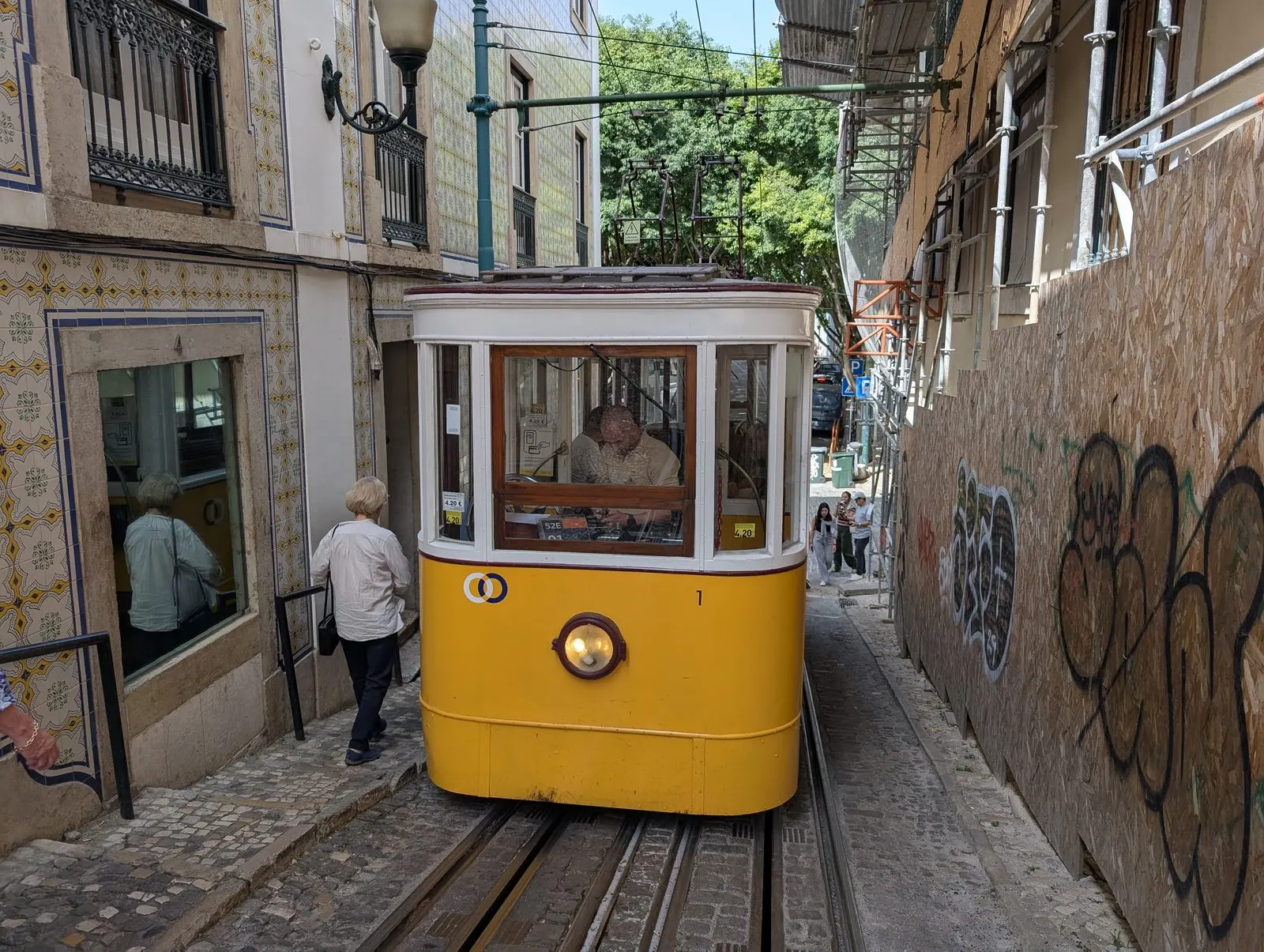
The Lavra Lift in Lisbon: the city's oldest funicular, opened in 1884, a National Monument since 2002, operated by Carris and currently closed.
- Location
- Lisboa, Lisboa
- Built
- 1882–1884
- Style
- Engenharia de transporte urbano do século XIX
The Lavra Lift climbs the Calçada do Lavra, between the Largo da Anunciada and the Travessa do Forno do Torel, in Lisbon. Carris describes it as the oldest lift in the city, opened in 1884. It is classified as a National Monument, together with the urban area surrounding it. When consulted on 5 November 2026, it was closed.
Mesnier du Ponsard’s first
The historical note from Património Cultural, I.P. places the Lavra within the context of the pioneering proposals of Raul (Raoul) Mesnier du Ponsard, who in the last quarter of the 19th century equipped the capital with nine lifts. The Lavra was the first to be built. The municipal council authorised the work in 1882, in favour of the Companhia dos Ascensores Mecânicos de Lisboa, and the lift was inaugurated in 1884; Carris gives the date as 19 April 1884.
It initially operated by rack and water counterweight, and in 1885 a steam system was tried. In 1897, the rupture of the cable linking the two cars left the lift out of service for several years. In 1915 it was fully electrified and resumed operation. According to the record, it stopped again only in 2006, due to the danger of collapse of a building on the Calçada do Lavra, and reopened in February 2007.
What the record describes
The structure consists of two cars that run alternately on two rail tracks, linked by a cable. At the top of the route a small boarding platform survives, set on a wrought-iron structure, with a double stone staircase and access platforms to the cars. The walls are lined with azulejo tile dado. For the context of the nineteenth-century metal structures, see iron architecture.
Classification
The property is a National Monument under Decree No. 5/2002, Diário da República, I Série-B, No. 42, of 19 February 2002, without restrictions, under the designation Ascensor do Lavra and the urban area surrounding it. The process began with a proposal from the Companhia Carris de Ferro de Lisboa, dated 1 August 1995. The Lisbon City Council gave a favourable opinion on 7 October 1996, and the Minister of Culture authorised the classification by dispatch of 9 April 1997. The same 2002 decree classified the Glória and Bica lifts, as each record indicates; the Santa Justa Lift is covered by the same instrument. The record does not indicate a special protection zone for the Lavra.
Status and visiting
The lift is operated by Carris. When consulted on 5 November 2026, the Carris lifts page listed the Lavra Lift as temporarily closed. RFM reported on 2 September 2026 that it remained closed and under technical assessment, with no date for reopening. The same RFM review notes that Lisbon’s historic lifts were out of service a year after the Glória Lift accident of 3 September 2025.
Even when closed, it is clearly visible from the Largo da Anunciada or the Calçada do Lavra itself. Before planning a visit, check the Carris website to see whether service has resumed.
Photograph by Philip Mallis, 31 May 2025. Original on Wikimedia Commons, under CC BY-SA 4.0; resized and compressed for the web, without altering the composition.
Frequently asked questions
- When was the Lavra Lift opened?
- Carris gives the opening date as 19 April 1884 and describes it as the oldest lift in the city. The Cultural Heritage record states that the municipal council authorised the work in 1882.
- Where is it and what route does it follow?
- It links the Largo da Anunciada with the Travessa do Forno do Torel, climbing the Calçada do Lavra, in the parish of Santo António, Lisbon.
- Is it a National Monument?
- Yes. The official designation is Ascensor do Lavra and the urban area surrounding it, classified by Decree No. 5/2002, published in the Diário da República on 19 February 2002.
- Is it open to the public?
- When consulted on 5 November 2026, Carris's page listed the Lavra Lift as temporarily closed. Please check the current status on the Carris website.
Sources
Keep exploring
Heritage nearby
More places to discover from here. Approximate straight-line distances, within 50 km.