Monuments
Café Majestic
Café Majestic (Rua de Santa Catarina, Porto): 1921–1922 Art Nouveau café, 1925 winter garden, 1992–1994 restoration and 1983 IIP classification.
- Location
- Porto, Porto
- Built
- 1921–1922; jardim de inverno 1925; restauro 1992–1994
The Café Majestic is at No. 112 Rua de Santa Catarina, the pedestrianised commercial street of the Baixa of Porto. The pale stone façade and the interior of mirrors, woodwork and stucco make it one of the best-known examples of Art Nouveau in the city. It still operates as a café and restaurant and has been an Imóvel de Interesse Público (property of public interest) since 1983. It nearly closed in the 1980s and reopened in 1994, after a restoration.
Elite or Majestic: the opening dates
The sources do not tell the origin in the same way, and it is worth distinguishing them.
The historical-artistic note in the cultural heritage register, written in 2008, says the café opened to the public in December 1921 under the name Café Elite, and that it changed to Majestic the following year, in evocation of Parisian life.
The history published by the café itself is more detailed and cites documents. On 17 December 1921, a group of merchants formed the company Café Elite, Limitada and leased the ground floor of Nos. 110 to 116 Rua de Santa Catarina. The contract began on 1 June 1922. The opening to the public, now as Majestic Café, is said to have taken place on 2 December 1922, according to the Commércio do Porto of that day. In 1924, the owning company was renamed Majestic Café, Lda.
The same disagreement exists over authorship. The official register attributes the building to the architect João Queirós, also the author of the Olympia cinema. The café, citing the 1922 newspaper, attributes the initial design to the architect José Pinto de Oliveira. It attributes to João Queiroz the design, dating from 1925, of the bar facing Rua de Passos Manuel, and states that the building dates from 1916.
The façade and the Art Nouveau room
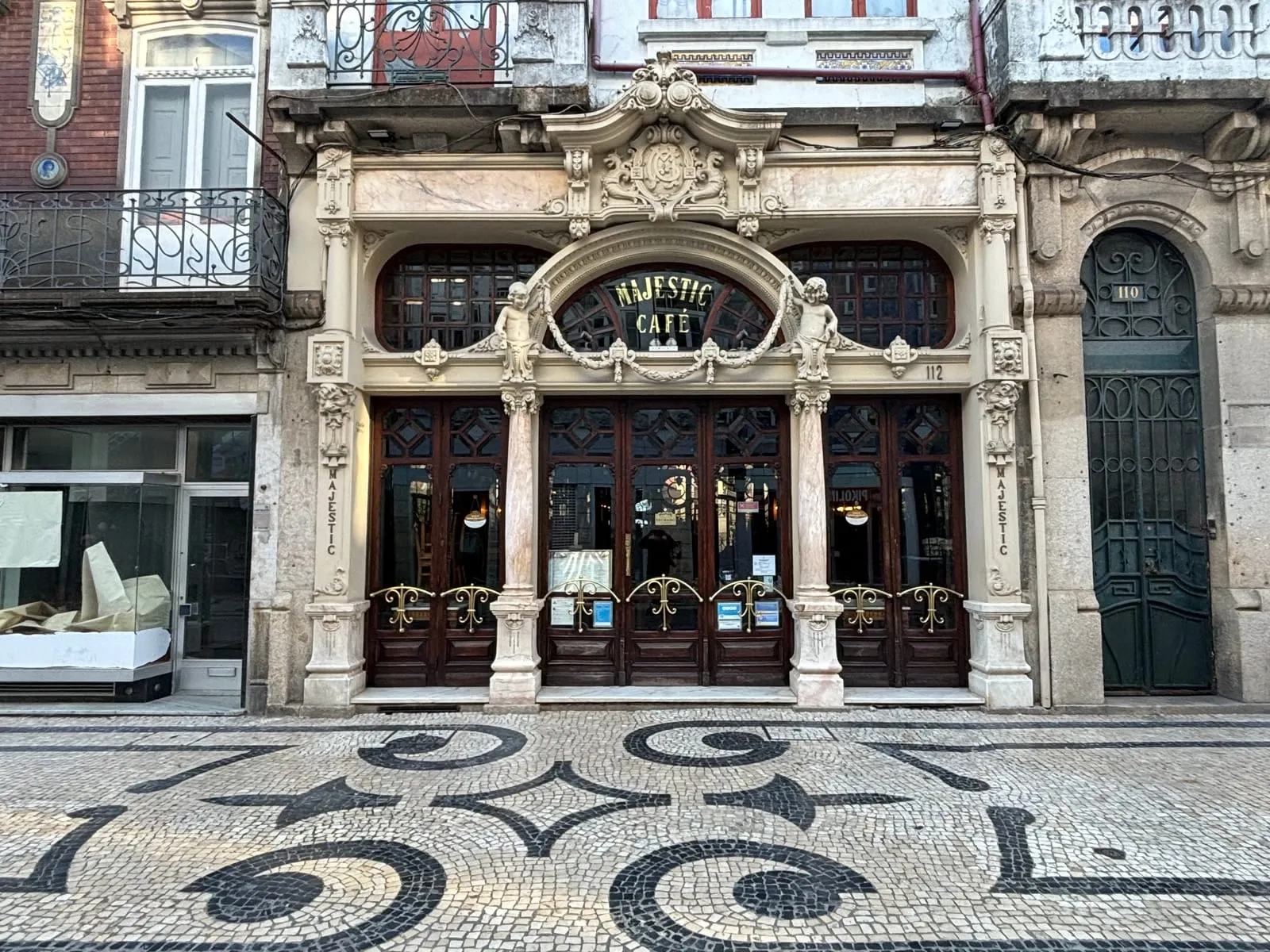
The marble façade is divided by three glazed wooden doors, which open the room wide onto the street. It has plant-motif garlands and fantastical figures: side masks and two children, the “meninos silvestres” (wild boys) of the register, who seem to invite passers-by in. A small reverse-curved pediment crowns the main entrance, and an upper frieze includes a medallion with the house’s initials.
The interior retains its Art Nouveau decoration. Wood and glass frames, large mirrors that visually enlarge the room, metal wall lamps, florals, masks and human figures in stucco give it the luxurious atmosphere of the period. The history of the café also mentions the embossed leather benches that replaced the original red velvet ones, and the lower floor, once occupied by a billiard room and now used for exhibitions.
The winter garden and the Passos Manuel front
In 1925, the master builder Pedro Mendes da Silva directed the construction of an inner courtyard conceived as a winter garden, with a small staircase and a bar. The work opened a second front onto Rua de Passos Manuel, in a simpler, more regional idiom, close to what Raul Lino would later call the Portuguese house. A small tobacconist’s shop operated there. According to the house’s history, the garden today hosts concerts during the summer.
Literary gatherings, decline and restoration
From the outset, the Majestic defined itself as a café of literary gatherings (tertúlia). Its history names regulars such as José Régio, Teixeira de Pascoaes, Leonardo Coimbra and the painter Júlio Resende, as well as students and teachers of the Porto School of Fine Arts. In 2020, J.K. Rowling wrote that the Majestic had probably been the most beautiful café in which she had ever written, according to the Observador.
From the 1960s, the café went through a progressive decline, which the register describes as almost irreversible by the 1980s. Under new owners, it closed in 1992 for a complete restoration, directed, according to the house’s history, by the architect Teresa Mano Mendes Pacheco. The floors were replaced and the original furniture reinstated, with the help of old photographs. It reopened on 15 July 1994.
Classification and protection
The café was classified as an Imóvel de Interesse Público (property of public interest) by Government Decree no. 8/83, published in the Diário da República, I series, no. 19, of 24 January 1983, which identifies it as “Café Majestic, situated at Rua de Santa Catarina, 112, in Porto”. The history of the café refers to a decree of 31 August 1981, but the official register cites only the 1983 instrument. The Atlas do Património Cultural records it under inventory number 3703.
The file includes proposals for a joint special protection zone, dated 2008 and 2010, covering the Coliseu do Porto, the Church of Santo Ildefonso and other buildings. On the plan included in the register, this joint zone appears as not being in force. The register also indicates that the café falls within the protection zone of the Coliseu do Porto.
Planning your visit
The Majestic is a working café and restaurant, not a museum. When consulted on 5 November 2026, the café’s website listed opening hours of Monday to Saturday, 9:00 to 23:00. The published telephone number is +351 222 003 887. Confirm opening times and events at cafemajestic.com. The façade and doors can be seen from the street; the room, the winter garden and the lower floor belong to the café’s premises.
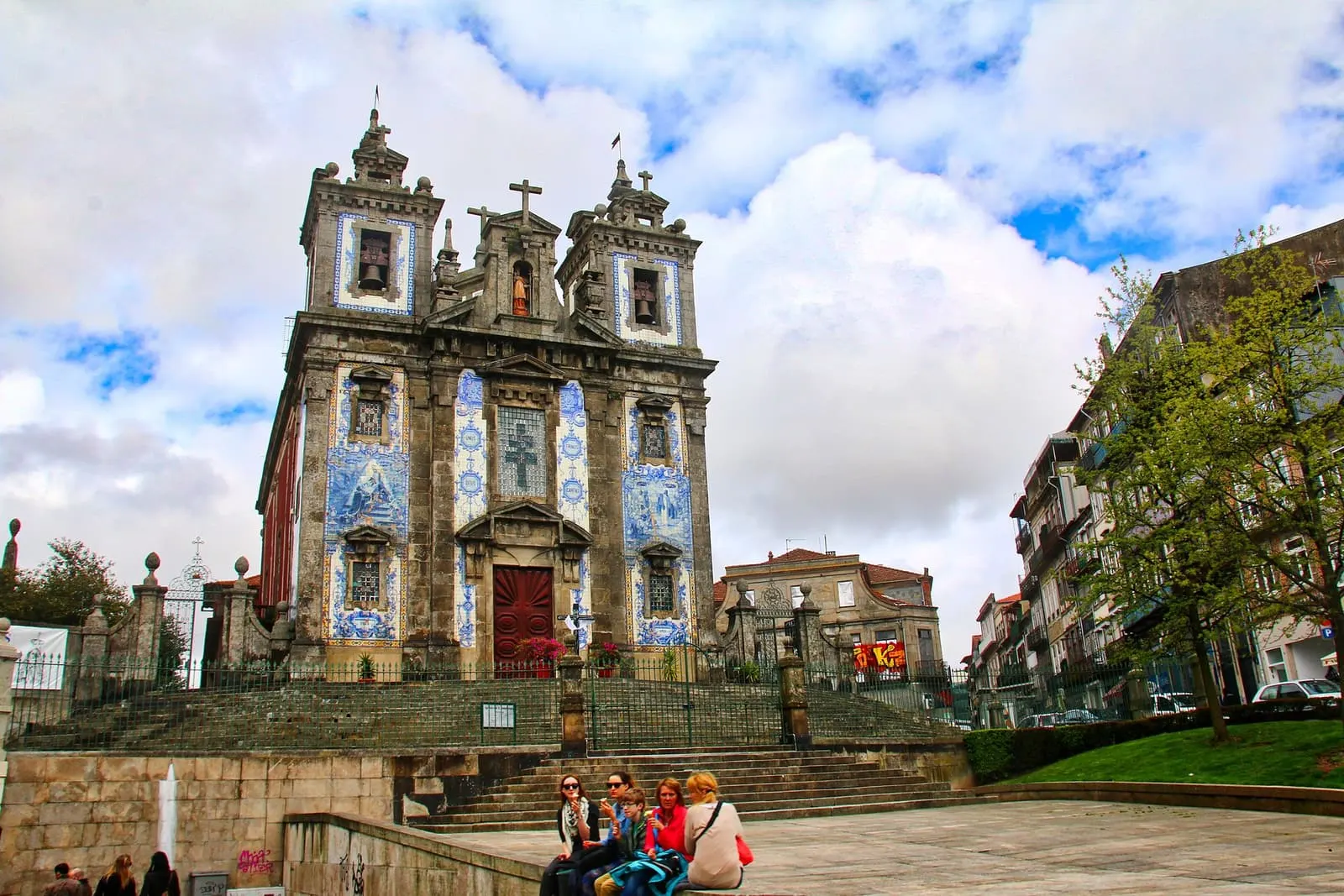
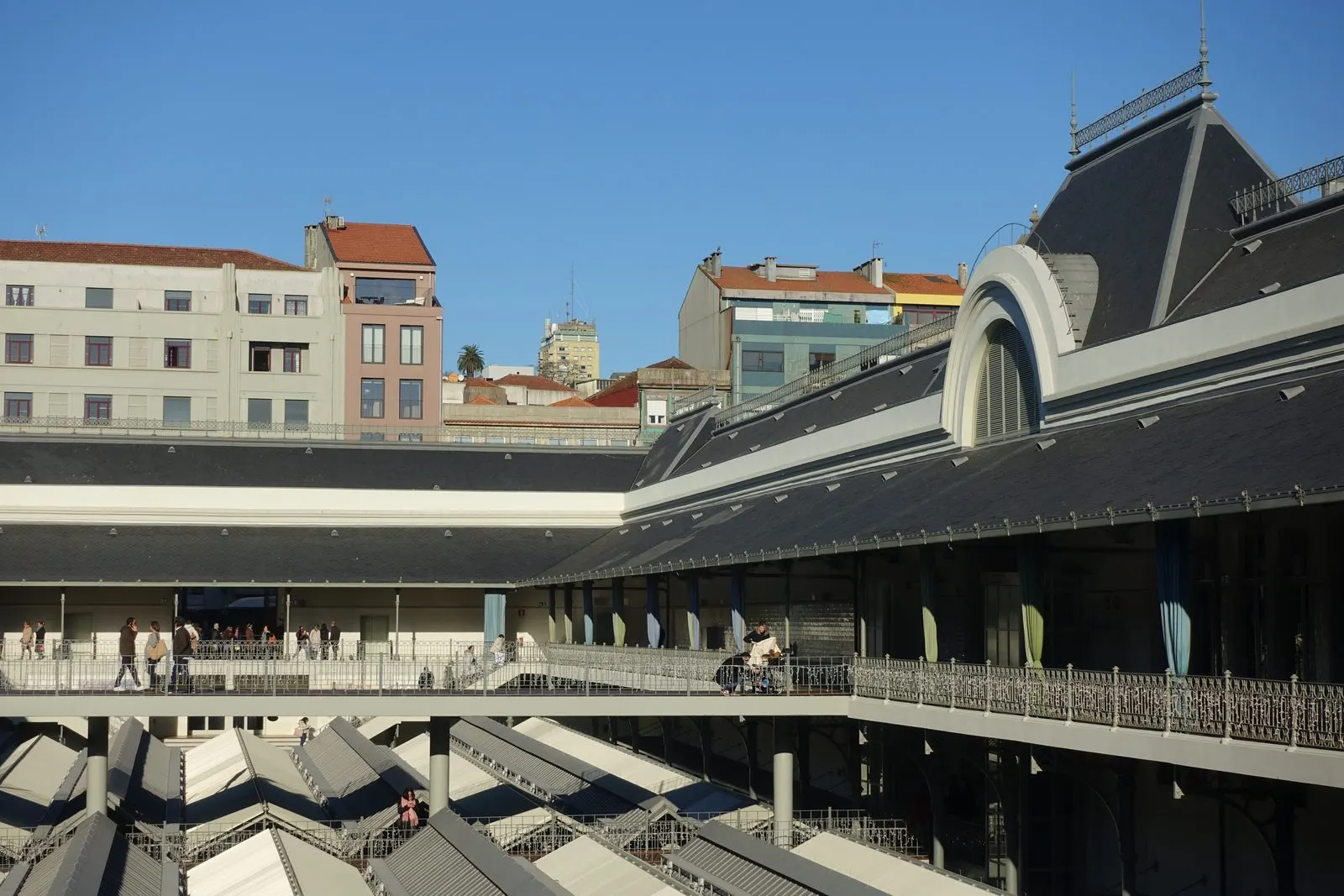
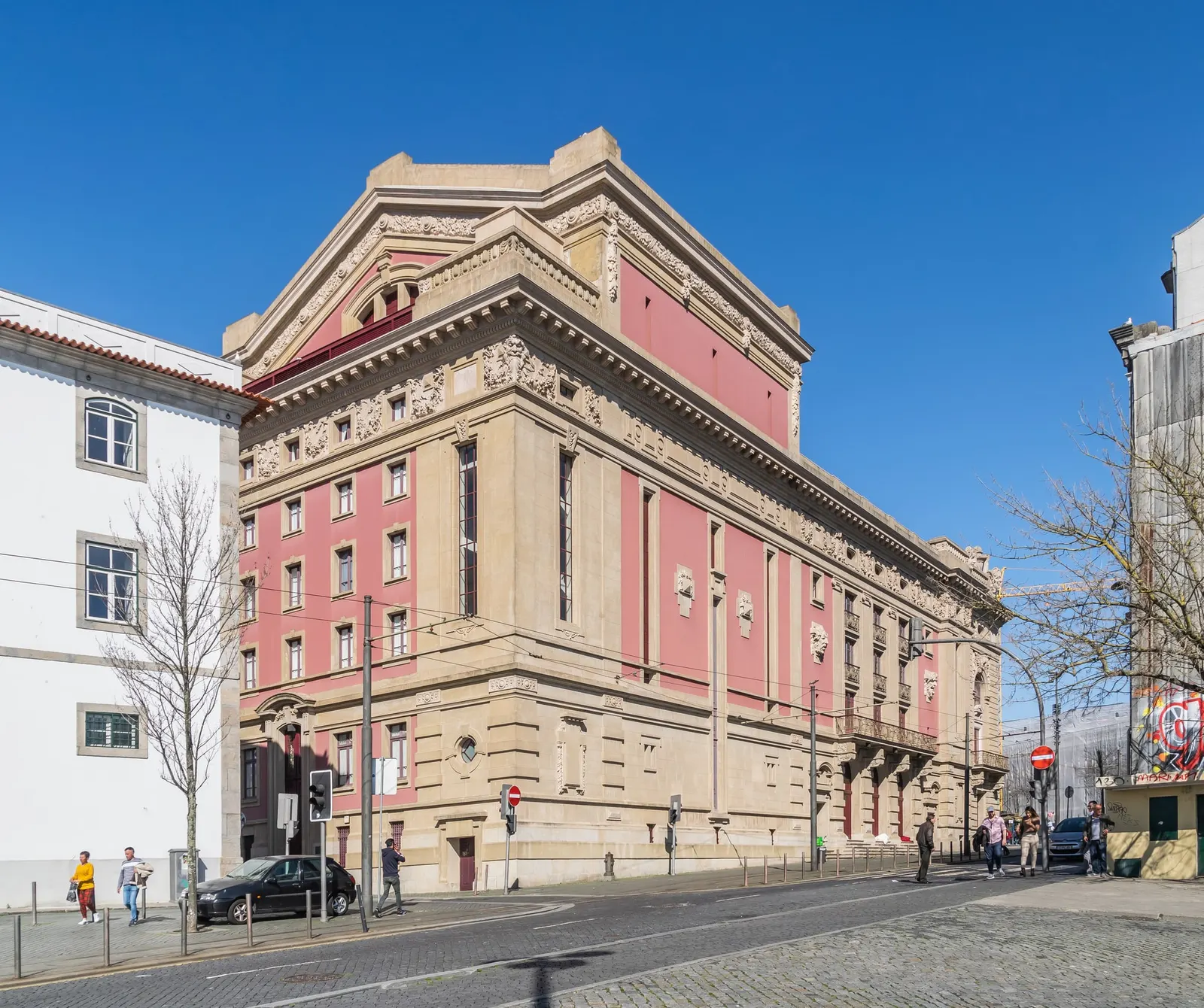
On the same street stands the Capela das Almas, with façades covered in tiles of 1929. In the same part of the Baixa are the Mercado do Bolhão and the Church of Santo Ildefonso, on Praça da Batalha.
Photograph by Frank Kovalchek, 15 September 2024. Original on Wikimedia Commons, under CC BY 2.0; resized and compressed for the web, without altering the composition.
Frequently asked questions
- When did the Café Majestic open?
- The sources disagree. The cultural heritage register gives December 1921, under the name Café Elite. The café's own published history dates the founding of the company Café Elite to 17 December 1921, and the opening to the public, now as Majestic Café, to 2 December 1922.
- Who was the architect?
- The official register attributes the building to João Queirós. The café, citing the Commércio do Porto newspaper of 1922, attributes the initial design to José Pinto de Oliveira and the 1925 bar, facing Rua de Passos Manuel, to João Queiroz.
- Is the Café Majestic listed?
- Yes. It is an Imóvel de Interesse Público (property of public interest) under Government Decree no. 8/83, published in the Diário da República of 24 January 1983, which identifies it on Rua de Santa Catarina, 112.
- What are the opening hours?
- When consulted on 5 November 2026, the café's website listed opening hours from Monday to Saturday, 9:00 to 23:00. Please confirm before your visit.
Sources
- Diário da República — Decreto do Governo n.º 8/83, de 24 de janeiro (classificação como IIP)
- Património Cultural, I.P. — Café Majestic (74502)
- Património Cultural, I.P. — Atlas do Património Classificado: Café Majestic (NINV 3703)
- Majestic Café — História
- Majestic Café — Como chegar e contactos
- Observador — Afinal, a Lello não inspirou Harry Potter: J.K. Rowling diz que nunca entrou na livraria (21-05-2020)
- Wikidata — Café Majestic (Q3208239)
Keep exploring
Heritage nearby
More places to discover from here. Approximate straight-line distances, within 50 km.