Monuments
Capela das Almas (Chapel of Souls), Porto
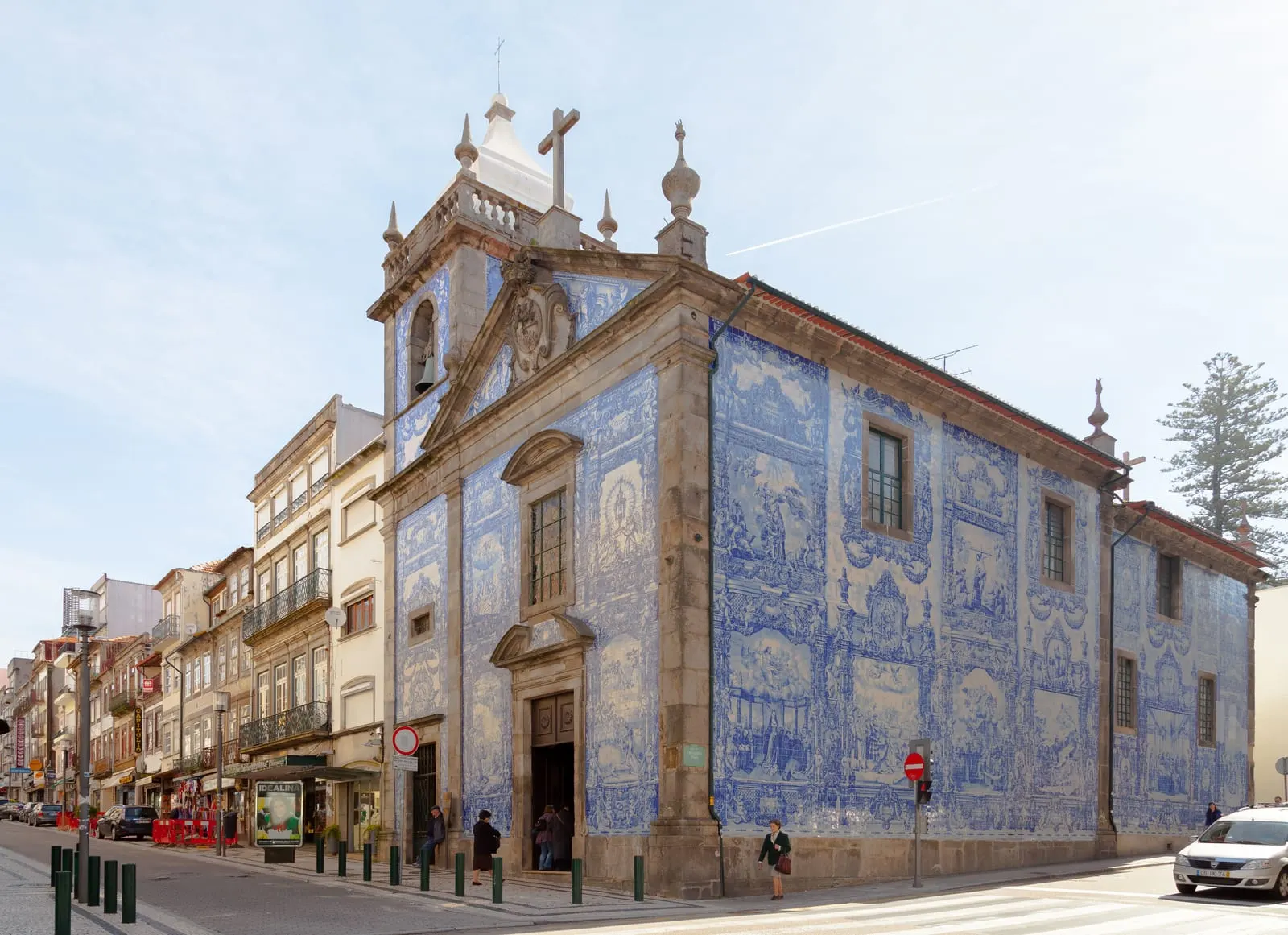
Capela das Almas on Rua de Santa Catarina, Porto: an early 18th-century chapel covered in 1929 with azulejos by Eduardo Leite, classified IIP in 1993.
- Location
- Porto, Porto
- Built
- Início do séc. XVIII; obras em 1801; azulejos de 1929
The Chapel of Souls, also known as the Chapel of Saint Catherine, stands on Rua de Santa Catarina, in the Baixa of Porto. It is a small church of simple architecture, yet its façades are entirely covered in blue and white tiles. This cladding, which looks eighteenth-century, was applied in 1929. The chapel remains open for worship and is also one of the most visited examples of façade azulejo in the city.
An eighteenth-century chapel transformed
According to the historical and artistic note in the cultural heritage record, the chapel was built in the early eighteenth century. The image of Our Lady of Souls kept inside dates from the same period, as indicated by Visit Porto, the municipality’s tourism portal. In 1801, enlargement and restoration works altered the building’s original style.
The main façade is restrained. At the centre, the doorway is framed and topped by a broken circular pediment. Above it, a large window, also with a circular pediment, holds a stained-glass panel depicting souls, made in the third quarter of the nineteenth century by the painter Amândio Silva. In the tympanum is a split coat of arms bearing the attributes of Saint Francis and Saint Catherine, set within a cartouche with a closed crown. On the left rises the two-storey bell tower, capped by a dome with an iron cross.
The 1929 tiles
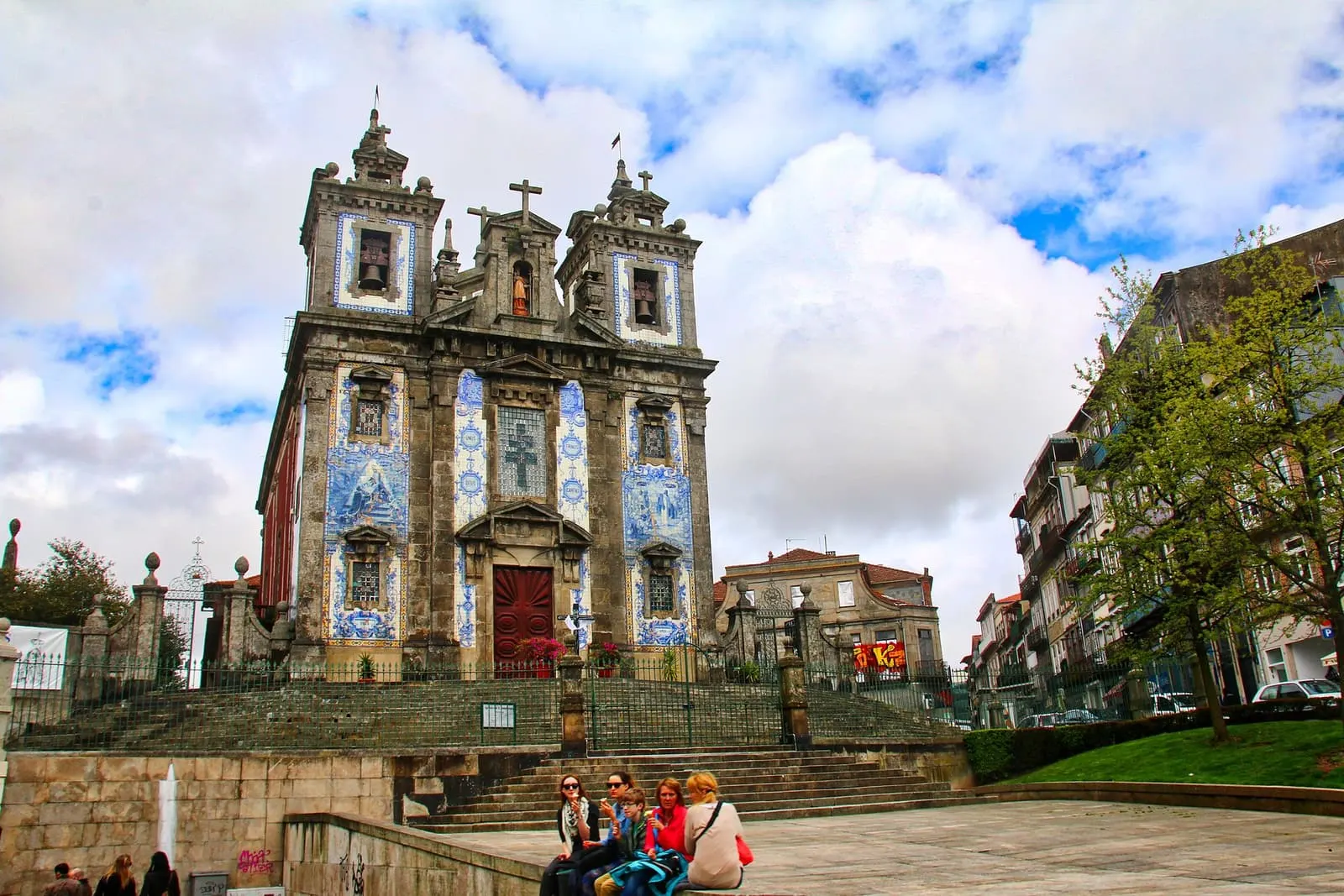
In 1929, the façades were completely covered with historiated blue and white panels. The official record attributes them to the ceramicist Eduardo Leite and states that they were produced at the Viúva Lamego factory in Lisbon. The panels deliberately imitate eighteenth-century azulejo work, which explains the frequent confusion about their date. They in fact belong to the same cycle of large figurative tile schemes of the early twentieth century as the panels by Jorge Colaço at São Bento railway station and the Church of Santo Ildefonso. For the artistic context, see azulejo from Art Nouveau to modernism.
The panels depict episodes from the lives of Saint Francis of Assisi and Saint Catherine. The record notes one detail: the artist mixed scenes of Saint Catherine of Siena with scenes of Saint Catherine of Alexandria, virgin and martyr, who dominates the main façade. Among the images photographed for the record is a panel showing the Coronation of Saint Catherine. Visit Porto adds that the tiles were restored in 1982.
Guides and travel websites frequently repeat a total of 15,947 tiles. This figure does not appear in the official sources consulted and should be read as an unconfirmed count.
The interior
The interior is considerably more restrained than the exterior. The high altar and the nave altars already show neoclassical features. According to the record, the side altars are dedicated to Saint John and Our Lady of the Conception on the left, and to Our Lady of Fátima, the Sacred Heart of Jesus and Our Lady of Sorrows on the right. The painting on the high altarpiece, depicting the Ascension of Christ, is by the painter Joaquim Rafael.
Classification and protection
The chapel was classified as a Property of Public Interest by Decree No. 45/93, published in the Diário da República, Series I-B, No. 280, on 30 November 1993. The annex to the decree identifies it as «Capela das Almas, também denominada “Capela de Santa Catarina”», at Rua de Santa Catarina, 426 to 428, then in the parish of Santo Ildefonso. The Atlas do Património Cultural records it under inventory number 4692.
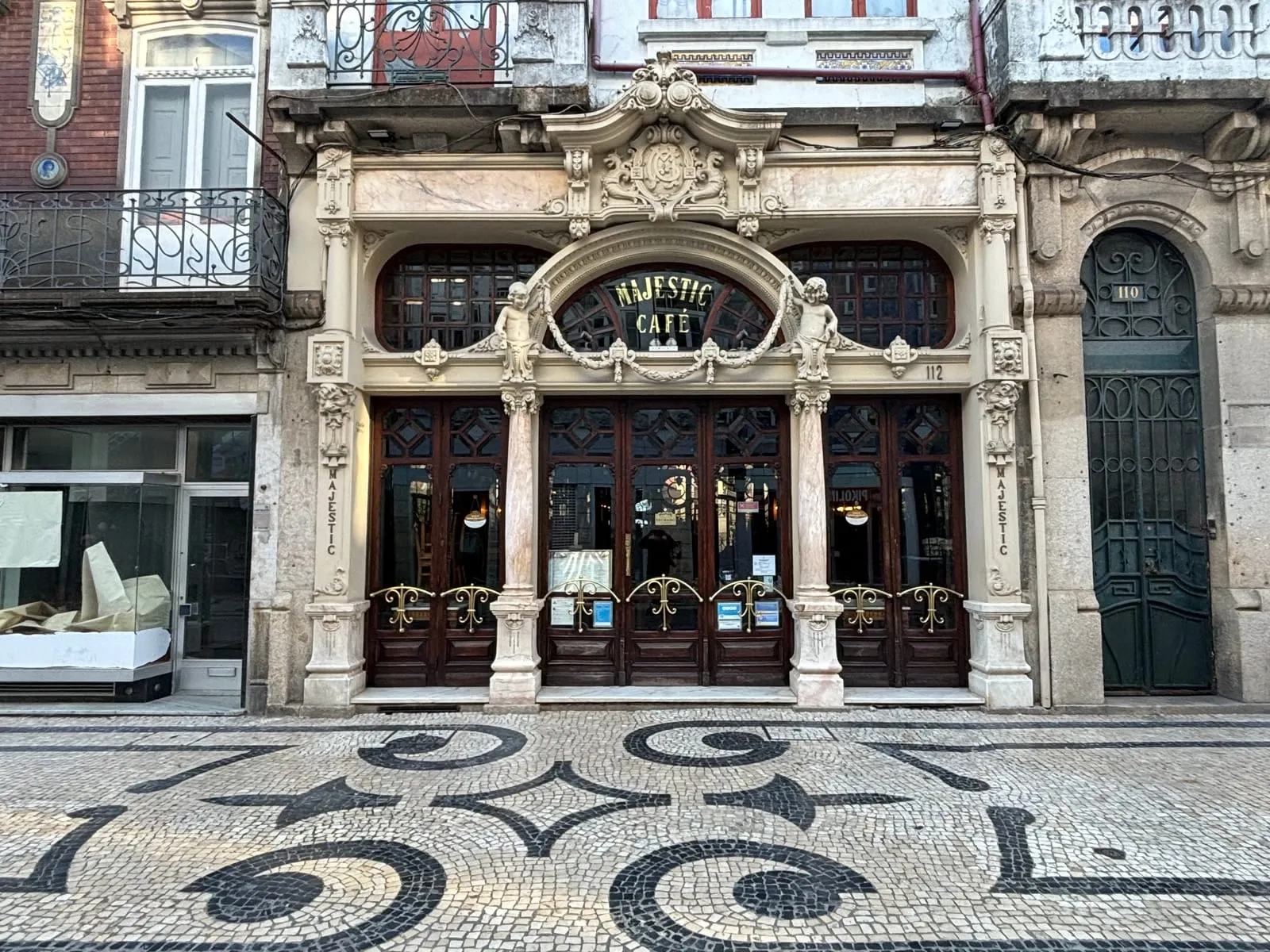
The file mentions a 2008 proposal for a joint special protection zone, covering other buildings in the area, among them the Coliseu do Porto, the Café Majestic and the Church of Santo Ildefonso. The sources consulted do not indicate that this zone has come into force. The record also does not present it as part of the property inscribed as a World Heritage Site in the Historic Centre of Porto: its own protection is the national classification of 1993.
Planning the visit
The chapel is at Rua de Santa Catarina, 428, one of the pedestrian shopping streets of the Baixa. As both the main and side façades are clad, it is worth viewing it from the corner, at a distance, before going in.
When consulted on 5 November 2026, Visit Porto listed free entry. The published hours were Monday to Friday, 7:30–18:00, and Saturday and Sunday, 7:30–12:45 and 18:00–19:00. The estimated average visit is about 15 minutes. As it is a working church, it is best to avoid visiting during services. Confirm the hours on the Visit Porto page or by telephone at +351 222 005 765.
To continue with the city’s azulejo, you can go on to the Church of Santo Ildefonso, in Praça da Batalha, and then walk down to São Bento railway station. More context is available in the general guide to azulejo.
Photograph by Diego Delso, May 2012. Original on Wikimedia Commons, under CC BY-SA 3.0; resized and compressed for the web, without altering the composition.
Frequently asked questions
- Who made the tiles of the Chapel of Souls?
- The blue and white panels covering the façades, installed in 1929, are the work of the ceramicist Eduardo Leite and were produced at the Viúva Lamego factory in Lisbon, according to the cultural heritage record.
- Are the tiles eighteenth-century?
- No. The chapel dates from the early eighteenth century, but the exterior cladding dates from 1929 and deliberately imitates eighteenth-century blue and white azulejo work.
- Is the Chapel of Souls listed?
- Yes. It is a Property of Public Interest under Decree No. 45/93, published in the Diário da República on 30 November 1993, under the designation «Capela das Almas, também denominada Capela de Santa Catarina».
- Can the interior be visited?
- Yes, it is a working church. When consulted on 5 November 2026, Visit Porto listed free entry, Monday to Friday 7:30 to 18:00, and Saturday and Sunday 7:30 to 12:45 and 18:00 to 19:00.
Sources
- Diário da República — Decreto n.º 45/93, de 30 de novembro (classificação como IIP)
- Património Cultural, I.P. — Capela das Almas, também denominada «Capela de Santa Catarina» (74379)
- Património Cultural, I.P. — Atlas do Património Classificado: Capela das Almas (NINV 4692)
- Visit Porto (Câmara Municipal do Porto) — Capela das Almas
- Wikidata — Capela das Almas (Q9695712)
Keep exploring
Heritage nearby
More places to discover from here. Approximate straight-line distances, within 50 km.