Monuments
Chalet and Garden of the Countess d'Edla
Chalet da Condessa d'Edla, Pena Park: alpine retreat of Ferdinand II and Elise Hensler, with cork decor, a 1999 fire, its restoration and visitor tips.
- Location
- Sintra, Lisboa
- Built
- 1864–1869
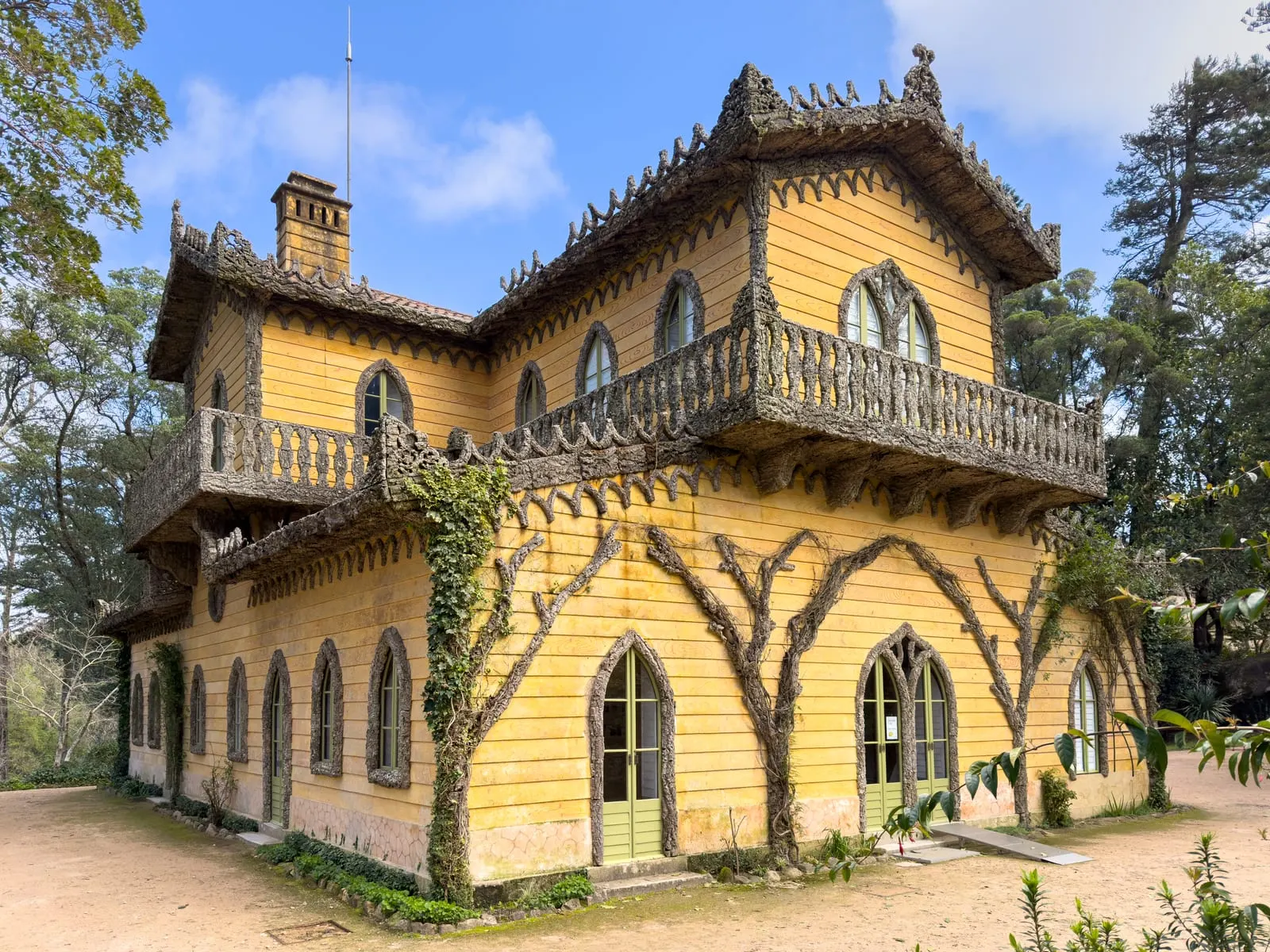
The Chalet of the Countess d’Edla is a pleasure house hidden on the western side of the Pena Park, in Sintra. Yellow walls that imitate wooden planks, pointed-arch windows and cork climbing plants give it the air of an Alpine hut transplanted to the hills. It was the private retreat of King Ferdinand II and Elise Hensler, and the garden surrounding it is part of the same work. From the Pena Palace, up on the heights, to here, both scale and tone change: instead of the royal residence, a house designed for the couple.
Who built it
Elise Hensler was born in Switzerland in 1836 and spent many years in Boston. She studied in Paris, performed in Milan and sang in the Teatro São João in Porto and the Teatro São Carlos in Lisbon, where King Ferdinand II met her. The widowed king of Maria II married her in 1869, with Luís I already on the throne. For this marriage, Duke Ernst II of Saxe-Coburg and Gotha, a cousin of Ferdinand, granted her the title of Countess d’Edla.
Parques de Sintra – Monte da Lua, the body that manages the monument, dates the construction of the chalet and the surrounding garden to 1864–1869 and says that Elise Hensler herself drew up and designed the building. The national heritage register adds that, by 1867, the work was far enough advanced for the interior stucco and painting to begin, entrusted to Sebastião Ribeiro Alves. It also mentions craftsmen such as Gregório and Domingos Martins Freire, but attributes the conception and supervision to Elise Hensler.
An Alpine house in Sintra
The model is that of the Alpine chalet, then fashionable across Europe. To build it, a site was chosen to the west of the palace, with a view of the Pena, the sea and the Feteira valley. The exterior is a stage set: according to the Parques de Sintra leaflet, the render imitates a cladding of wooden boards. Cork is one of the main materials of the decoration. It shapes the window frames, covers balusters and imitates climbing plants that run up the walls. A photograph from around 1870, attributed to C. Relvas, even shows garden furniture in cork. For the raw material and the crafts, see cork work.
The ground floor is divided into a service area, with kitchen and pantry, and a reception area. In the Sala das Heras (Ivy Room), the stucco reproduces ivy stems springing from the corners, as if the garden had entered the room. The Dining Room has its walls lined with rough cork. Parques de Sintra explains that this covering was inspired by the Convento dos Capuchos, then known as the Cork Convent. In the stairwell hall, the 1869 wall painting extends the idea of a wooden house, and on the landing are the arms of King Ferdinand II. The upper floor holds the couple’s bedroom, overlooking the palace, and the dressing rooms of the king and the countess. A wardrobe also served Elise Hensler as a sitting and work room. The countess’s dressing room has a blue background and painted Swiss lace, a fashion of the boudoirs of the late 1860s.
The ensemble is a small but very complete example of the taste that marked the hills in the nineteenth century. To frame it, see Romanticism and Revivalism.
The countess’s garden
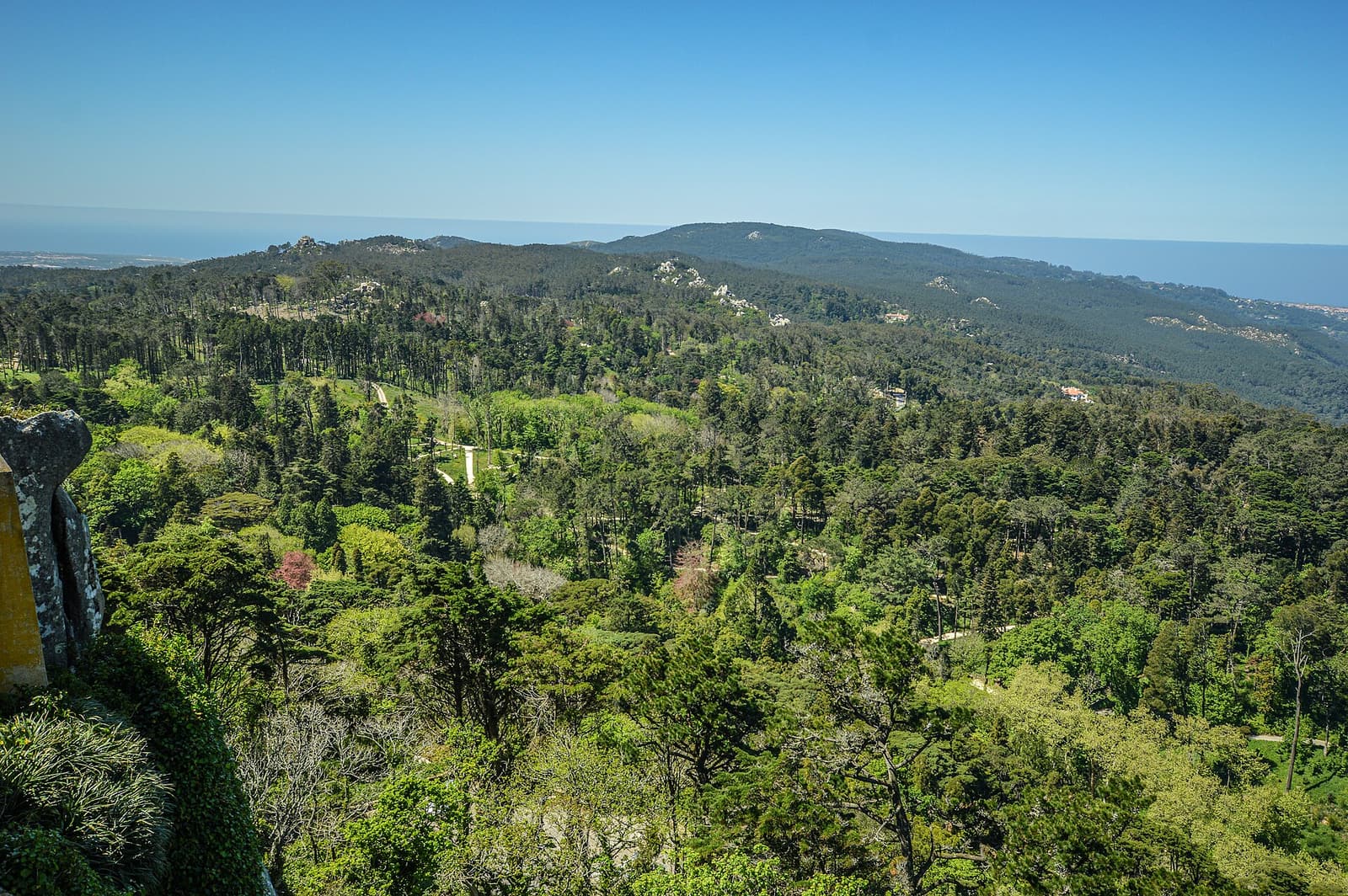
The garden came into being with the house. The Parques de Sintra leaflet mentions a collection of more than 200 species, among native vegetation and exotic specimens. Notable are the Countess’s Fern Valley, with the oldest collection of tree ferns in the park, the azaleas and rhododendrons, introduced in 1864 according to the same source, and the camellias. Among the camellias are varieties named «D. Fernando II» and «Condessa d’Edla». Near the chalet rise the Chalet Rocks, a jumble of granite boulders with lookouts over the palace. For visitors coming from the Pena Palace, one of the entrances is the Ponte Nova, a wooden pergola over a rustic bridge. The ensemble helps to read the rest of the Pena Park, which the couple continued to plant.
Inheritance, neglect, fire and restoration
King Ferdinand II died in 1885 and bequeathed all his property to the countess in his will, including the Pena Palace and the Moorish Castle. A lawsuit followed to transfer this heritage to the Crown. According to Parques de Sintra, Elise Hensler eventually sold the park, the palace and the castle to the State and kept the usufruct of the chalet and garden until 1904. The leaflet from the same body places the sale in 1889.
The national register indicates that the building was abandoned in the 1930s and 1940s. In 1999, a fire destroyed much of the building. According to the application that won the Europa Nostra award, roofs, floors, partition walls and the veranda collapsed. The recovery project, supported by the EEA Grants, began in 2007 with the recovery of remains, the study of original techniques and 3D modelling. Works started in 2010: reinforcement of the masonry, reconstruction of the interior wooden elements, conservation of the exterior renders that imitate boards, and restoration of the cork decoration. The chalet reopened to the public in 2011. In 2013, the restoration received the European Union Prize for Cultural Heritage – Europa Nostra, in the Conservation category.
Classification and World Heritage
The national register identifies the Chalé da Condessa de Edla, also called «Chalé da Condessa», as a Property of Public Interest, by Decree No. 45/93 of 30 November, published in the Diário da República, I Série-B, No. 280. The decree places it «in the Pena Park, Sintra, parish of São Pedro de Penaferrim».
The chalet lies within the perimeter of the Cultural Landscape of Sintra, inscribed on the World Heritage List in 1995. UNESCO’s statement of outstanding universal value mentions the chalet when discussing the restoration works by Parques de Sintra, not in the list of landscape landmarks. This inscription is not a separate one for the building itself. UNESCO notes that the whole inscribed property is also classified as a National Monument, a framework the national register repeats in the chalet’s record. For the wider ensemble, see the Cultural Landscape of Sintra.
Planning the visit
When consulted on 5 November 2026, the official page stated that the chalet opened from 09:00 to 17:30, with last entry at 17:00, and the Pena Park from 09:00 to 19:00. Entry to the chalet and garden was included in the tickets for the Pena Park and for the Pena National Park and Palace. The chalet’s entrance gate closed between 12:00 and 14:00, but tickets and access remained available through the park’s other entrances. Confirm opening hours and prices on the Parques de Sintra page.
The same page stated that private vehicles are not permitted on the access roads to the monument. From Sintra railway station, it indicated bus 434 operated by Scotturb. For those on foot, it listed three signposted routes to the Pena Park: the Santa Maria route, the Vila Sassetti route and the Seteais route, which starts at the Seteais Palace.
Photograph by Kent Wang, dated 14 February 2026. Original on Wikimedia Commons, under CC BY 4.0; resized and compressed for the web, without altering the composition.
Frequently asked questions
- Who built the Chalet of the Countess d'Edla?
- King Ferdinand II and Elise Hensler, who only received the title of Countess d'Edla in 1869, the year of their marriage. Parques de Sintra dates the chalet and the garden to 1864–1869 and states that Elise Hensler designed and planned it.
- Where is the cork in the chalet?
- Outside, cork shapes the window frames, balusters and false climbing plants that run up the walls. Inside, the dining room has walls lined with rough cork, which Parques de Sintra relates to the Convento dos Capuchos.
- What happened in 1999?
- A fire destroyed much of the building. After the recovery of remains and studies begun in 2007, works started in 2010 and the chalet reopened in 2011. In 2013 the restoration received the European Union Prize for Cultural Heritage – Europa Nostra.
- What protection does the chalet have?
- It is classified as a Property of Public Interest by Decree No. 45/93 of 30 November. It lies within the perimeter of the Cultural Landscape of Sintra, inscribed on the World Heritage List in 1995; it has no separate UNESCO inscription of its own.
Sources
- Parques de Sintra – Monte da Lua — Chalet e Jardim da Condessa d'Edla
- Parques de Sintra – Monte da Lua — Chalet e Jardim da Condessa d'Edla: história
- Parques de Sintra – Monte da Lua — Chalet da Condessa d'Edla: Casa de Jantar
- Parques de Sintra – Monte da Lua — Chalet da Condessa d'Edla: Átrio da Escada
- Parques de Sintra – Monte da Lua — Chalet da Condessa d'Edla: Sala das Heras
- Parques de Sintra – Monte da Lua — Jardim da Condessa d'Edla
- Parques de Sintra – Monte da Lua — Pedras do Chalet
- Parques de Sintra – Monte da Lua — Folheto «Jardim e Chalet da Condessa» (PDF)
- Património Cultural, I.P. — Chalé da Condessa de Edla (72946)
- Diário da República — Decreto n.º 45/93, de 30 de novembro (I Série-B, n.º 280)
- Europa Nostra — European Heritage Awards: The Chalet of the Countess of Edla, Sintra (2013)
- UNESCO — Cultural Landscape of Sintra (723)
- Wikidata — Chalet da Condessa de Edla (Q54253293)
Keep exploring
Heritage nearby
More places to discover from here. Approximate straight-line distances, within 50 km.