Monuments
Capuchos Convent, Sintra
Capuchos Convent, in Sintra: a Franciscan house founded in 1560, cork-lined cells, owned by Francis Cook, recent restoration and visitor information.
- Location
- Sintra, Lisboa
- Built
- 1560 (fundação)
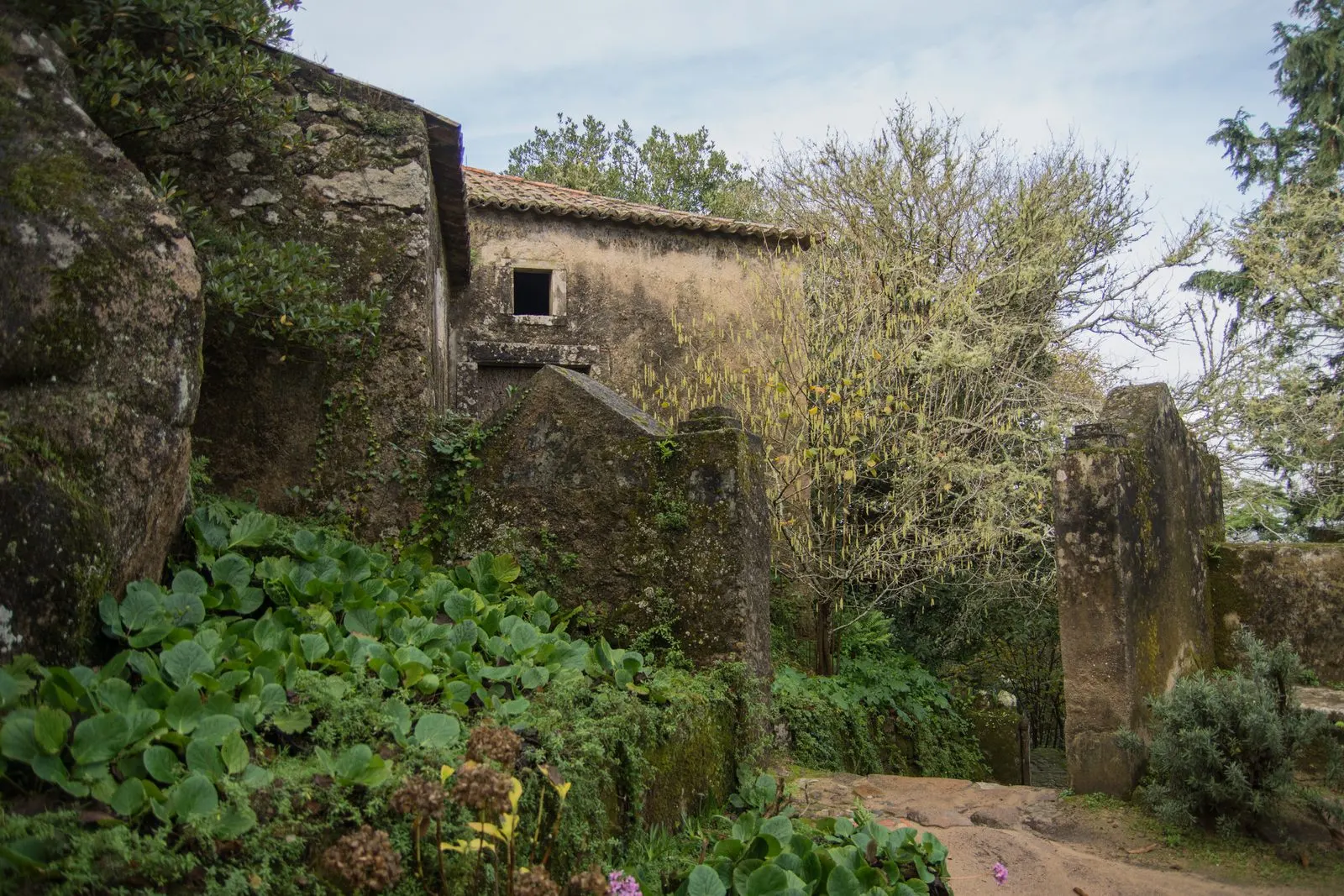
The Capuchos Convent is the counterpoint to the palaces of Sintra. Instead of towers and grand halls, it has doorways so low they force one to bend, minimal cells and walls that lean against the granite boulders of the hills. Cork, used in many of its linings, gave it the popular name Cork Convent. Its founding name is Convent of Santa Cruz da Serra de Sintra.
Foundation and Franciscan ideal
Parques de Sintra – Monte da Lua, the body that manages the monument, dates the construction of this conventual house to 1560. The work was promoted by D. Álvaro de Castro, Councillor of State to King D. Sebastião, in fulfilment of a vow made by his father, D. João de Castro, Viceroy of India and owner of those lands. The convent was entrusted to the Order of Saint Francis. The programme embodies the Franciscan ideal of withdrawal from the world, poverty and contemplation.
The founding tradition, as recounted by the managing body, is a legend and should be read as such. D. João III is said to have fallen asleep, during a hunt, in the shade of a large rock. In a dream, he saw angels adoring the Holy Cross in the hollow of the stone and ordered a convent to be founded there. D. João de Castro did not realise the project during his lifetime and entrusted it to his son. The church, which resembles a grotto, evokes this narrative.
Later, by order of the Cardinal-King D. Henrique, the convent received some improvements. In 1581, according to the same source, Philip I of Portugal (II of Spain) visited the house and left a frequently quoted remark: in his kingdom, two things pleased him greatly, the Escorial for being so rich, and the Convent of Santa Cruz for being so poor.
An architecture of humility
The route begins at the Terreiro das Cruzes, with three crosses representing Golgotha. One climbs to the terrace by one of the two paths beside the smaller crosses, not by the larger cross. Access to the convent is through the Pórtico das Fragas, between two granite blocks, where a bell was rung to summon the guardian friar. Above the gate, a skull and two crossed bones symbolise death to the life left behind.
In the corridor of the cells, reserved for the friars, the doors are very low and narrow. Entering required a gesture of humility. The religious did not sleep in beds: they lay on the floor, on a straw mat or a cork board. Cork was used abundantly in the linings and decoration, in openings, doors and other elements. It is an architectural use of a material that also has its own history in cork working and the montado.
The austerity has one calculated exception: the church altar, with a marble frontal and polychrome stone inlays. It was the only part of the interior visible to pilgrims and bore witness to the power of the patrons. In the refectory, food was frugal and depended on the vegetable gardens and donations. The surrounding woodland was preserved by the friars and is today, according to Parques de Sintra, one of the most remarkable examples of the primeval forest of Sintra. In a rocky hollow of the woodland lies the so-called Cova do Frei Honório. Tradition says the friar lived there in seclusion for about thirty years.
From the suppression of the orders to Monserrate
The convent was inhabited by Franciscans for some 250 years. In 1834, with the suppression of religious orders in Portugal, it was abandoned. It was later bought by the 2nd Count of Penamacor, who in 1873 sold the property to Francis Cook, 1st Viscount of Monserrate, the same owner of the neighbouring Monserrate Palace. The connection is recorded in the classification itself: the 1948 decree describes the «Convento dos Capuchos, que faz parte da Quinta de Monserrate».
The Portuguese State only acquired the monument in 1949, when its deterioration was already very visible. Some works were then carried out. Since 2000, the convent and its surroundings have been managed by Parques de Sintra.
Restoration and European prize
In 2013, Parques de Sintra began a comprehensive conservation, restoration and requalification project. Preliminary surveys estimated the risk of loss of historic heritage at 52%. Among the causes were rot in the timbers of the mixed masonry walls and biological colonisation. The intervention recovered roofs, renders, tiles, cork linings and the church altar. The present colour of the walls results from traces identified through test probes and laboratory analyses. According to the managing body, all works were financed by Parques de Sintra itself.
In 2022 the project received a European Union Prize for Cultural Heritage / Europa Nostra Awards, in the category of Conservation and Adaptive Reuse.
Classification and World Heritage
The convent is a Property of Public Interest under Decree No. 37 077, published in the Diário do Governo, I series, no. 228, on 29 September 1948. Parques de Sintra presents it as part of the Cultural Landscape of Sintra, inscribed on the World Heritage List in 1995. UNESCO’s statement of outstanding universal value does not name it, but the convent’s coordinate falls within the perimeter of the Cultural Landscape of Sintra in the Atlas of Cultural Heritage, I.P. The inscription covers the landscape as a whole and does not constitute a separate inscription for the convent. The property also lies within the Sintra-Cascais Natural Park.
For the context of the hills, see the Cultural Landscape of Sintra and the neighbouring Castle of the Moors. To compare with other religious houses, consult the pages on convents and monasteries. In the Arrábida, the Convent of Arrábida shows another version of Franciscan austerity in the landscape.
Planning the visit
Consulted on 5 November 2026, the official page indicated opening hours of 9:00 to 17:30, with last ticket sales and last entry at 17:00. The ticket office closed between 12:00 and 13:00, with an automatic vending point available. Published prices were €11 (adult, 18–64 years), €9 (youth, 6–17 years, and senior, over 65) and €29 (family ticket, two adults and two young people). Please confirm opening times, prices and access on the Parques de Sintra page.
The convent stands isolated in the hills. Without a car, the managing body indicated bus 1253 of Carris Metropolitano from Sintra station, followed by about 40 minutes’ walk, or taxi. By car, access is via the EN247 to Pé da Serra and then the EN247-3.
Photograph by Pedro J Pacheco, 31 December 2013. Original on Wikimedia Commons, under CC BY-SA 4.0; resized and compressed for the web, without altering the composition.
Frequently asked questions
- Why is it also called the Cork Convent?
- Because cork was used extensively in the convent's linings and decoration, including doors, openings and interior elements. The friars slept on the floor, on a straw mat or a cork board.
- Who founded the convent and when?
- Construction was promoted in 1560 by D. Álvaro de Castro, Councillor of State to King D. Sebastião, in fulfilment of a vow made by his father, D. João de Castro. The house was named the Convent of Santa Cruz da Serra de Sintra and was entrusted to the Franciscans.
- What is the classification of the Capuchos Convent?
- It is a Property of Public Interest under Decree No. 37 077 of 29 September 1948, which describes it as the convent that forms part of the Monserrate Estate. Parques de Sintra presents it as part of the Cultural Landscape of Sintra, inscribed on the World Heritage List in 1995.
- How do I get to the convent?
- Consulted on 5 November 2026, Parques de Sintra indicated, from Sintra station, bus 1253 of Carris Metropolitano, with about 40 minutes' walk to the convent, or taxi. By car, access is via the EN247 and then the EN247-3, from Pé da Serra.
Sources
- Parques de Sintra – Monte da Lua — Convento dos Capuchos
- Parques de Sintra – Monte da Lua — Convento dos Capuchos: história
- Parques de Sintra – Monte da Lua — Restauro do Convento dos Capuchos
- Parques de Sintra – Monte da Lua — Corredor das Celas
- Parques de Sintra – Monte da Lua — Igreja do Convento dos Capuchos
- Parques de Sintra – Monte da Lua — Terreiro das Cruzes
- Parques de Sintra – Monte da Lua — Portaria
- Parques de Sintra – Monte da Lua — Refeitório
- Parques de Sintra – Monte da Lua — Cova do Frei Honório
- Diário do Governo — Decreto n.º 37 077, de 29 de setembro de 1948
- Património Cultural, I.P. — Atlas do Património Classificado: Convento dos Capuchos (NINV 3421) e Paisagem Cultural de Sintra (NINV 72949)
- UNESCO — Cultural Landscape of Sintra (723)
- Wikidata — Convento dos Capuchos (Q1129421)
Keep exploring
Heritage nearby
More places to discover from here. Approximate straight-line distances, within 50 km.