Monuments
Seteais Palace
Palácio de Seteais in Sintra: began as consul Gildemeester's home, expanded by the Marquis of Marialva, arch from 1802, hotel since the 1950s, protected.
- Location
- Sintra, Lisboa
- Built
- 1783–1787; ampliação de 1801–1802
- Style
- Neoclássico
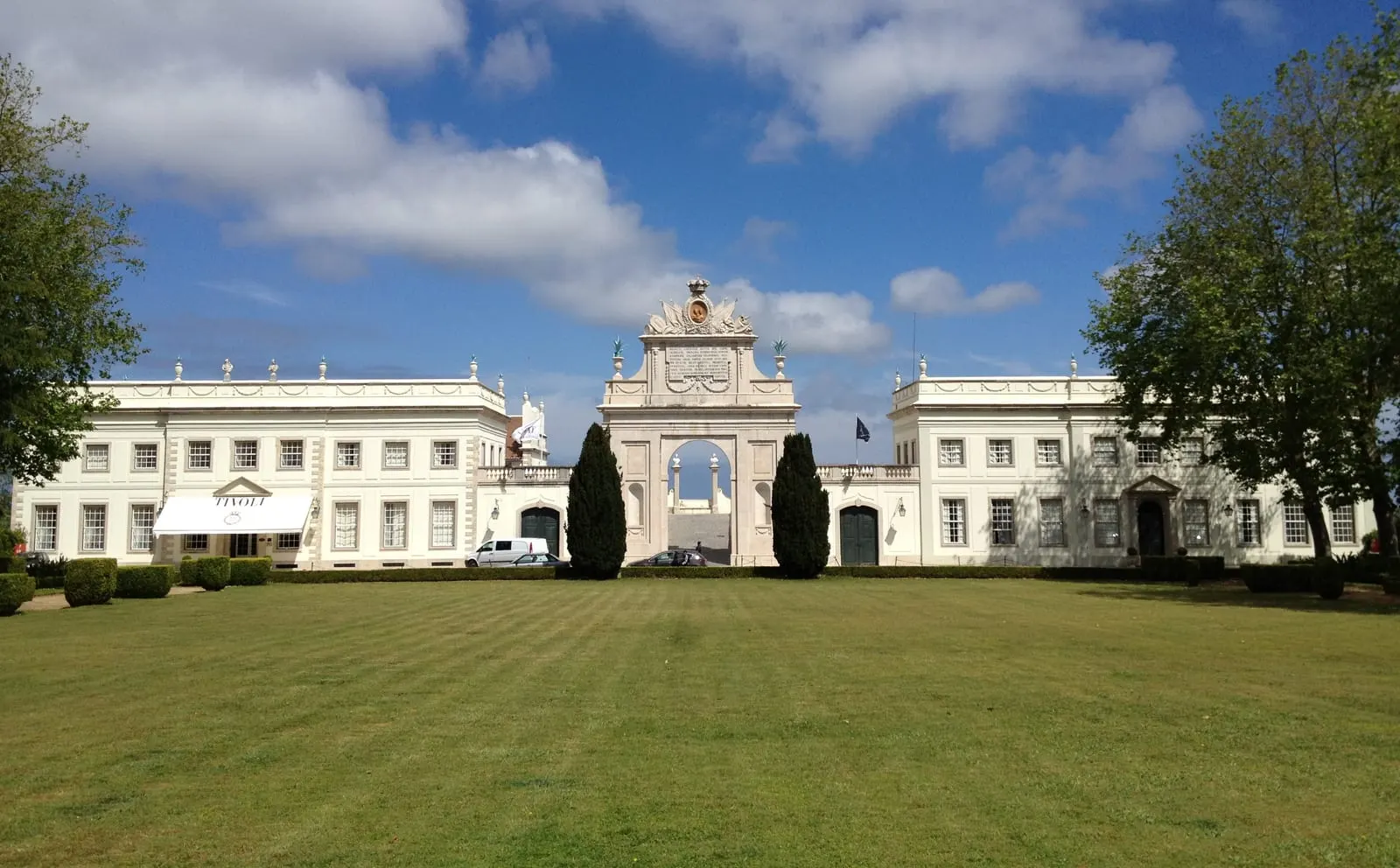
The Palácio de Seteais stands on Rua Barbosa du Bocage, in Sintra, facing a large forecourt. Two symmetrical white wings are joined by a triumphal arch that frames the view of the mountain range. It began as a country house for a foreign merchant at the end of the eighteenth century and was extended by the 5th Marquis of Marialva. Today it operates as a hotel, which shapes how visitors can experience it.
The house of consul Gildemeester
The original core is due to Daniel Gildemeester, Dutch consul in Portugal and a man of great wealth. According to the national heritage register, the Marquis of Pombal had granted him the exclusive right to export diamonds. The register’s entry places the start of works in 1783 and their completion in 1787. The palace was inaugurated on 25 July 1787. The English writer William Beckford attended the celebration and described it in his diary: he found the house austere, but praised the table. According to Parques de Sintra, Beckford became tenant of Monserrate in 1794, where the Monserrate Palace now stands.
The siting already made the most of the landscape. The rear façade opens onto a geometric box-hedge garden. Framed by the arch, on the so-called Penedo da Saudade, the view stretches over the mountains and «the palace of Sintra», in the words of the national register.
The Marquis of Marialva and the 1802 arch
Gildemeester died in 1793, and the family’s financial difficulties led to the sale of the property. The 5th Marquis of Marialva, D. Diogo José Vito de Menezes Noronha Coutinho, bought it in 1797. Between 1801 and 1802, the marquis extended the palace and the stables. The national register describes the change: the main façade became the one opening onto the courtyard, and a second, scenographic façade was built, symmetrical to the first.
The two wings were joined by a triumphal arch, built in 1802 to mark the visit of the prince regent D. João, future D. João VI, and of D. Carlota Joaquina. On the arch, lances, banners and coats of arms frame the busts of the monarchs. The entry attributes the arch to Francisco Leal Garcia and notes that the design of the buildings has been attributed to the architect José da Costa e Silva, author of the Teatro de São Carlos.
The register notes several influences: the neo-Palladian classicism of the straight lines and the garlands on the parapets, in the Louis XVI taste. It also cites José-Augusto França, for whom the ensemble raises the question of how neoclassicism was understood, or misunderstood, in Portugal at the turn of the century. The interiors of the same campaign were lined with silks and painted in fresco by followers of Pillement, some with Chinese influence. For context, see Neoclassicism in Portugal.
From neglect to hotel
The marquis died in 1803, shortly after the works were completed. Problems of succession and several mortgages followed, until the State acquired the property in 1946. The national register dates the opening of the luxury hotel to 1954 and stresses that the conversion kept the existing building. The current operator gives a different date, 29 September 1955, and attributes the conversion to the architect Raul Lino. The discrepancy between the two sources is unresolved.
The name Seteais has several explanations. The hotel operator recounts two legends: that of an echo repeated seven times in the gardens, staged by the marquis, and that of a Moorish princess who would die at the seventh «ai». It also mentions a more prosaic hypothesis, that the name derives from «centeais», rye fields. None of these explanations is documented in the official sources consulted.
Classification and World Heritage
The Palácio de Seteais, including the group of buildings and enclosed forecourt, gardens, terraces and estate, is a Property of Public Interest under Decree No. 36 383 of 28 June 1947, published in the Diário do Governo, I Series, No. 147. The protection therefore covers the palace and the surrounding estate, not just the façade.
The palace lies within the Cultural Landscape of Sintra, inscribed on the World Heritage List in 1995. UNESCO’s statement of outstanding universal value names the Palácio de Seteais, dating from the late eighteenth and early nineteenth centuries, among the landmarks that engage with one another and with the landscape, such as the Pena, the Castle of the Moors or the Quinta da Regaleira. It has no separate inscription: it forms part of the inscribed property, which the national register also considers a National Monument, under Law No. 107/2001.
How to visit Seteais
As consulted on 5 November 2026, the palace operated as a hotel under the Valverde Palácio Seteais brand, according to the operator’s website. We found no official information on visits for non-guests. Before going, confirm access conditions to the gardens and forecourt directly with the hotel.
Seteais is also a walking starting point for the mountains. On the same date, Parques de Sintra listed the Percurso de Seteais: it begins at the palace, measures 2410 metres and leads to the Pena Park in about 1h30. In the park are the Chalet da Condessa d’Edla and the Pena National Palace.
Photograph by Gryffindor, dated 26 May 2013. Original on Wikimedia Commons, under CC BY-SA 4.0; resized and compressed for the web, without altering the composition.
Frequently asked questions
- Who commissioned Seteais Palace?
- The Dutch consul Daniel Gildemeester. According to the national heritage register, work began in 1783 and finished in 1787; the palace was inaugurated on 25 July 1787, at a party attended by William Beckford.
- Why does it have a triumphal arch?
- The 5th Marquis of Marialva, who bought the property in 1797, extended the palace in 1801–1802 and joined the two wings with an arch built in 1802. The arch marks the visit of the prince regent D. João, future D. João VI, and of D. Carlota Joaquina.
- Since when has it been a hotel?
- The State bought the palace in 1946. The national register dates the opening of the hotel to 1954; the current operator gives 29 September 1955 and attributes the conversion to the architect Raul Lino.
- What protection does Seteais Palace have?
- It is a Property of Public Interest under Decree No. 36 383 of 28 June 1947, covering the buildings, the enclosed forecourt, gardens, terraces and estate. It also forms part of the Cultural Landscape of Sintra, a World Heritage Site since 1995, without its own separate inscription.
Sources
- Património Cultural, I.P. — Palácio de Seteais, incluindo o conjunto de construções e terreiro vedado, jardins, terraços e quinta (72840)
- Diário do Governo — Decreto n.º 36 383, de 28 de junho de 1947 (I Série, n.º 147)
- Património Cultural, I.P. — Atlas do Património Classificado: Palácio de Seteais (NINV 3435) e Paisagem Cultural de Sintra (NINV 72949)
- UNESCO — Cultural Landscape of Sintra (723)
- Valverde Palácio Seteais — História e Cultura
- Parques de Sintra – Monte da Lua — Chalet e Jardim da Condessa d'Edla (percursos pedestres, incluindo o Percurso de Seteais)
- Parques de Sintra – Monte da Lua — Parque e Palácio de Monserrate: história
- Wikidata — Palácio de Seteais (Q1108996)
Keep exploring
Heritage nearby
More places to discover from here. Approximate straight-line distances, within 50 km.