Monuments
Quinta da Penha Verde, Sintra
Sintra's Quinta da Penha Verde, viceroy D. João de Castro's leisure estate: 1542 hermitage, chapels, fountains. National Monument since 1953; privately owned.
- Location
- Sintra, Lisboa
- Built
- séculos XVI a XVIII (ermida de 1542; capelas de 1638 a 1651)
- Style
- Renascimento / Maneirismo
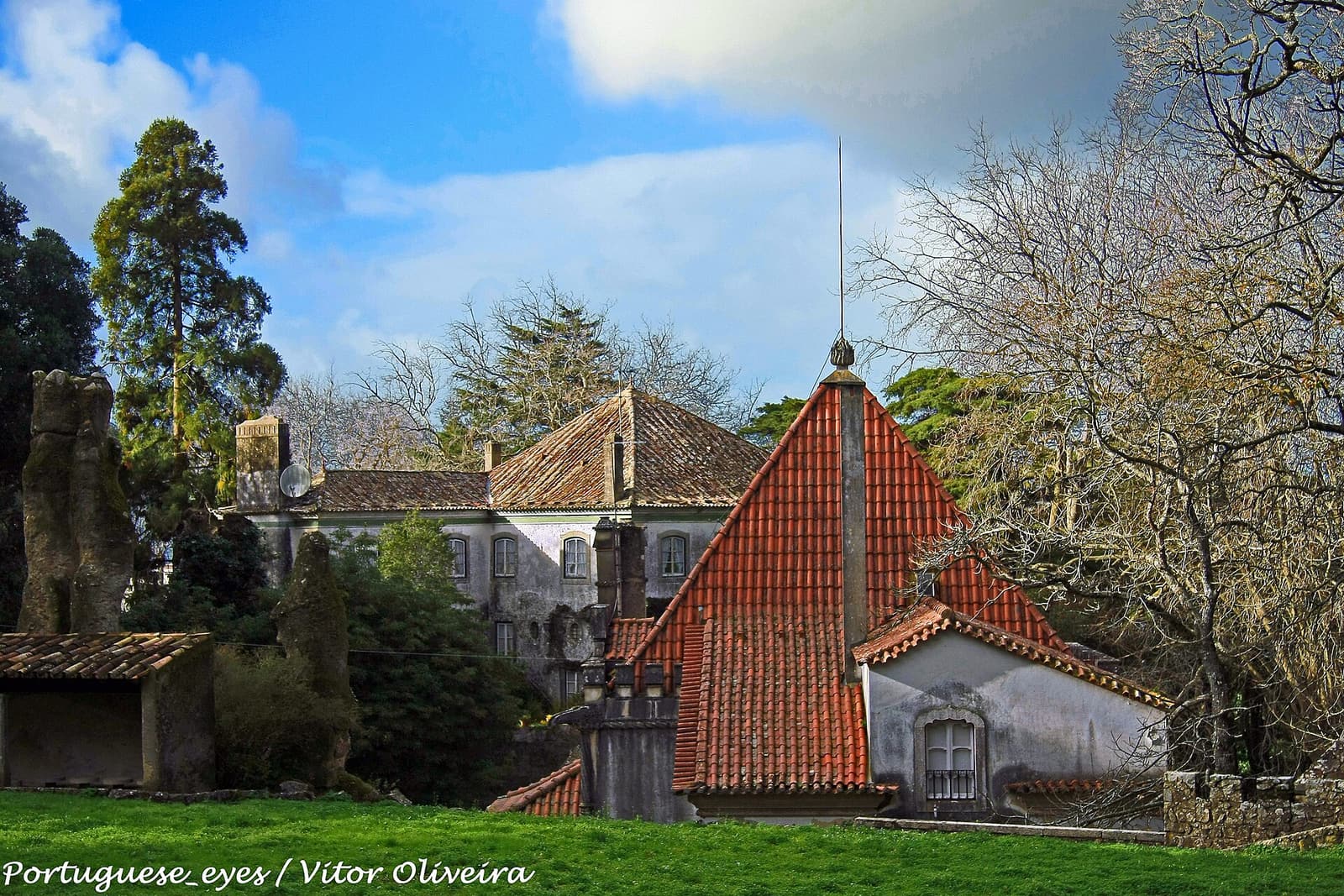
The Quinta da Penha Verde, on the northern slope of the Sintra mountains, was created by D. João de Castro, Viceroy of India, as a pleasure estate and place of retreat. It has been a National Monument since 1953 and remains private property. This text draws on what is known of its garden of chapels, fountains and inscriptions from official records and a historic gardens inventory, not from a visit.
A viceroy’s estate
According to the record of the Património Cultural, the lands of Penha Verde and the neighbouring Quinta dos Cedros were granted by D. Manuel at the beginning of the sixteenth century to D. João de Castro, who decided to make a pleasure estate there. SIPA adds that he had the fruit trees uprooted and let the vegetation grow, determining that the estate should never be productive. The original small palace dates from around 1534.
In 1542 he commissioned the chapel of Nossa Senhora do Monte, of circular plan. An inscription over the door, transcribed by SIPA, states that he dedicated it to the Virgin in fulfilment of a vow, and the jambs bear the dates 1542 and 1543. The record attributes the tempietto to Francisco de Holanda; the historic gardens inventory refers to a design by Miguel Arruda, and SIPA lists both as attributions. In 1543 D. João III granted him the hill of Alvíssaras, later called Alto de Santa Catarina. D. João de Castro died in India in 1548.
Chapels, fountains and stones from India
Between 1638 and 1651, his grandson D. Francisco de Castro, Inquisitor-General, enlarged the small palace and had chapels built: that of Santa Catarina, at the highest point (inscriptions of 1638 and 1641), that of São João Baptista, lined with azulejo panels depicting the saint’s life, and that of São Brás, integrated into the house. The record places the current entrance in this period, with a Mannerist portal and the arms of the Castro family. The formal gardens preceding the house are from the eighteenth century.
The rest lies in the woodland. The fountains of Neptune, of the Azulejos and of the Little Birds (this one with azulejos dated 1651) punctuate the paths, and SIPA notes two slabs with inscriptions in Sanskrit along the route to the chapel. The inventory of the Portuguese Association of Historic Gardens reads in them the memories of D. João de Castro’s time in India and considers the estate one of the most notable gardens in the country, but that assessment belongs to the inventory, not the official record.
Classification
The Quinta da Penha Verde is a National Monument under Decree No. 39 175, published in the Diário do Governo, 1st series, No. 77, of 17 April 1953. The record indicates that it lies within the protection zone of the Palácio de Seteais and the Cultural Landscape of Sintra, inscribed on the World Heritage List; we have not verified this membership in UNESCO documents. For context, see Sintra, historic gardens and pleasure estates.
Ownership and access
SIPA records the property as private, held by a legal entity, and summarises its succession: leased in 1873 to Sir Francis Cook, sold in 1913 to the 2nd Viscount of Monserrate, in 1940 to the Sociedade da Quinta da Penha Verde, Lda., of the Rau family, and acquired in 1991 by two English companies. Restoration of the gardens began in 1992, under the coordination of the landscape architect Gerald Luckhurst. The current owner has not been identified.
As of consultation on 5 November 2026, we found no official body or operator announcing visits, and the estate is not listed as managed by Parques de Sintra. The historic gardens inventory, consulted in 2014 and 2020, classifies it as residential and not visitable. Those wishing to see other estates on the same slope may continue to the Palácio de Seteais, the Quinta da Regaleira or the Palácio de Monserrate; please confirm visiting conditions with each operator.
Frequently asked questions
- Who founded the Quinta da Penha Verde?
- D. João de Castro, Viceroy of India, to whom D. Manuel I granted the land in the first decades of the sixteenth century. He had a simple small palace built around 1534 and the chapel of Nossa Senhora do Monte in 1542, according to the record of the Património Cultural.
- Is it classified?
- Yes, as a National Monument, by Decree No. 39 175, published in the Diário do Governo, 1st series, No. 77, of 17 April 1953. The record indicates that it is covered by the Cultural Landscape of Sintra, inscribed on the World Heritage List.
- Can it be visited?
- No public access has been confirmed. The estate is private property: the SIPA record lists it as owned by a legal entity, and the inventory of the Portuguese Association of Historic Gardens, consulted in 2014 and 2020, classifies it as not visitable.
- Who manages the estate?
- It is not listed as managed by Parques de Sintra. It is private property, and the current owner has not been identified in the sources consulted.
Sources
- Património Cultural, I.P. — Quinta da Penha Verde (registo 70450), cópia arquivada de 2018
- SIPA — Quinta da Penha Verde / Quinta da Fonte de El-Rei (IPA.00022684), cópia arquivada
- Património Cultural, I.P. — Atlas do Património Classificado: Quinta da Penha Verde (NINV 3440)
- Diário do Governo — Decreto n.º 39 175, de 17 de abril de 1953
- Associação Portuguesa dos Jardins Históricos — Quinta da Penha Verde (inventário)
- Wikidata — Solar da Quinta da Penha Verde (Q66814435)
Keep exploring
Heritage nearby
More places to discover from here. Approximate straight-line distances, within 50 km.