Monuments
National Rope Factory (Cordoaria Nacional), Lisbon
Belém's Cordoaria Nacional is an 18th-century Navy rope factory and National Monument since 1996, with a municipal gallery in the Torreão Nascente.
- Location
- Lisboa, Lisboa
- Built
- Segunda metade do século XVIII
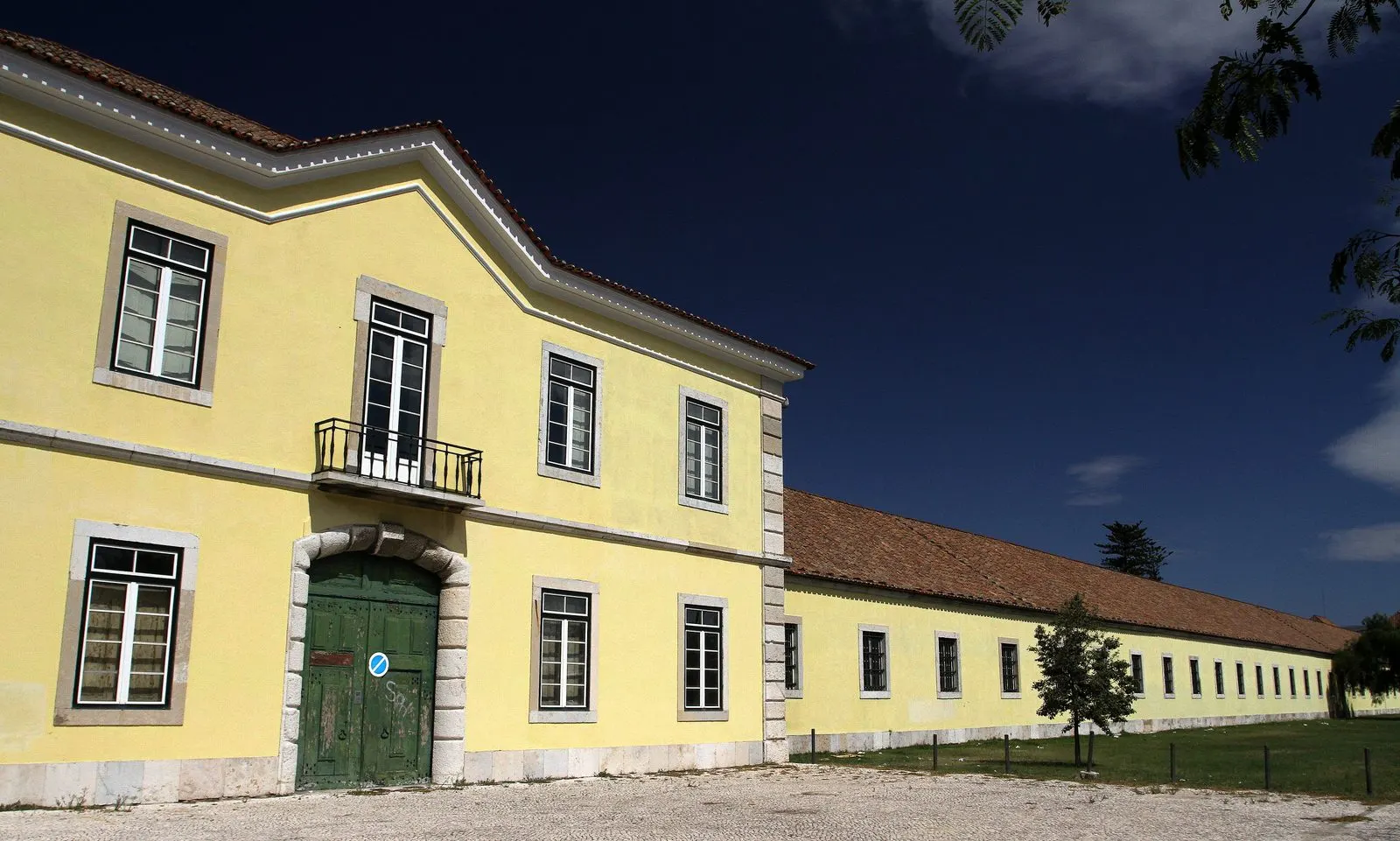
The Fábrica Nacional da Cordoaria, also called the Cordoaria Nacional, Real Fábrica da Cordoaria da Junqueira or Real Cordoaria da Junqueira, is a very long factory building parallel to the Tagus river, between Rua da Junqueira and Avenida da Índia, in Belém, Lisbon. It was designed to produce the cordage, sails and flags on which Navy ships depended. It ceased to be a factory in 1992 and today functions in part as an art gallery. It forms part of the capital’s eighteenth-century industrial heritage.
A factory for the Navy
The national heritage register of the Património Cultural, I.P. notes that construction was ordered by decree of the Marquês de Pombal, with a probable design by the architect Reinaldo Manuel dos Santos, and dates from the second half of the 18th century. The attribution to the architect is presented as probable, not documented. For the context of the period, see the Pombaline style.
The Navy’s Cultural Directorate recalls that, after the earthquake of 1 November 1755, Pombal ordered a rope-making workshop to be set up in the new premises of the Royal Naval Arsenal. In July 1775, decrees appointed António Baptista de Sá as master ropemaker, with responsibility for the Junqueira ropeworks. The Navy itself interprets this as a sign that the Junqueira factory was operating around 1775, and states that the workshop of the south wing, the Cocha, was completed in 1778.
The Galerias Municipais de Lisboa place the work on land next to the Forte de São João da Junqueira. They describe a modular plan, with the rope-making workshop in the long central body and areas for dyeing, spinning, rigging, tailoring, weaving and flag production, as well as carpentry, metalwork and administration.
The building
According to the Navy, the complex consists of two parallel wings, each 353.3 metres long and 12.27 metres wide, separated by a courtyard along their full length. Three towers link the wings, at the ends and in the centre. The south wing housed the Cocha workshop, where ropes were twisted for ships’ rigging; the north wing served silk and linen spinning. Work was manual or carried out with hand-operated machines, and the factory employed blind people, disabled veterans and prisoners.
The register describes an architecture marked by decorative restraint. It highlights, on the north façade of the central body, a stone portal with an apron window and curved lintel and, on the south façade, another portal with a segmental arch lintel. The building underwent several campaigns of works, prompted by the fires of 1826, 1881 and 1949, by its adaptation to services unrelated to its original function, and by changes to the surrounding road network.
Part of the building had other uses. The Galerias Municipais indicate that, in 1902, the School of Tropical Medicine was installed there, renamed the Institute of Tropical Medicine in 1937. Between 1924 and 1969, the Navy notes, the factory was directed by naval construction engineers. On 30 October 1992, according to the Navy, the Government ordered the abolition of the Cordoaria Nacional.
Classification
The building is classified as a National Monument by Decree No. 2/96, published in the Diário da República, I Série-B, No. 56, on 6 March 1996, under the designation «Edifício da Fábrica Nacional da Cordoaria». The process was opened by order of 31 October 1989 of the then president of the IPPC; it was followed by the opinion of the Advisory Council of 8 November 1990 and approval on 8 April 1991. The register does not associate it with any World Heritage property. It stands near the Jerónimos Monastery, the Tower of Belém and the Padrão dos Descobrimentos, which have their own statuses.
Planning a visit
The Torreão Nascente, with about 1,250 m² of exhibition space, came into being in 1995 through a protocol between the Navy and the Lisbon City Council. The Galerias Municipais have organised exhibitions there since 2003. When consulted on 5 November 2026, EGEAC listed opening hours of 10:00 to 13:00 and 14:00 to 18:00, with closure on Mondays and on 1 January, 1 May, 25 and 31 December. Please confirm the programme, prices and access conditions on the websites of the Galerias Municipais and EGEAC.
The Navy also advertises the Cocha wing as a space available for events, which shows that not all of the building has regular public use. The façade and the length of the wing are clearly visible from Avenida da Índia and Rua da Junqueira.
Photograph by Joaomartinho63, dated 18 September 2011. Original on Wikimedia Commons, under CC BY-SA 3.0; resized and compressed for the web, without altering the composition.
Frequently asked questions
- When was the Cordoaria Nacional built?
- The national heritage register places its construction in the second half of the 18th century, on the orders of the Marquês de Pombal. The Navy's Cultural Directorate states that the workshop of the south wing, the Cocha, was completed in 1778.
- Is the Cordoaria Nacional a listed monument?
- Yes. It was classified as a National Monument by Decree No. 2/96, published in the Diário da República on 6 March 1996.
- What is the building used for today?
- The Torreão Nascente houses a gallery of the Galerias Municipais de Lisboa, created in 1995 under a protocol between the Navy and the Lisbon City Council. The Navy states that the factory was abolished by the Government on 30 October 1992.
- Can I visit the Cordoaria Nacional?
- The Torreão Nascente operates as a gallery of the Galerias Municipais. When consulted on 5 November 2026, EGEAC listed opening hours of 10:00 to 13:00 and 14:00 to 18:00, with closure on Mondays. Please confirm on the official website.
Sources
- Património Cultural, I.P. — Edifício da Fábrica Nacional da Cordoaria (70634)
- Património Cultural, I.P. — Atlas do Património Classificado, registo NINV 4770
- Diário da República — Decreto n.º 2/96, I Série-B, n.º 56, de 06-03-1996
- Direção Cultural da Marinha — National Rope Factory, “Cocha” Wing
- Galerias Municipais de Lisboa — Torreão Nascente da Cordoaria Nacional
- EGEAC — Torreão Nascente da Cordoaria Nacional
- Wikidata — Cordoaria Nacional (Q10260557)
Keep exploring
Heritage nearby
More places to discover from here. Approximate straight-line distances, within 50 km.