Monuments
Padrão dos Descobrimentos
Padrão dos Descobrimentos, in Belém: monument from 1940 rebuilt in 1960, Wind Rose, classification in progress, critical views and practical information.
- Location
- Lisboa, Lisboa
- Built
- 1940 (versão efémera); 1960 (versão permanente)
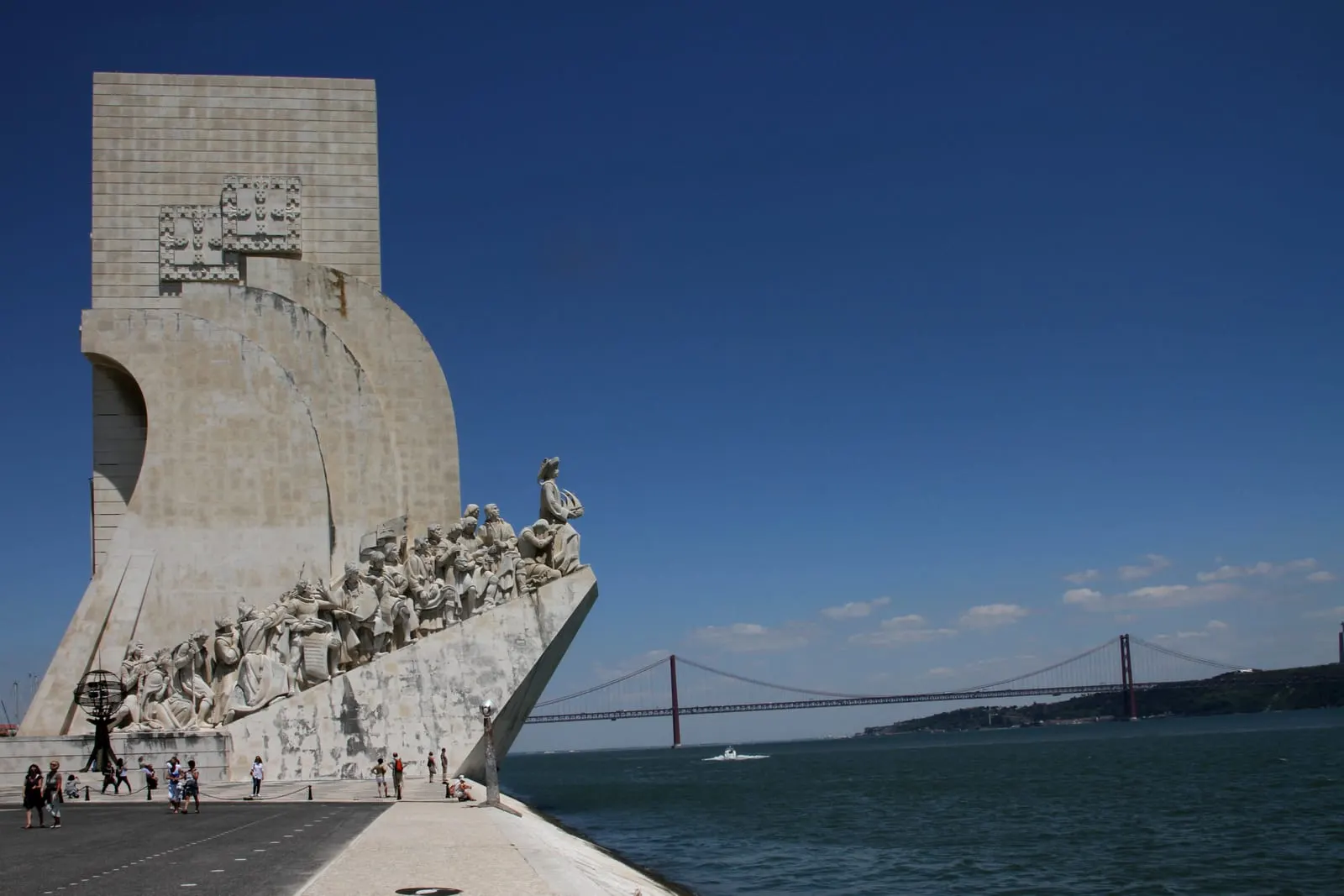
The Padrão dos Descobrimentos rises on the bank of the Tagus, in Belém, near the Jerónimos Monastery and the Tower of Belém. It is a stone prow with Infante D. Henrique at the front and figures of the Portuguese expansion lined up behind him. It is a twentieth-century monument dedicated to the fifteenth century. The managing body itself notes that it was built, and rebuilt in 1960, during the Estado Novo.
From a 1940 set piece to a 1960 monument
The monument’s management attributes the design to the architect Cottinelli Telmo (1897–1948) and the sculptor Leopoldo de Almeida (1898–1975). The first version was erected in 1940, in an ephemeral form, for the Exhibition of the Portuguese World. It had a light iron and cement structure, and the sculptures were modelled in estafe, a mixture of plaster and tow over an armature.
The context of that exhibition and of the regime’s official art is discussed in architecture and art of the Estado Novo. The monument’s website reproduces a text by Leitão de Barros, published in 1960 in the magazine Turismo, about the genesis of the form. According to that account, after seeing the exhibition plan in Cottinelli Telmo’s studio, Leitão de Barros told Minister Duarte Pacheco that it lacked a starting point. The minister sent him back to the studio that same night; Telmo sketched the profile of the Padrão and Leopoldo de Almeida was called in to give it volume.
In 1960, for the commemorations of the 500th anniversary of the death of Infante D. Henrique, the Padrão was rebuilt in concrete and dressed stone of pedra rosal from Leiria. The sculptures were made of limestone from Sintra. In 1985 it opened as the Centro Cultural das Descobertas, with an interior remodelled by the architect Fernando Ramalho: a viewing platform, an auditorium and exhibition rooms.
Reading the monument
The composition represents a stylised caravel. The Infante, 9 metres tall, stands at the prow; behind him follow 32 figures of navigators, cartographers, warriors, evangelisers, chroniclers and artists, each 7 metres tall. The management gives the dimensions as 56 metres high, 20 metres wide and 46 metres long.
On the north face, two inscriptions in metal letters dedicate the monument to the Infante and to the Portuguese who discovered the sea routes, and mark the Henrician quincentenary (1460–1960). Two metal armillary spheres on plinths flank the monument.
In the square, the Wind Rose is about 50 metres in diameter and made of lioz limestone in black and red. A planisphere 14 metres wide marks dates, naus and caravels of the expansion routes in the fifteenth and sixteenth centuries. The management notes that some names and dates are today debated by historians. It was designed in the studio of Luís Cristino da Silva and inaugurated on 5 August 1960. An inscription on the south end commemorates the gift of the Union of South Africa, in 1960, and another records the 1994 restoration. The wave pattern of “open sea” links it to the tradition of the Portuguese pavement.
A contested monument
The Padrão is also a site of debate about colonial memory. In September 2021, the Diário de Notícias described it as associated with the aesthetics of the Estado Novo’s Discoveries and considered by many to be a celebration of Portuguese colonialism. The newspaper recalled that the Socialist deputy Ascenso Simões had argued, in an article published in Público in February 2021, that the Padrão, “in a respectable country, should have been destroyed”. For the deputy, the monument represented myths constructed by Salazarism. The same newspaper heard from Paulo Ferrero, of the association Fórum Cidadania Lx, who considered it obvious that it was a monument. The association requested its classification in February 2021.
The managing body itself places this debate within its mission. It proposes to promote discussion of the monument’s theme and of the patrons who, on the political, cultural and artistic planes, made it possible. In the consultation of 5 November 2026, the exhibition PADRÃO. Casa-Obsessão, on view until 30 December 2026, presented representations of the monument since 1940. According to the presentation, the accumulated readings are some more critical than others. For comparison with other cases, see the commemorative monuments in Portugal.
Protection status
The classification procedure was opened by dispatch of 9 May 2023, published as Notice No. 130/2023, of 28 June. Since then, the Padrão and the surrounding paved area with the Wind Rose have been in the process of classification, with a general protection zone of 50 metres. Notice No. 368/2025, of 4 December 2025, published the draft decision to classify them as a monument of public interest and opened a public consultation.
In the consultation of 5 November 2026, the national register still listed the property as in the process of classification, with no final classification decree recorded. The register also places it within the protection zones of the Belém Monastery and the building of the Museum of Popular Art. The Padrão is not part of the World Heritage property formed by the Jerónimos Monastery and the Tower of Belém.
Planning the visit
The building is owned by the Lisbon City Council and managed by EGEAC, a municipal company. In the consultation of 5 November 2026, the published opening hours were 10:00 to 18:00 from October to February, and 10:00 to 19:00 from March to September. The last entry was half an hour before closing. It closed on 1 January, 1 May and 24, 25 and 31 December.
The ticket for the viewing platform, exhibition and film cost €10.00, and the ticket for the exhibition alone €5.00. There were reductions and exemptions, including free entry for residents of the municipality of Lisbon on Sundays and public holidays until 14:00. The viewing platform is not accessible to wheelchair users: the lift goes up to the 6th floor, followed by a narrow staircase of 42 steps. Please confirm these conditions on the official page before going.
Photograph by Gerd Eichmann, of 3 June 2011. Original on Wikimedia Commons, under CC BY-SA 4.0; resized and compressed for the web, without altering the composition.
Frequently asked questions
- Who designed the Padrão dos Descobrimentos?
- The architect Cottinelli Telmo and the sculptor Leopoldo de Almeida. The first version, which was ephemeral, was built for the Exhibition of the Portuguese World in 1940.
- Why was it rebuilt in 1960?
- For the commemorations of the 500th anniversary of the death of Infante D. Henrique. The 1960 version was made of concrete and dressed stone, with the sculptures in limestone from Sintra.
- Is the Padrão dos Descobrimentos classified?
- In the consultation of 5 November 2026, the national register listed it as being in the process of classification. Notice No. 368/2025 published the draft decision to classify it as a monument of public interest, together with the paved area and the Wind Rose.
- Who gifted the Wind Rose?
- According to the Padrão dos Descobrimentos, it was designed in the studio of Luís Cristino da Silva and inaugurated on 5 August 1960. An inscription on the south end commemorates the gift of the Union of South Africa.
Sources
- Padrão dos Descobrimentos (EGEAC) — O monumento
- Padrão dos Descobrimentos (EGEAC) — Rosa dos Ventos
- Padrão dos Descobrimentos (EGEAC) — Missão
- Padrão dos Descobrimentos (EGEAC) — Contactos e horários
- Padrão dos Descobrimentos (EGEAC) — Bilheteira
- Padrão dos Descobrimentos (EGEAC) — Acessibilidade
- Padrão dos Descobrimentos (EGEAC) — Exposição PADRÃO. Casa-Obsessão
- Património Cultural, I.P. — Padrão dos Descobrimentos e calçada envolvente que inclui a Rosa-dos-Ventos
- Diário da República — Anúncio n.º 130/2023, 2.ª série, n.º 124, de 28-06-2023
- Diário da República — Anúncio n.º 368/2025, 2.ª série, n.º 234, de 04-12-2025
- Diário de Notícias — Padrão dos Descobrimentos não é monumento nacional, nem sequer municipal (08-09-2021)
- Wikidata — Padrão dos Descobrimentos (Q1133712)
Keep exploring
Heritage nearby
More places to discover from here. Approximate straight-line distances, within 50 km.