Monuments
Forte da Ínsua (Ínsua Fort)
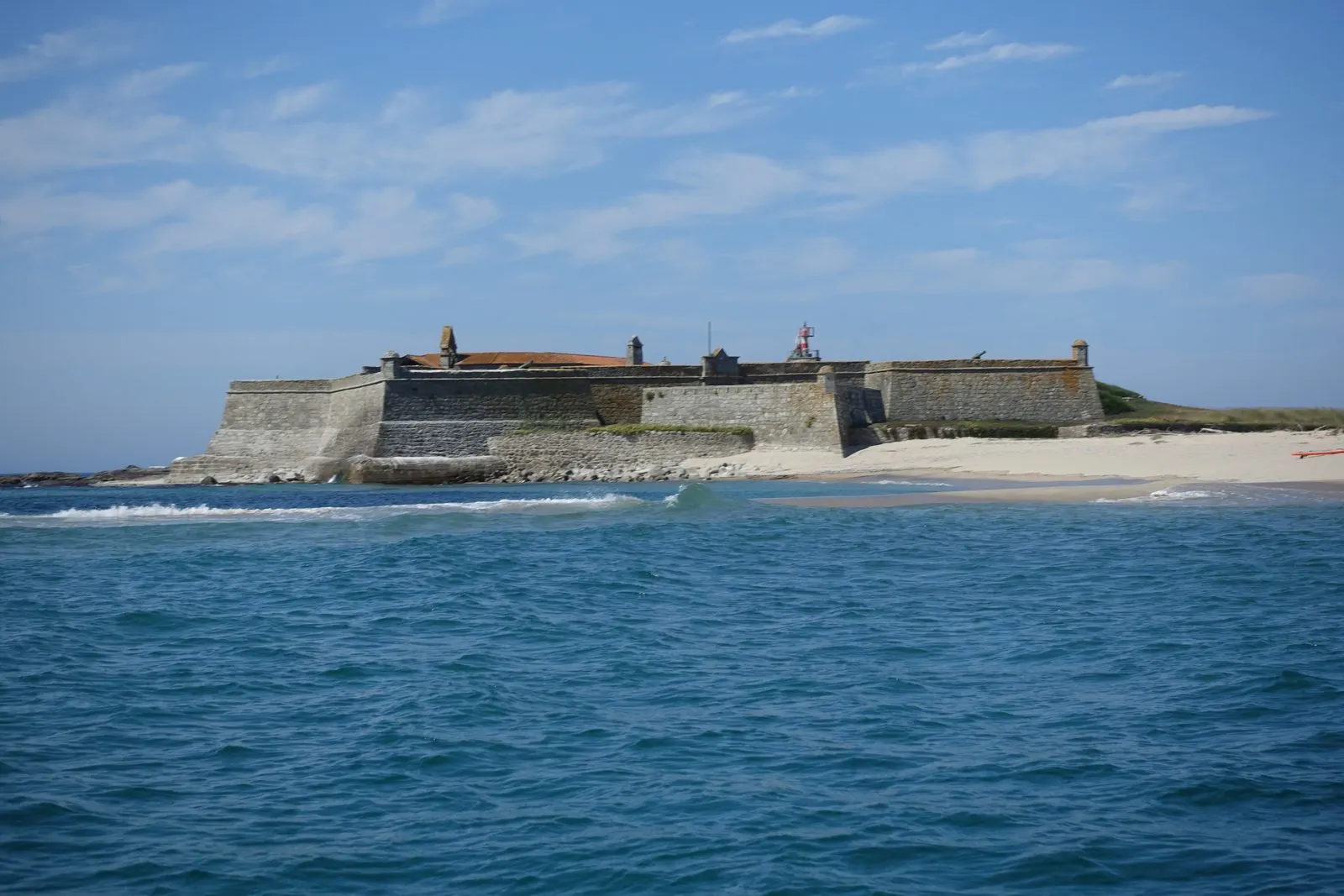
Caminha's Forte da Ínsua: a bastioned fortress (1649–1652) on an islet at the mouth of the Minho, built around a Franciscan convent. National Monument.
- Location
- Moledo, Caminha, Viana do Castelo
- Built
- Convento franciscano de 1392; forte abaluartado construído entre 1649 e 1652
The Ínsua Fort occupies a small rocky islet southwest of the mouth of the Minho river, about 200 metres from the coast, opposite Moledo beach, in the municipality of Caminha. The government designates the islet as Ínsua de Santo Isidro. The national register of Cultural Heritage, I.P. highlights two distinctive features: the fort was built on an islet, and it incorporated within its walls a convent that already existed there. It has been classified as a National Monument since 1910.
A convent before the fort
The occupation of the islet began in the Middle Ages. In 1392, a Franciscan community founded the Convent of Santa Maria there. The convent was expanded and renovated in 1471 and again in 1502, by order of King Manuel I. It is believed that during the 15th and 16th centuries the islet had fortified structures, but nothing of them remains. The government’s 2019 communiqué presents 1392 as the start of construction, by order of King John I, with the convent erected at the same time.
The Restoration fortress
The fort seen today dates from the reign of King John IV. It was designed within the framework of the reform of coastal fortresses during the Restoration Wars and built between 1649 and 1652. According to the national register, it marked the beginning of the defensive line then laid out along the Portuguese Atlantic coast. It crossed fire with the fortress of Caminha and was the first defence of the kingdom’s northwest frontier. It was also the first line of fire of the system of interior fortifications established along the banks of the Minho river. The principles of this type of fortification are explained in bastioned forts and coastal forts.
The fort kept the convent and the friars who lived in it, and they took part in the construction. The convent was again extended and improved in 1676, 1717, 1767 and 1795.
What the fort is like
The national register describes a bastioned fortress with an irregular star-shaped plan:
- two polygonal bastions, to the north and west, and two half-bastions, between south and east, joined by a central tenaille, all linked by flat-profiled curtain walls;
- sentry boxes with faceted bodies and spherical-cap roofs at the corners of the bastions, and a rectangular balcony on corbels on one of the wall curtains;
- an arms square divided into two parts. In one, paved, were the barracks, the storehouse and the kitchen. In the other stood the convent, of sober architecture, with a single-nave church and sacristy, a quadrangular Ionic cloister and conventual outbuildings;
- the gate of arms, on the east front, facing the land. It has a full round arch and a triangular pediment with three coats of arms: those of Portugal and those of the Governor of the Province of Minho. Beside it, a stone plaque commemorates the construction. There is also a secondary door in the bastion on the eastern front.
The fort also has a freshwater well in the middle of the sea. According to the national register, it is one of only three such wells in the world.
From the 19th century to REVIVE
The 19th century was a difficult one. In 1807, during the first French Invasion, the fort was occupied by Spanish troops. In 1834, with the dissolution of the religious orders, the Franciscans had to leave the convent. From then on the Ínsua was occupied only by the Army, which installed a lighthouse in 1886. The lighthouse operated until the 1970s (on coastal signalling, see lighthouses). The last governor of the fortress was appointed in 1909.
After 1979, local and national authorities repeatedly recorded the abandonment and ruin of the fort. In 2016 it was included in the REVIVE programme, which grants concessions of vacant public properties for tourist use. On 8 August 2019, the government launched the public tender for its concession, for 50 years, for tourist exploitation. We found no official source indicating the current state of the concession or of the works.
Classification and protection
The Ínsua Fort is a National Monument under the Decree of 16 June 1910, published in the Diário do Governo no. 136, of 23 June 1910. The decree includes it in the list of castles of the district of Viana as “Caminha — Forte da Insua”. The Atlas of Classified Heritage does not indicate a special protection zone of its own. It is not part of any UNESCO listing.
Preparing the visit
The fort stands on an islet and, according to the government, access is by boat. When consulted on 5 November 2026, we found no opening hours, tickets or visiting conditions published by an official source. It is clearly visible from Moledo beach and from the coast near the mouth of the Minho. Before planning a crossing, enquire with the Caminha Municipal Council.
Your visit can continue in the historic centre of Caminha and, upriver, at the fortified town of Valença. For other fortifications, consult the castles of Portugal and the Norte region.
Photograph by Joseolgon, dated 18 August 2021. Original on Wikimedia Commons, under CC BY-SA 4.0; resized and compressed for the web, without altering the composition.
Frequently asked questions
- Where is Ínsua Fort?
- On a small rocky islet southwest of the mouth of the Minho river, about 200 metres from the coast, opposite Moledo beach, in the municipality of Caminha. The government designates the islet as Ínsua de Santo Isidro and states that it is accessible by boat.
- When was it built?
- The present fort was built between 1649 and 1652, during the reign of King John IV, during the Restoration Wars. A Franciscan convent had already stood on the islet since 1392, and it was enclosed within the walls.
- Can it be visited?
- When consulted on 5 November 2026, we found no officially published opening hours or visiting conditions. In 2016 the fort was included in the REVIVE programme, which grants concessions of public properties for tourist use, and the concession tender was launched in 2019.
- Is Ínsua Fort classified?
- Yes. It is a National Monument under the Decree of 16 June 1910, published in the Diário do Governo (Official Gazette) no. 136, of 23 June 1910.
Sources
- Património Cultural, I.P. — Forte da Ínsua (70476)
- Património Cultural, I.P. — Atlas do Património Classificado, Forte da Ínsua (NINV 4105)
- Diário do Governo — Decreto de 16 de junho de 1910 (n.º 136, 23-06-1910)
- XXI Governo Constitucional — Lançado concurso Revive do Forte da Ínsua, em Caminha (8 de agosto de 2019)
- Wikidata — Forte da Ínsua (Q10283763)
Keep exploring
Heritage nearby
More places to discover from here. Approximate straight-line distances, within 50 km.