Monuments
Church of Saint Anthony of Lisbon
Visit Igreja de Santo António de Lisboa near the Sé, traditional site of the saint's birth, with post-earthquake work by Mateus Vicente and Pedro Alexandrino.
- Location
- Lisboa, Lisboa
- Built
- fundação medieval; igreja atual 1767–1787
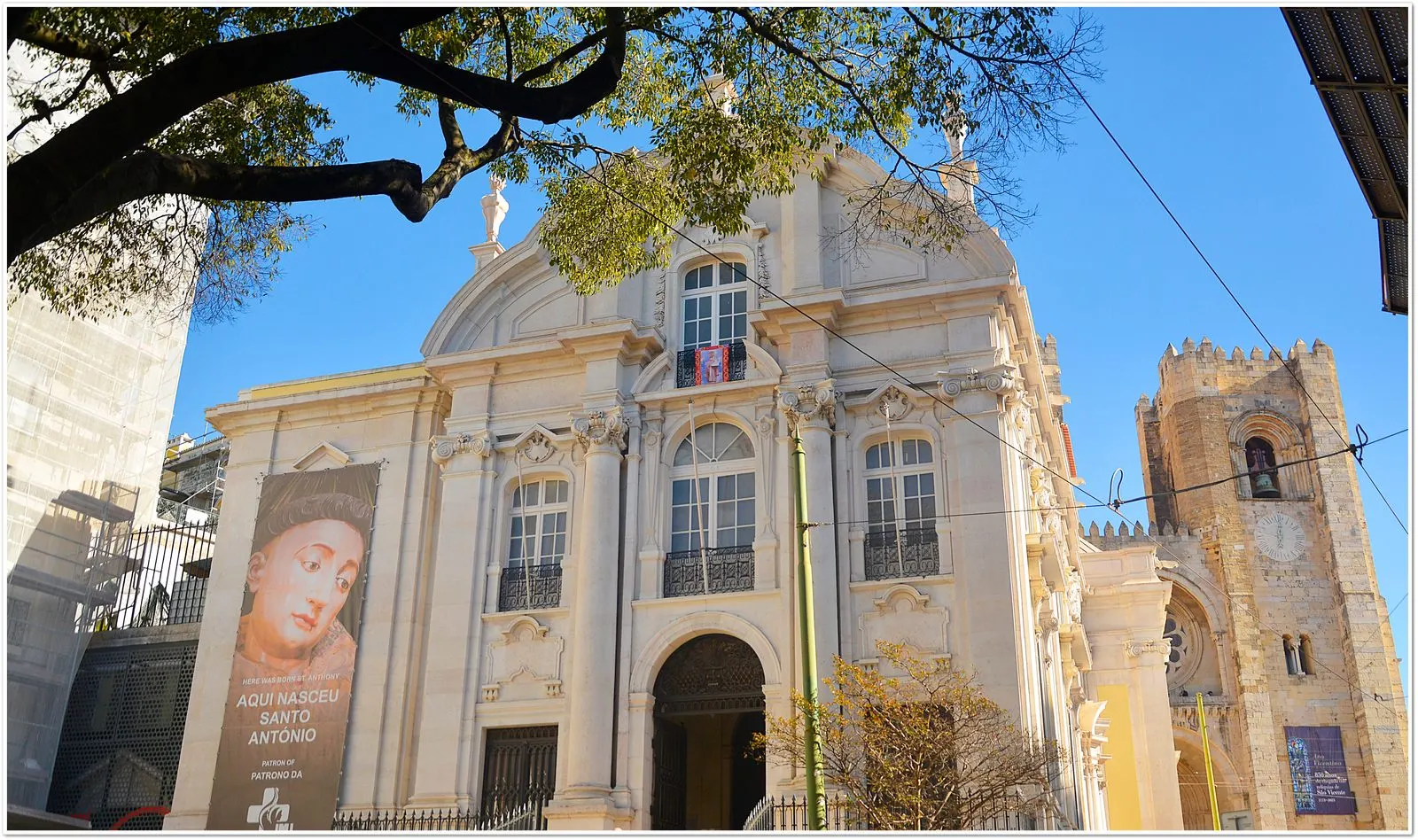
The Church of Saint Anthony of Lisbon, also called the Church of Saint Anthony at the Sé, stands in the square of the same name, adjoining the Lisbon Cathedral. It is the Lisbon sanctuary of the city’s most popular saint: tradition places the house where Fernando de Bulhões, who would become Saint Anthony, was born on this site, and it is one of the places of devotion associated with the Saint Anthony festivities. The building seen today, however, is a late eighteenth-century construction, built after the 1755 earthquake.
The birthplace
According to Turismo de Lisboa, it is believed that the church was built on the site of the saint’s birth, where a chapel commissioned by King João II had already stood, and that the saint’s image survived the earthquake. The national heritage register summarises the earlier history as a medieval foundation with a Manueline campaign, before the present building. This is a tradition of place, upheld by the city and the Church, and not a fact proven by documents: it should be read as such.
Next door, the Museu de Lisboa – Santo António occupies an adjoining space and is devoted to the life and cult of the saint, according to Turismo de Lisboa. Press and guidebooks also mention an underground crypt that tradition associates with the floor of the birthplace; we have found no description of this crypt in an official source, so we do not treat it here as a confirmed fact.
The post-earthquake reconstruction
The earthquake of 1755 destroyed the earlier church. The national register dates the present building to 1767–1787 and attributes the design to Mateus Vicente de Oliveira. The result, the register notes, combines disparate elements: the portal still belongs to the Joanine Baroque, and the cartouche on the south façade is Rococo. The church has a single nave, covered by a barrel vault, and makes abundant use of marble. For the general context, see Baroque architecture in Portugal.
What to see inside
The national register highlights three ensembles. The first is the pictorial richness of the chapels, conceived by Pedro Alexandrino. The second is the sacristy tile scheme, from the second half of the eighteenth century, of interest to anyone following the azulejo. The third is the neo-Medieval ironwork grilles by the architect Vasco Regaleira, which imitate the famous grille of Lisbon Cathedral.
Turismo de Lisboa also mentions the underground corridor lined with azulejos and the paintings by Pedro Alexandrino in the nave as elements that survived the earthquake. These two indications come from a promotional text and do not fully match the dating in the national register, so the question of what predates 1755 is not reliably answered in this text.
Classification and protection
The church and the sacristy were classified as a National Monument by Decree No. 19 484 of 24 February 1931, published in the Diário do Governo No. 64 (1st series) of 18 March 1931. The text of the decree declares as a national monument “the church of Saint Anthony of Lisbon and the sacristy, with the decoration that adorns them: metalwork, straw-stuffed woodwork and altarpieces, almost entirely by Pedro Alexandrino”. The special protection zone was established by an ordinance published in the Diário do Governo, 2nd series, No. 213, of 11 September 1961, covering the Cathedral, other buildings in the nucleus and the church itself. The national register also notes the building’s links to Pombaline Lisbon; it is not a World Heritage Site.
Planning the visit
The church is on Largo de Santo António da Sé, in Santa Maria Maior, a short walk from the Cathedral and the route to São Jorge Castle. In our consultation of 5 November 2026 we found no current visiting hours in an official source, and secondary sources disagree; Turismo de Lisboa lists the Museu de Lisboa as a contact (218 860 447; [email protected]). The church is an active place of worship, especially busy in June, so please respect ceremonies and confirm access before going.
To continue, see the Lisbon Cathedral, the city of Lisbon and the Church of São Roque, another major Lisbon church with a strong presence of gilded woodcarving and azulejos.
Photograph by Miguel Ángel García, dated 21 November 2023. Original on Wikimedia Commons, under CC BY 2.0; resized and compressed for the web, without altering the composition.
Frequently asked questions
- Was Saint Anthony really born in this church?
- The church was built on the site that tradition identifies as the house where Saint Anthony was born, around 1195. It is a tradition of place, maintained for centuries; the sources we consulted describe it as belief and do not provide documentary proof of the exact location.
- When was the present church built?
- According to the national heritage register, the medieval church, with a Manueline campaign, gave way to a post-earthquake building erected between 1767 and 1787, to a design by Mateus Vicente de Oliveira.
- What is its classification?
- National Monument, under Decree No. 19 484 of 24 February 1931, published in the Diário do Governo No. 64 of 18 March 1931. The decree covers the church and the sacristy, together with their decoration, which is almost entirely the work of Pedro Alexandrino.
- What are the visiting hours?
- In our consultation of 5 November 2026 we found no hours in a current official source; secondary sources disagree. Please confirm with the church, the Museu de Lisboa ([email protected], 218 860 447) or Turismo de Lisboa.
Sources
- Património Cultural, I.P. — Igreja de Santo António de Lisboa e sacristia (70503)
- Património Cultural, I.P. — Atlas do Património Classificado e em Vias de Classificação (NINV 3291)
- Diário do Governo — Decreto n.º 19 484, de 24 de fevereiro de 1931 (DG n.º 64, 18-03-1931)
- Turismo de Lisboa — Igreja de Santo António
- Museu de Lisboa — Santo António (núcleo)
- Wikidata — Igreja de Santo António de Lisboa (Q2976487)
Keep exploring
Heritage nearby
More places to discover from here. Approximate straight-line distances, within 50 km.