Monuments
Church of Carmo and Chapel of Bones (Faro)
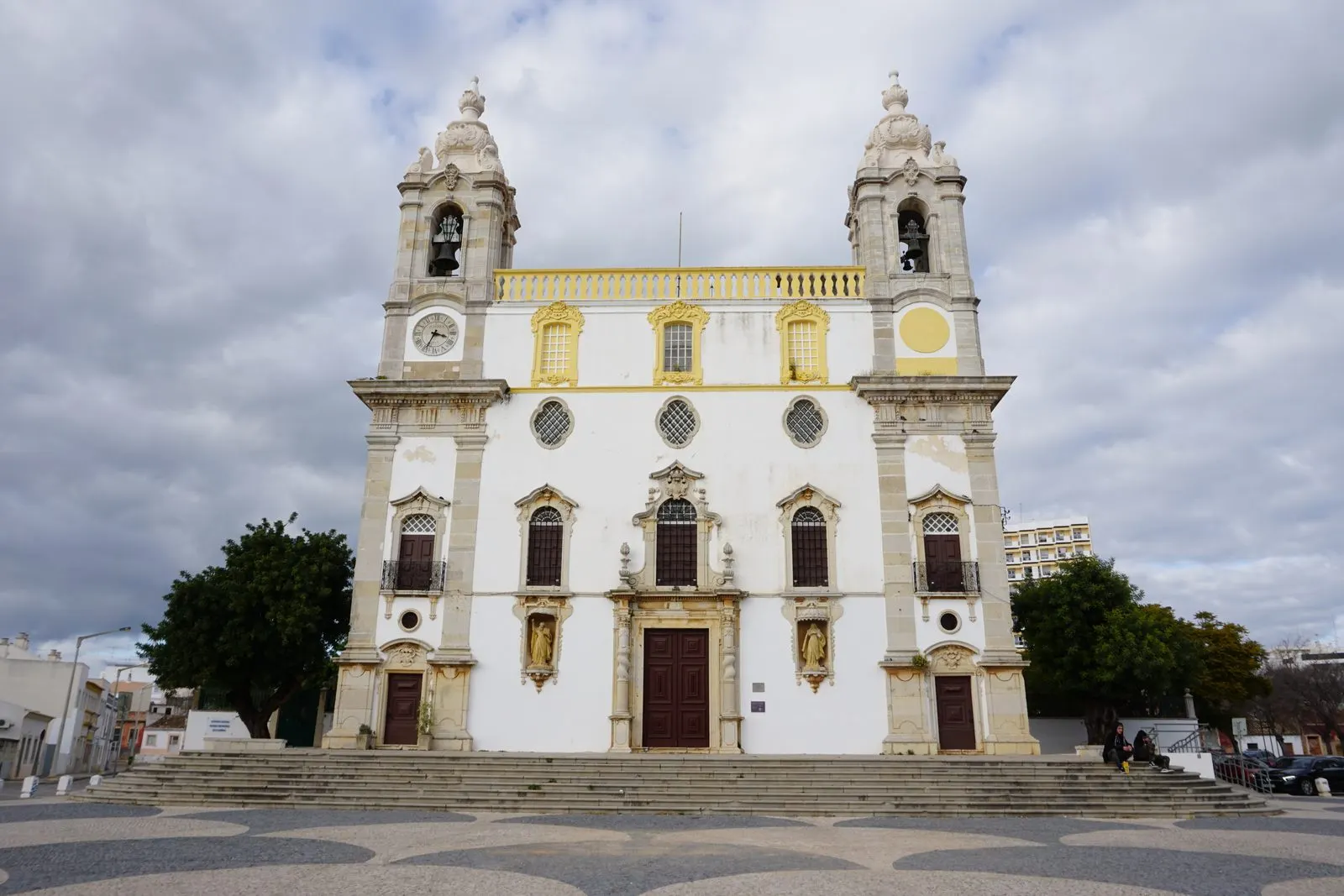
Church of Carmo in Faro: a Baroque temple of the Third Order begun in 1713, a Joanine façade, woodwork by Manuel Martins and the Chapel of Bones of 1816.
- Location
- Faro, Faro
- Built
- 1713–1878 (fachada a partir de 1747; Capela dos Ossos, 1816)
The Church of Carmo dominates the Largo do Carmo, at the northern edge of the old city of Faro, beside the Church of São Pedro and outside the walled nucleus where the Sé stands. The white two-towered façade rises above a staircase. Inside, those whom the national register calls the region’s best eighteenth-century sculptors worked on the decoration. Adjoining the church is the Chapel of Bones, dating from 1816. The temple belongs to the Venerable Third Order of Our Lady of Mount Carmel of Faro, whose brothers — nobility and clergy of the Algarve, according to the National Centre for Culture — financed the successive works.
A church built over a century and a half
The Bishop of the Algarve D. António Pereira da Silva acquired the site, in the former Horta de São Pedro, and laid the first stone in 1713. The design of the original church was by the Carmelite Frei Manuel da Conceição, who came from Lisbon. According to the National Centre for Culture’s record, the bishop’s successor, Cardinal D. José Pereira de Lacerda, solemnly blessed the church in 1719.
From 1747, the initial façade and central body were demolished to make way for a larger building, designed and executed by the master mason from Faro Diogo Tavares. The work dragged on: the top storey was finished in 1755, the upper windows in 1775, the east tower at the start of the nineteenth century, and the west tower only in 1878. This one holds a carillon of nine bells, cast in 1876 by Gregório José da Silva from the bronze of the four original bells.
Joanine façade
The record of the Património Cultural, I.P. describes the frontage as a good example of Baroque architecture, symmetrical, in the style of D. João V — the Joanine Baroque. The wider central bay has a portal flanked by two Corinthian columns with twisted shafts, topped by finials. On each side, niches under canopies hold images of Saint Elijah and Saint Teresa, central figures of the Carmelite tradition. Above, the Carmelite coat of arms crowns an ornate window. A balustrade links the two towers.
Woodwork and statuary
The church has a single nave, a main chapel and four side chapels, decorated with tilework and gilded woodwork. The masters Gaspar Martins, Manuel Martins and Miguel Nobre worked here. According to the National Centre for Culture’s record:
- the high altarpiece, with woodwork by Manuel Martins between 1735 and 1739, is presented as the first and most significant manifestation of the Joanine period in the Algarve;
- the altarpiece of Saint Teresa was commissioned from Manuel Martins in 1741, and that of Saint Vincent Ferrer (now of Saint Joseph), made in imitation of it in 1751 by the workshop’s successors, has an arch described as the first manifestation of Rococo woodwork in the Algarve;
- the vault of the main chapel received perspective painting in 1794;
- the sacristy holds images from the former Procession of the Triumph, depicting the Passion of Christ, attributed to Manuel Martins.
The national register also highlights the decoration of the sacristy and the office room, and the collection of statuary from the Procession of the Triumph.
The Chapel of Bones
Adjoining the church, the Chapel of Bones dates from 1816. The National Centre for Culture’s record states that it was built free of charge by masons who were brothers of the Order, using the bones of a former private cemetery attached to the church, and gives a count of 1,245 skulls.
Like the Chapel of Bones in Évora, which is older, it is a place of meditation on death rather than a simple ossuary. The two should not be confused: the one in Évora belongs to the Franciscan convent, the one in Faro to the Third Order of Carmo.
Classification
The national register classifies the Church of Carmo — also known as the Church of the Third Order of Our Lady of Mount Carmel — as a Property of Public Interest, by Decree No. 95/78, of 12 September 1978. It is neither a National Monument nor part of any UNESCO inscription.
Planning a visit
The church is at Largo do Carmo, 8000-148 Faro. When consulted on 5 November 2026, we found no opening hours or prices published by the Third Order: the site indicated in the National Centre for Culture’s record was not accessible, and that record, updated in 2013, only listed the Sunday Mass at 8:30. To confirm hours and prices before going, use the telephone number 289 824 490 or the address [email protected] given in that record. Avoid visiting during services.
Photograph by Matt Kieffer, dated 10 February 2019. Original on Wikimedia Commons, under CC BY-SA 2.0; resized and compressed for the web, without altering the composition.
Frequently asked questions
- When was the Church of Carmo in Faro built?
- The first stone was laid in 1713 by Bishop D. António Pereira da Silva, and the church was blessed in 1719. From 1747, the master mason Diogo Tavares rebuilt the façade and central body; the west tower was only completed in 1878.
- Where do the bones in the Chapel of Bones come from?
- According to the National Centre for Culture's record, the chapel was built in 1816 by mason brothers of the Third Order using the remains from a former private cemetery attached to the church, with a stated total of 1,245 skulls.
- How does it differ from the Chapel of Bones in Évora?
- They are distinct monuments. The one in Évora belongs to the Church of São Francisco and dates from the 17th century; the one in Faro dates from 1816 and belongs to the Third Order of Carmo church. Both use human bones as a meditation on death.
- Is the church a National Monument?
- No. The national register classifies it as a Property of Public Interest by Decree No. 95/78, of 12 September 1978. It is not part of any UNESCO inscription.
Sources
- Património Cultural, I.P. — Igreja do Carmo (73245)
- Património Cultural, I.P. — Atlas do Património Classificado e em Vias de Classificação (NINV 2830)
- Diário da República — Decreto n.º 95/78, de 12 de setembro
- Centro Nacional de Cultura (e-cultura) — Igreja da Ordem Terceira de Nossa Senhora do Monte do Carmo
- Wikidata — Igreja do Carmo (Q3585514)
Keep exploring
Heritage nearby
More places to discover from here. Approximate straight-line distances, within 50 km.