Monuments
Church of São Cristóvão de Rio Mau
Rio Mau's São Cristóvão church in Vila do Conde: Augustinian monastery, 1151 chevet, Romanesque portal, historiated capitals and 1910 classification.
- Location
- Rio Mau, Vila do Conde, Porto
- Built
- Cabeceira iniciada em 1151 (data inscrita); nave entre finais do séc. XII e inícios do XIII
The Church of São Cristóvão de Rio Mau stands in a rural area of the parish of Rio Mau, in the municipality of Vila do Conde. It is what remains of a monastery of Canons Regular of Saint Augustine and one of the smallest and most studied Romanesque churches of the coastal Minho: the national inventory stresses that its study is «of great importance for understanding the currents of Minho Romanesque and their chronologies». For the general context, see the page on Romanesque architecture in Portugal.
An Augustinian monastery reduced to the church
According to the SIPA inventory, the building was initially used as a male monastery of the Order of Canons Regular of Saint Augustine. The chronology in the record is brief and firm on two points. First, a date inscribed in the chancel, 1151, places the start of construction. Second, in 1443 the monastery of São Cristóvão de Rio Mau was incorporated into that of São Simão da Junqueira, on which the church came to depend: in 1758, the Memórias Paroquiais state that the parish priest was a vicar presented by the prior of that monastery. The conventual buildings have not survived; today only the church continues to serve the community, as a parish church.
The same inventory distinguishes two phases of construction. The apse came first and is the most carefully executed part, with decoration inspired by Galicia, more precisely from Tui (the diocese of Tui). The nave is later, described in the record as completed, poorer and less carefully finished, and is placed between the end of the twelfth and the beginning of the thirteenth century. The construction period given is thus «séc. 12 / 13».
What to see from outside
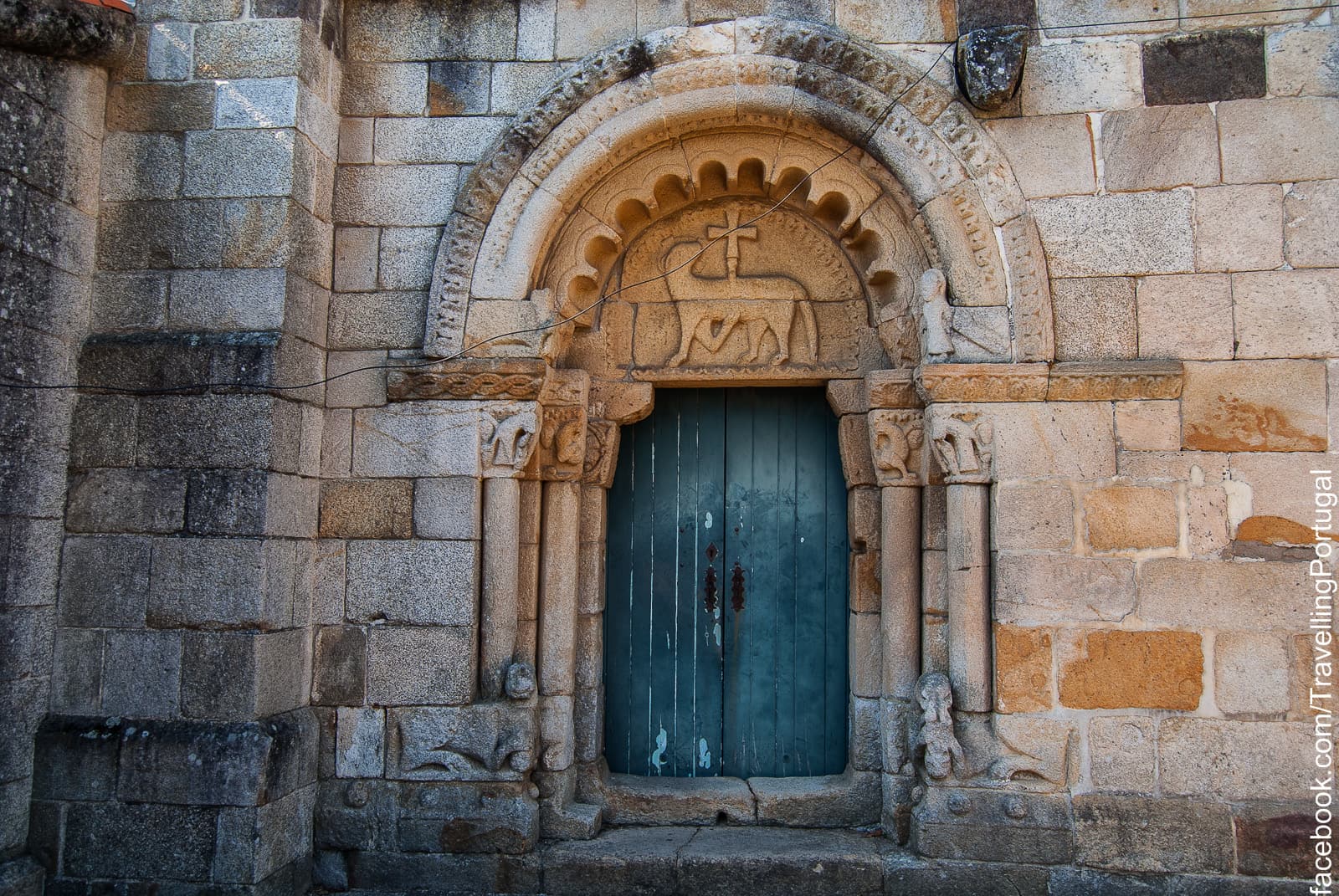
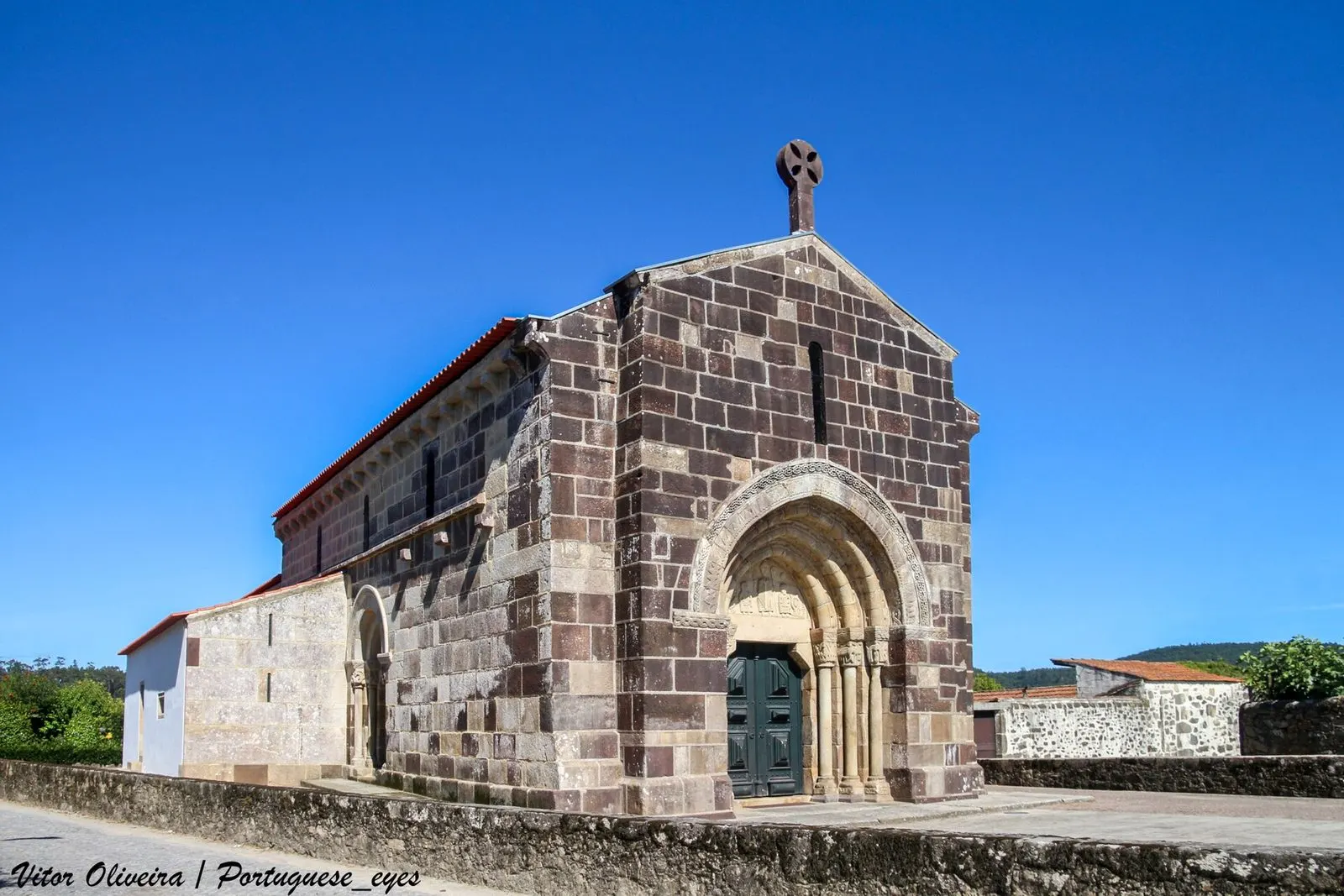
The main façade has the portal set into a projecting body topped by a tall gable, higher than the nave roof and crowned by a cross that the inventory describes as a Templar cross. The portal has three archivolts of slightly pointed profile, decorated with bead mouldings and enclosed by a double frieze with interlace, resting on six colonnettes with carved capitals. In the tympanum there is a bas-relief of Saint Augustine between two acolytes, which matches the order to which the monastery belonged. The church also has two side portals and a corbel table of small, simple modillions. The dark and rose-coloured stone of the façade, in ashlar blocks of different colours, is one of the features most easily recognised in photographs of the monument.
The interior and the apse sculpture
The nave is lit by seven windows and covered by a curved timber ceiling; the apse has a barrel vault, with remains of foliate decoration. The triumphal arch has three sharp-edged archivolts resting on pairs of columns of unequal section, and it is among its historiated capitals that the record singles out, on the right side, the largest: two men who appear to be seizing a warrior in chain mail and, beside them, a minstrel playing a bowed viola. The chancel is divided by a reinforcing arch of the vault, and the side walls have blind arcades. The inventory classes the capitals, friezes and modillions of the chancel as remarkable for their originality and plastic quality.
One point calls for caution. The idea that the church preserves fifteenth-century mural paintings does not appear in the national inventory we consulted. What the record says is more modest: the painting on the chapel vault was made directly on the stone and is very worn, without dating it. We could not confirm, in any official source we were able to read, the existence or chronology of fifteenth-century mural paintings, so we do not assert them. The two side altarpieces and the wooden pulpit are in gilded woodcarving.
Interventions
SIPA records works by the former Directorate-General for Buildings and National Monuments (DGEMN) between 1968 and 1981, including conservation of stonework, reconstruction of the chancel roof in 1976, the making of stained-glass windows (the six windows of the apse now have modern stained glass) and, in 1980, the demolition of the choir loft and the spiral access staircase. A photograph from 1910 showed a bell-gable with two bells on the north side of the main door, demolished in 1929, when the bell tower with clock now seen beside the cemetery entrance was built. A further conservation campaign took place in 1993.
Classification
The church is a National Monument by the Decree of 16 June 1910 (Diário do Governo no. 136, of 23 June 1910), the same instrument that classified many of the country’s major monuments. The Atlas of Classified Heritage records it under the name «Igreja de São Cristóvão de Rio Mau». It is state-owned public property and is not part of any UNESCO inscription. According to the inventory, the setting is rural: a walled forecourt, the parish house and meadow fields with vine arbours around it.
Rota do Românico and other churches
The Rota do Românico is the official Romanesque route of the Sousa, Tâmega and Douro valleys. When consulted on 5 November 2026, the list of municipalities in the monument filter of the route’s website (Amarante, Baião, Castelo de Paiva, Celorico de Basto, Cinfães, Felgueiras, Lousada, Marco de Canaveses, Paços de Ferreira, Paredes, Penafiel and Resende) did not include Vila do Conde, so Rio Mau does not appear as part of that itinerary. To compare with another Romanesque church of the North that was also a monastery, see the Church of São Fins de Friestas. In the same municipality, the Igreja Matriz de Vila do Conde shows the same territory already in the Manueline style, and the Mosteiro de Grijó is another house of Augustinian canons in the Porto region.
Planning the visit
The inventory gives the access roads as Vila do Conde, EN 206, Rio Mau, Rua Igreja Antiga and Rua Reitor Abreu. When consulted on 5 November 2026 we did not find opening hours, tickets or visiting rules published in an official source we could read. It is a working parish church, so it is advisable to confirm access to the interior with the parish or the Municipality of Vila do Conde (cm-viladoconde.pt) before travelling. The exterior, with the portal, can be seen from the forecourt.
Photograph by Vitor Oliveira, 12 July 2023. Original on Wikimedia Commons, under CC BY-SA 2.0; resized and compressed for the web, without altering the composition.
Frequently asked questions
- When was the Church of Rio Mau built?
- The SIPA inventory cites a date inscribed in the chancel, 1151, which allows the start of construction to be dated, and places the nave between the late twelfth and early thirteenth centuries. The apse is the most carefully executed part, with Galician influence.
- Does the church have fifteenth-century mural paintings?
- We could not confirm this. The national inventory only states that the painting on the chapel vault was made directly on the stone and is very worn, without dating it. We did not find in any official source we could read any fifteenth-century mural paintings.
- What does the tympanum of the main portal depict?
- According to the inventory, a bas-relief of Saint Augustine between two acolytes, which relates to the Order of Canons Regular of Saint Augustine, to which the monastery belonged.
- What is the church's classification?
- National Monument, by Decree of 16 June 1910 (Diário do Governo no. 136, of 23 June 1910). It is not part of any UNESCO inscription and, when consulted on 5 November 2026, was not listed among the municipalities on the Rota do Românico website.
Sources
- Património Cultural, I.P. — Igreja de São Cristóvão de Rio Mau (70620)
- Património Cultural, I.P. — Atlas do Património Classificado e em Vias de Classificação (NINV 3824)
- DGPC — SIPA: Igreja Paroquial de Rio Mau / Igreja de São Cristóvão / Igreja Velha (IPA.00005246)
- Diário do Governo — Decreto de 16 de junho de 1910 (n.º 136, 23-06-1910)
- Rota do Românico — Monumentos (filtro de concelhos)
- Wikidata — Igreja de São Cristóvão de Rio Mau (Q10300724)
Keep exploring
Heritage nearby
More places to discover from here. Approximate straight-line distances, within 50 km.