Monuments
Church of the Grilos (Porto)
Igreja dos Grilos or Church of São Lourenço, in Porto: a Jesuit college from 1577, Mannerist façade, coffered vault, sacred art museum and National Monument.
- Location
- Porto, Porto
- Built
- Obras iniciadas em 1577; agostinhos descalços desde 1780
The Igreja dos Grilos, or Church of São Lourenço, dominates the Largo do Colégio, next to the Sé (Cathedral) of Porto. It is the church of the former Jesuit College of São Lourenço and one of the leading examples of Mannerism in the city. The popular name comes from a nickname given to the Discalced Augustinians, who occupied it from 1780. Today the complex houses the Museum of Sacred Art and Archaeology of the Diocese of Porto.
From Jesuit college to the Grilos
The Portuguese Cultural Heritage register (Património Cultural, I.P.) dates the start of construction to 1577, in the Mannerist style. According to the Diocese of Porto, the design is by the Jesuit architect Baltazar Álvares. The same source describes a building of particularly harmonious balance, with a Mannerist structure showing already Baroque influence, and a church dedicated to the deacon and martyr Saint Lawrence of Huesca.
The nickname «Grilos» (Crickets) is attributed by the Diocese to the Discalced Augustinians, who have owned the church and college since 1780. After the seminary was installed, the complex appears in the official record under the designations Church and College of São Lourenço and Major Seminary of the Sé of Porto (Major Seminary of Our Lady of the Conception). We did not explore, in the sources consulted, the intermediate chronology between 1780 and the installation of the seminary.
The façade and interior
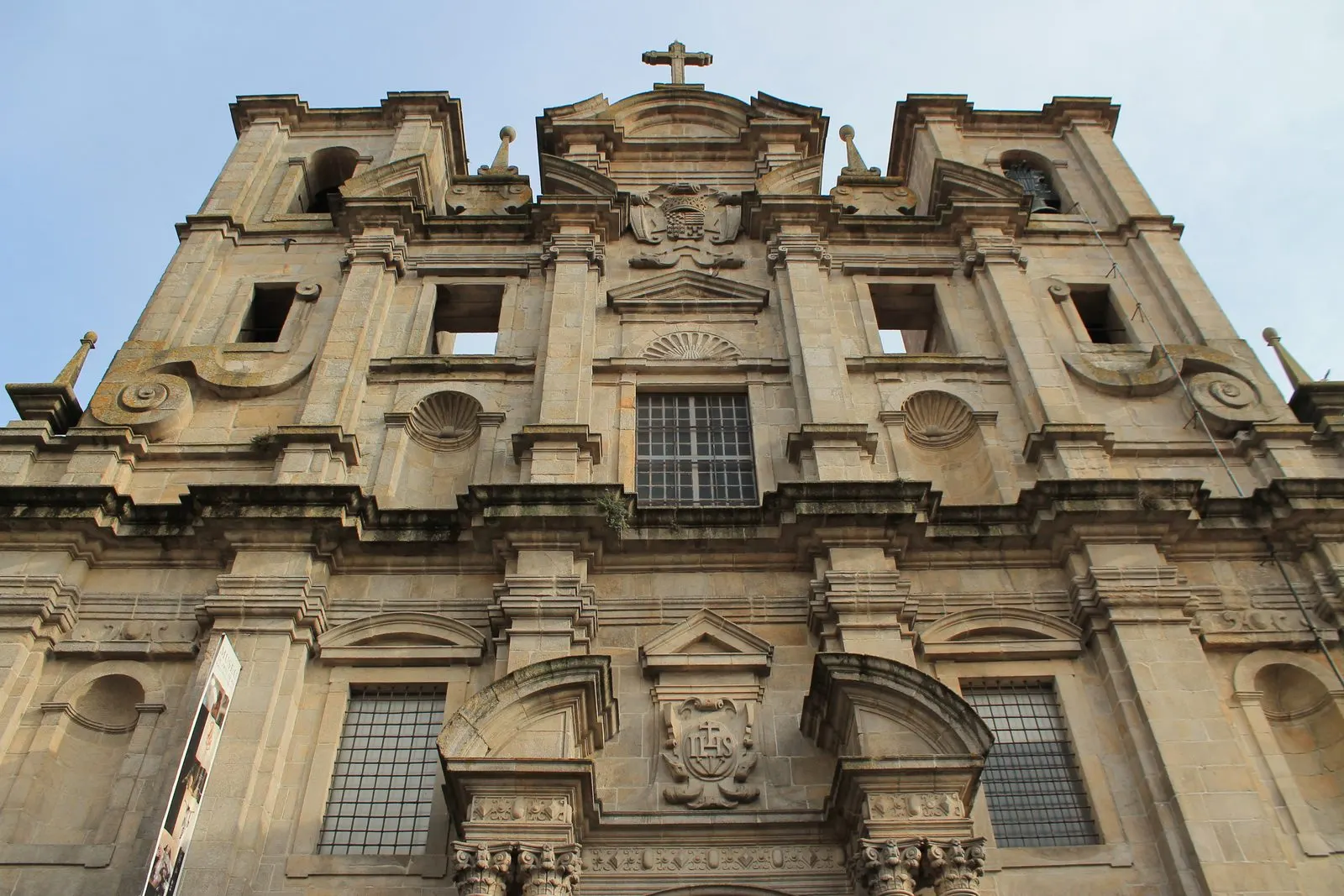
The monumental façade has two levels, combining pediments, entablatures, cornices, pilasters and windows. On the first level there are three doorways with pediments, the central one framed by a portal of coupled Corinthian columns set on pedestals. At the centre, between Tuscan pilasters, appears the emblem of the Society of Jesus; on the second level, above the central window, is the coat of arms of Friar Luís Álvares de Távora, topped by a Maltese cross on a pedestal. The record also mentions the towers, with large volutes and brick domes.
Inside, the nave is covered by a granite barrel vault with coffers, and the walls are supported by broad Tuscan pilasters with niches at the top, which hold images of Evangelists and Apostles in painted clay. Classical pilasters frame the triumphal arch, above which a complex pediment, with Jesuit and Flemish motifs, is interrupted by the niche of Saint Lawrence. The main chapel also has a coffered vault, with cartouches framed by stonework, and Ionic pilasters with fluted shafts and decorative stuccowork. There is a panel by João Baptista Ribeiro and an image of Saint Ignatius of Loyola, which the record describes as unique in the city. The sacristy has a panelled wooden ceiling, a retable and four paintings with fine late eighteenth-century Rococo woodcarving.
To see other religious interiors in Porto, compare the gilded woodcarving of the Church of São Francisco and the Baroque Church and Tower of the Clérigos.
The museum
According to the Diocese of Porto, the then Major Seminary of Our Lady of the Conception inaugurated, on 9 March 1958, the Museum of Archaeology and Art, at the initiative of Bishop D. Domingos de Pinho Brandão, who was rector at the time. Since 1970 it has been called the Museum of Sacred Art and Archaeology, and in 2020 the name of its founder was added, to mark the centenary of his birth. It is housed in a seventeenth-century wing of the former Colégio de São Lourenço, with the porch, the staircase, the great hall and a corridor, all vaulted in granite. The former «corredor das lousas» (corridor of the slabs) is now a gallery of religious sculpture from the thirteenth to the nineteenth centuries; the collection also includes painting, illumination, goldsmithing, medals, liturgical vestments and furnishings, and archaeology.
Classification
The complex is classified as a National Monument under the designation Church and Convent of the Grilos, including its furnishings, by Decree No. 28/82, published in the Diário da República, Series I, No. 47, on 26 February 1982. The “Other classification” field of the record refers to the Historic Centre of Porto, Luiz I Bridge and Monastery of Serra do Pilar, which UNESCO inscribed in 1996. UNESCO does not list individual buildings in the database consulted, so what we can state is the indication in the Portuguese record; please confirm the boundaries in the property’s documentation. See the Historic Centre of Porto, the Sé of Porto and the city of Porto.
Planning your visit
The museum’s telephone number is 223 395 020. When consulted on 5 November 2026, the Diocese of Porto indicated opening hours of Monday to Friday, 10:00 to 17:00 (last entry at 16:30), and on Saturday, 10:00 to 12:30 (last entry at 12:00) and 13:30 to 18:00 (last entry at 17:30), closed on Sundays and public holidays. We did not find a ticket price or information on whether the church is open to visitors, so please confirm both with the Diocese or the museum before travelling.
Photograph by Jsamwrites, 17 September 2016. Original on Wikimedia Commons, under CC BY-SA 4.0; resized and compressed for the web, without altering the composition.
Frequently asked questions
- Why is it called Igreja dos Grilos?
- The Diocese of Porto attributes the nickname to the Discalced Augustinians, who have owned the church and college since 1780. The church is dedicated to Saint Lawrence (São Lourenço) and was part of the former Jesuit College of São Lourenço (Colégio de São Lourenço).
- When did construction begin?
- The Portuguese Cultural Heritage register (Património Cultural, I.P.) dates the start of construction to 1577, in the Mannerist style. The Diocese of Porto names the Jesuit architect Baltazar Álvares as the author.
- What is its classification?
- It is a National Monument, as the Church and Convent of the Grilos, including its furnishings, under Decree No. 28/82 of 26 February 1982.
- Is there a museum in the building?
- Yes, the Museum of Sacred Art and Archaeology of the Diocese of Porto, housed in a seventeenth-century wing of the former college and inaugurated in 1958. When consulted on 5 November 2026, the Diocese indicated opening from Monday to Saturday, with reduced hours on Saturday.
Sources
- Património Cultural, I.P. — Igreja e Convento dos Grilos, incluindo o seu recheio (70400)
- Património Cultural, I.P. — Atlas do Património Classificado e em Vias de Classificação (NINV 3749)
- Diário da República — Decreto n.º 28/82, de 26 de fevereiro
- Diocese do Porto — Museu de Arte Sacra e Arqueologia
- Wikidata — Convento dos Grilos (Q5994345)
- Wikimedia Commons — Jsamwrites, Exterior view of Igreja dos Grilos 01 (CC BY-SA 4.0)
Keep exploring
Heritage nearby
More places to discover from here. Approximate straight-line distances, within 50 km.