Monuments
Almoster Monastery
Almoster Monastery (Santa Maria de Almoster), Santarém: Cistercian nuns' house founded in the late 13th century, with Gothic church, cloister ruins and listing.
- Location
- Almoster, Santarém, Santarém
- Built
- Fundação nos finais do séc. XIII; igreja gótica (c. 1300–1310); fonte do claustro de 1625
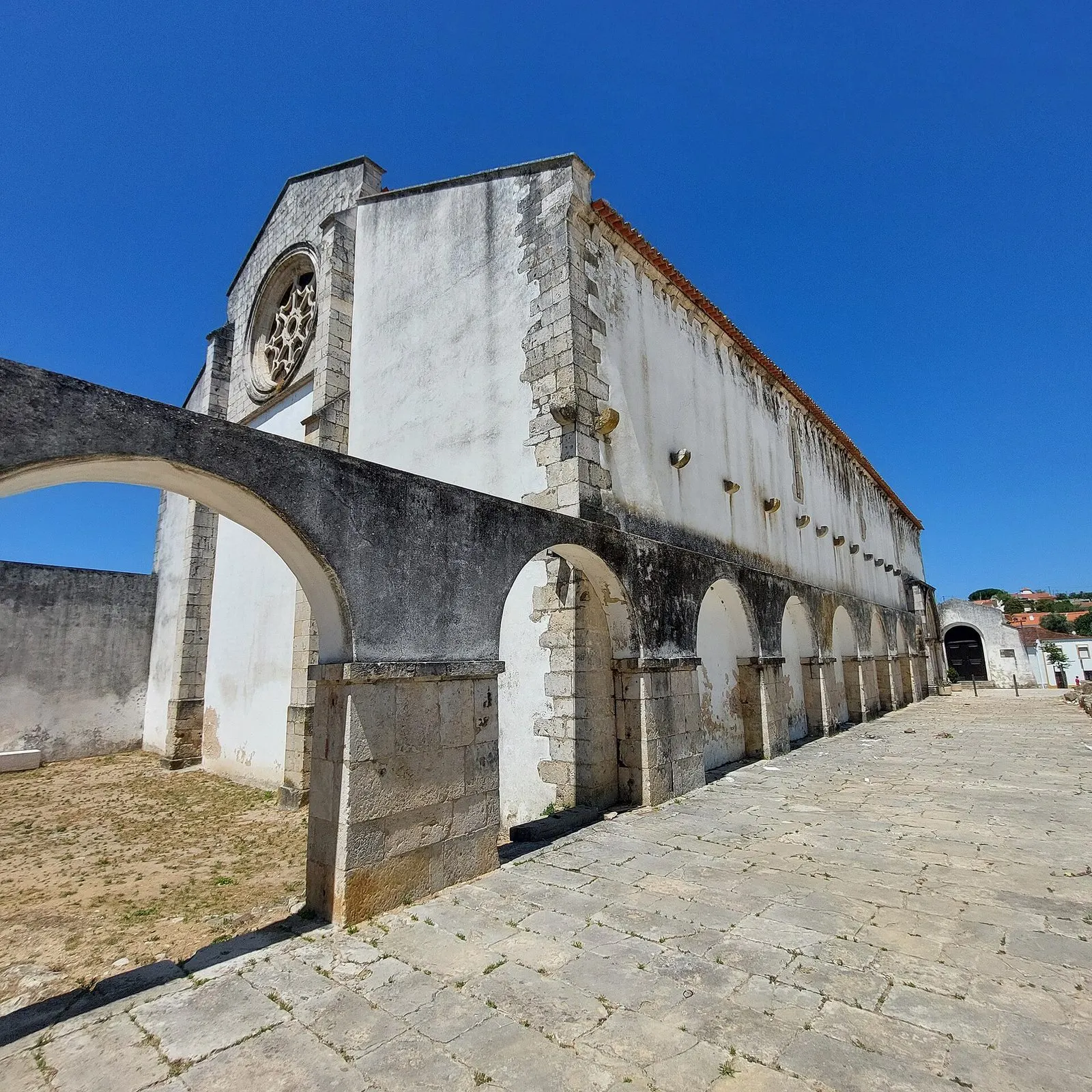
The Monastery of Santa Maria de Almoster stands in the parish of Almoster, in the municipality of Santarém, on a small square from which one can take in at once the long whitewashed nave of the church, a stretch of arcading from the former cloister and a plain bell tower. It was a female house of the Cistercian Order, founded at the end of the 13th century, and is now partly in ruins. The official name of the classified monument, «Igreja de Almoster e as ruínas do respectivo claustro» (Church of Almoster and the ruins of its cloister), describes well what remains: the church, intact, and some scattered elements of the rest.
A foundation between D. Sancha Pires and Berengueira Ayres
The information panel installed on site by the Municipality of Santarém relates that the monastery was founded at the end of the 13th century by Berengueira Ayres, a lady of the court of Queen D. Isabel, in fulfilment of the testamentary wish of her mother, D. Sancha Pires, to house a community of nuns of the Cistercian Order. A study by Luís Miguel Rêpas, published by the University of Porto, draws on documents from 1287, among them the will of D. Sancha Pires, dated 2 July that year, and the approval by the General Chapter of Cîteaux of Almoster’s affiliation with Clairvaux, to underline the mother’s role in the founding process. According to the same study, the chronicle of Fr. Francisco Brandão had undervalued that role.
The panel adds that around 1300 the building received its first nine nuns, whose novitiate had been carried out at the Cistercian monastery of Celas, in Coimbra, among them the first abbess, D. Maria Gonçalves. It gives 1310 as the year the works were completed, and attributes to Queen Isabel of Aragon, with the support of King D. Dinis, the funding of the cloister, the infirmary and other buildings. D. Violante Gomes, mother of D. António, prior of Crato, also professed here, and her tombstone is one of those visible in the cloister.
The church
According to the panel, the church follows the typology of mendicant Gothic (see Gothic architecture), a typology one can compare, within the same city, with the Convent of São Francisco in Santarém. Inside, it has three naves of five bays with pointed arches, separated by piers with engaged pilasters and capitals of vegetal character. The high chapel, with stepped volumes and covered by a rib vault, holds the tombstone of Gil Eanes da Costa and his wife. A low Mannerist choir divided the space between the area of the nuns and that of the laity. Among the furnishings, the panel highlights a 14th-century Gothic sculpture of Christ on the Cross, which it describes as unique in the country.
Outside, the main façade has a radiating oculus, and access is through a pointed-arch portal opened in the side façade. Of the conventual area, the panel notes that only two stretches of the cloister remain, along with the fountain of the crasta, dated 1625, and it describes the ruined dormitories, the former refectory and the chapter house. On the floor of the chapter house are tomb slabs of abbesses and, above the benches, a dado of 18th-century azulejos.
There is also a link to 16th-century Portuguese painting: a Resurrection by Diogo de Contreiras (the Master of São Quintino), dated to around 1540–1545, is recorded as coming from the convent of Santa Maria de Almoster and is now in a private collection in Lisbon, according to the description on Wikimedia Commons.
From abandonment to restoration
With the suppression of the religious orders, in 1834, the monastery was gradually left to decay. The panel reports that the then DGEMN carried out some conservation and restoration works between 1950 and 1980, and that between 2001 and 2006 the IPPAR undertook a far-reaching restoration of the integrated heritage: altarpieces, azulejos, stained glass, sculptures, mural painting, bronze bells, and also the movable liturgical heritage and vestments.
Classification and protection
The national register identifies the property as Igreja de Almoster e as ruínas do respectivo claustro, with the alternative designation Convento de Santa Maria de Almoster. It is a National Monument under Decree No. 6 644 of 27 May 1920 (Diário do Governo, 1st series, No. 109), which, under Article 43 of the decree of 26 May 1911, ordered the classification of the church of Almoster (district of Santarém) and the ruins of its cloister. The property is not a World Heritage Site.
Planning your visit
The monastery is at Largo do Convento, 2005-111 Almoster. As of 5 November 2026, the Visit Ribatejo portal indicated that visits are made by prior appointment, at +351 243 491 235. We found no official opening hours or prices published by the Municipality of Santarém. Confirm the conditions before travelling. For a broader look at the subject, see the other Portuguese monasteries.
Photograph by Threeohsix, 19 July 2024. Original on Wikimedia Commons, under CC BY-SA 4.0; resized and compressed for the web, without altering the composition.
Frequently asked questions
- Was the Almoster Monastery a Poor Clares house?
- No, it was a Cistercian convent for nuns. The information panel on site describes a community of the Cistercian Order, with the first nuns trained at the monastery of Celas, in Coimbra. A study by Luís Miguel Rêpas notes that the General Chapter of Cîteaux approved, in 1287, Almoster's affiliation with Clairvaux.
- Who founded the monastery?
- The panel on site names Berengueira Ayres, a lady of the court of Queen Isabel, acting in fulfilment of the testamentary wish of her mother, D. Sancha Pires. Based on documents from 1287, Rêpas highlights the role of D. Sancha Pires, whose part, he argues, the chronicler Fr. Francisco Brandão undervalued.
- What is its classification?
- National Monument, under the designation «Igreja de Almoster e as ruínas do respectivo claustro» (Church of Almoster and the ruins of its cloister), by Decree No. 6 644 of 27 May 1920 (Diário do Governo, 1st series, No. 109).
- Can I visit the monastery?
- As of 5 November 2026, the Visit Ribatejo portal indicated that visits are by prior appointment, at +351 243 491 235. Confirm with the Municipality of Santarém before going.
Sources
- Património Cultural, I.P. — Igreja de Almoster e as ruínas do respectivo claustro (70494)
- Património Cultural, I.P. — Atlas do Património Classificado (NINV 3925)
- Diário do Governo — Decreto n.º 6 644, de 27 de maio de 1920 (1.ª série, n.º 109)
- Município de Santarém — Painel informativo «Mosteiro Santa Maria de Almoster» (fotografia de 2024, Wikimedia Commons)
- Luís Miguel Rêpas — A fundação do mosteiro de Almoster: novos documentos para uma velha questão (Universidade do Porto)
- Visit Ribatejo — Convento de Santa Maria de Almoster
- Pedro Amendoeira — A igreja de Santa Maria de Almoster: edifício, lugar e território (FAUP, 2013)
- Wikimedia Commons — Diogo de Contreiras, Ressurreição (proveniência: convento de Almoster)
- Wikidata — Convento de Santa Maria de Almoster (Q9871543)
Keep exploring
Heritage nearby
More places to discover from here. Approximate straight-line distances, within 50 km.