Monuments
Maceira Dão Monastery
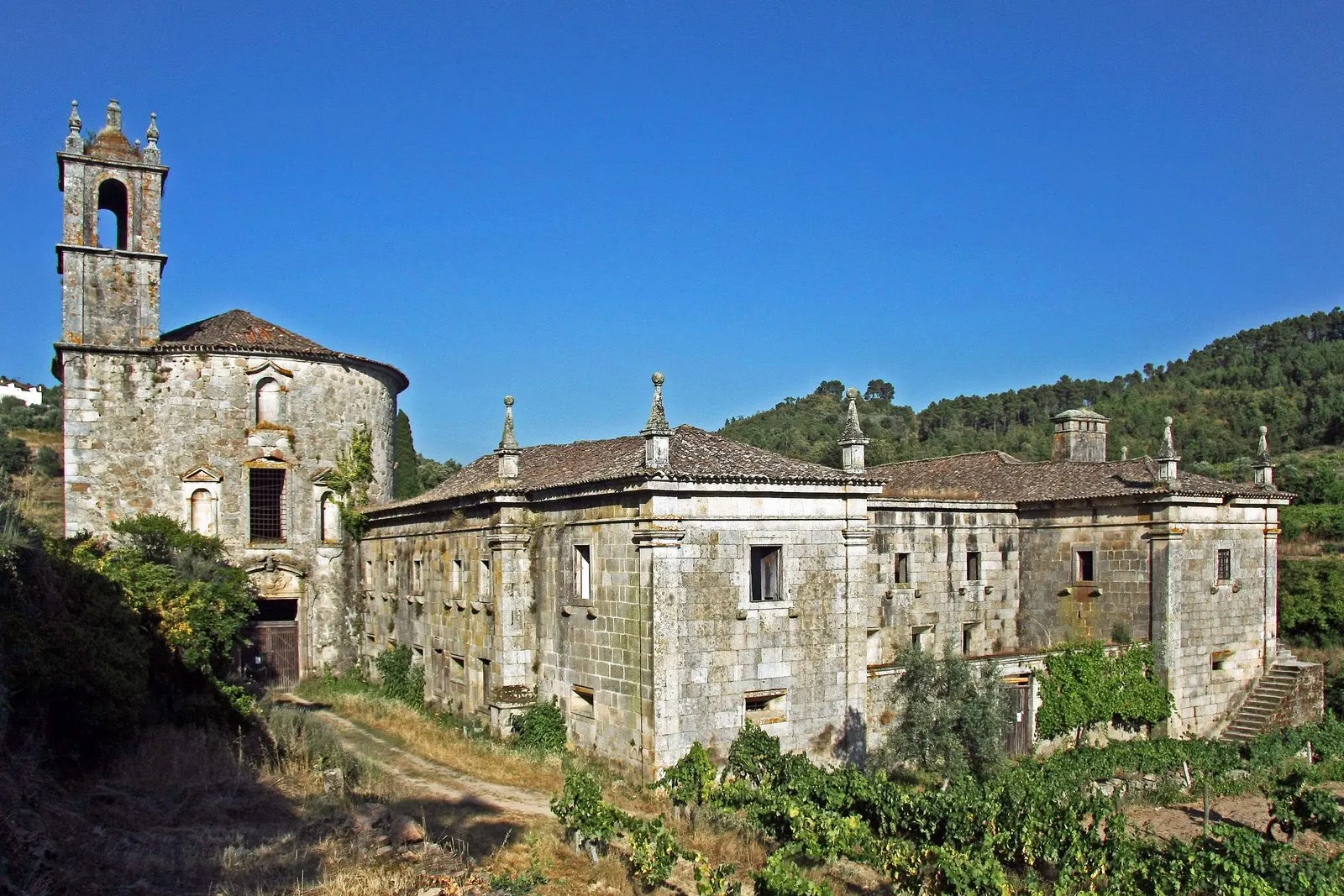
Maceira Dão Monastery in Mangualde: a 12th-century Cistercian house with a 17th-century cloister, an 18th-century elliptical-nave church and National Monument.
- Location
- Vila Garcia, Fornos de Maceira Dão, Mangualde, Viseu
- Built
- Fundação no século XII; claustro e fachada do século XVII; igreja de 1744–1779
The Monastery of Santa Maria de Maceira Dão lies in a valley in the municipality of Mangualde, in the district of Viseu, in the parish of Fornos de Maceira Dão, near the village of Vila Garcia. It began as a Benedictine house in the twelfth century, became Cistercian, affiliated with Alcobaça, was largely rebuilt between the seventeenth and eighteenth centuries, and remains privately owned, in the Centro region.
From the Rule of St Benedict to that of St Bernard
The national heritage register places its origins in a first community founded, at an uncertain date, by D. Soeiro Tedoniz in Moimenta do Dão, which is thought to have existed by 1154 and to have followed the Rule of St Benedict. Climate and topography are said to have led the religious to move to Maceira, most likely in 1168. On 31 October 1173 they were already there, for on that date D. Afonso Henriques granted a charter of immunity to Abbot Soeiro. The exchange of the Benedictine rule for the Cistercian, under the protection of the abbots of Alcobaça, is dated by some authors to 1188, but the register only confirms that by 1212 the monastery was already Cistercian.
Three phases of building work
According to the register, “little or nothing” of the first monastery has survived, apart from perhaps some of the marked stones reused in the cloister and church. The bell tower may date back to the twelfth to fourteenth centuries, and the Rota de Cister notes that it predates the monastery and was incorporated into it. The complex seen today results from three phases.
The conventual range was rebuilt mainly in the early seventeenth century: the gateway bears a chronogram for 1613, and the dates 1628, 1668 and 1669, carved on the bases of the cloister pinnacles, show works that dragged on for at least forty years owing to financial difficulties. This range housed the cloister, the chapter house, the refectory, the kitchen and the cellar, and on the upper floor the cells, the abbot’s room, the library and the infirmary.
The church was the last to be rebuilt. In 1744 the work was contracted to four master masons from Minho (João Ribeiro Alves, João Martins, João da Costa Coelho and João Fernandes Ribeiro) and was completed in 1779, after which decoration began: José da Fonseca Ribeiro designed and executed the high altarpiece, and seven years later Pascoal Parente painted several canvases. To compare the idiom of this period with other churches in the country, see Baroque architecture in Portugal.
The church with an elliptical nave
What distinguishes Maceira Dão is the church’s plan: a very deep chancel and an elliptical nave, which is reflected in the main façade. This has a segmental-pedimented doorway bearing the royal arms, and three niches that were meant to hold an image of Our Lady of the Assumption, to whom the church is dedicated, flanked by St Benedict and St Bernard. The Rota de Cister adds that the nave is covered by a continuous dome, that the interior of the chancel is an irregular octagon, and that the centralised plan, common at the time, probably follows the Spanish Cistercian model of Santa Maria de Alcalá de Henares. Within the precinct stands also the Chapel of Nossa Senhora da Cabeça, eighteenth-century, with a centralised plan, which the same source associates with an annual pilgrimage.
Suppression, abandonment and recent works
In 1834, with the suppression of the religious orders, the convent was hastily inventoried and sold to a man from Viseu, passing afterwards through several owners. Its furnishings were dispersed: the high altarpiece is today, heavily adapted, in the parish church of Fragosela. According to the Rota de Cister, the building housed several families and served agriculture until the 1960s, after which it fell into ruin. In 2020 the Observador described spaces used for storing farm implements and produce.
In July 2019 the municipality, the owning family and the Regional Directorate of Culture of the Centro signed a protocol to restore the roofs. Work began in October 2020, and Dão Digital reported it complete on 18 December 2023, at an investment of over 660 thousand euros, of which about 460 thousand came from the Centro 2020 funds. At the ceremony, the family’s representative lamented that the cloister had still not been restored.
Classification
The monastery is a National Monument under Decree No. 5/2002, of 19 February (Diário da República, I série-B, No. 42), which describes it as the “Mosteiro de Santa Maria de Maceira Dão”. The register shows that the process began with a proposal from the Mangualde Municipal Council in 1978, was opened in 1990 and confirmed in 1998. The register also records a special protection zone procedure, with opinions dated 2011 and 2012, but we have not confirmed its publication in a legal instrument. The monastery is not part of any UNESCO inscription.
Planning a visit
Access is by municipal road no. 1441 and by an unclassified public path of about 600 metres, beside the Regato das Freiras, west of the Chapel of Nossa Senhora da Cabeça. In 2016 the then Minister of Culture described the monument as “entirely private”, and when consulted on 5 November 2026 the Rota de Cister entry gave no visiting hours; it merely stated that the church is being prepared to host a permanent exhibition on the history of Maceira Dão and to open to cultural visits and events, and that the remaining buildings await intervention. We have found no official source confirming regular visits, so it is advisable to contact the Câmara Municipal de Mangualde or the Regional Directorate of Culture of the Centro before going. To place the monastery among the order’s houses, see the Cistercian routes in Portugal and the general overview of monasteries.
Photograph by Vitor Oliveira, 6 September 2011. Original on Wikimedia Commons, under CC BY-SA 2.0; resized and compressed for the web, without altering the composition.
Frequently asked questions
- When and how did Maceira Dão Monastery come into being?
- According to the national heritage register, the first community, following the Rule of St Benedict, was founded at an uncertain date by D. Soeiro Tedoniz in Moimenta do Dão and was already in existence in 1154. It probably moved to Maceira, most likely in 1168, and in 1173 D. Afonso Henriques granted a charter of immunity (carta de couto) to Abbot Soeiro. By 1212 the monastery was already Cistercian, affiliated with Alcobaça.
- What remains of the medieval building?
- Very little. The register mentions, perhaps, some reused marked stones in the cloister and church, and suggests that the bell tower may date back to the twelfth to fourteenth centuries. The cloister and façade date from the early seventeenth century (the gateway bears a chronogram of 1613), and the present church was rebuilt from the 1740s onward.
- What is its classification?
- National Monument, under Decree No. 5/2002, published in the Diário da República, I série-B, No. 42, of 19 February 2002. It is not part of any UNESCO inscription.
- Can it be visited?
- The monastery remains privately owned. When consulted on 5 November 2026, we found no visiting hours confirmed by an official source: the church roof works were declared complete in December 2023, but the cloister has not been restored, and reopening to the public has been announced without a date.
Sources
- Património Cultural, I.P. — Mosteiro de Santa Maria de Maceira Dão (72103)
- Património Cultural, I.P. — Atlas do Património Classificado e em Vias de Classificação (NINV 1422)
- Diário da República — Decreto n.º 5/2002, de 19 de fevereiro (I série-B, n.º 42)
- Rota de Cister — Mosteiro de Santa Maria de Maceira Dão
- Dão Digital — Obras da igreja do Mosteiro de Santa Maria de Maceira Dão estão concluídas (18 de dezembro de 2023)
- Observador — Mosteiro em Mangualde começa a ser recuperado (22 de outubro de 2020)
- Governo de Portugal — Governo disponível para procurar soluções para conservar mosteiro de Maceira Dão (15 de março de 2016)
- Wikidata — Mosteiro de Santa Maria de Maceira Dão (Q1775565)
Keep exploring
Heritage nearby
More places to discover from here. Approximate straight-line distances, within 50 km.