Resources
Archaeologist's Portal and Endovélico: searching archaeological sites
Guide to the Archaeologist's Portal and Endovélico: search sites by name or CNS, consult works and reports, request registration and know data limits.
The Archaeologist’s Portal (Portal do Arqueólogo) is the public gateway to Endovélico, the national database of archaeological sites and works in mainland Portugal. It is maintained by Património Cultural, I.P. and allows you to check whether a site is inventoried, find its CNS or learn what works were carried out there, without registration. The current address is arqueologia.patrimoniocultural.pt.
Endovélico and the Archaeologist’s Portal: what each one is
The Regulation on Archaeological Works (Decree-Law No. 164/2014, of 4 November) defines the two terms. Endovélico is «the information and data management system for the terrestrial and underwater archaeological heritage and for archaeological activity in mainland Portugal». The Archaeologist’s Portal is the electronic platform that integrates the data recorded in that database and makes it accessible.
In practice, Endovélico is the database and the portal is the interface. Each site is identified by a National Site Code (Código Nacional de Sítio, CNS). When a study, an environmental impact report or a municipal record cites a CNS, that number lets you find the corresponding record on the portal.
At the time of consultation on 5 November 2026, the site search returned 40,179 records and the works search 45,622. These figures change as the database is updated.
What can be searched
The main menu has five areas:
- Sites (Sítios): the inventory list, with designation, CNS and municipality or parish. You can filter by environment (terrestrial, underwater or mixed), historical period, type of site and municipality.
- Images (Imagens): images of archaeological sites, with the same period and type filters.
- Works and Projects (Trabalhos e Projetos): archaeological interventions, filterable by type (field survey, test trench, excavation, monitoring, study of finds, among others) and by status (authorised, report pending, report approved, etc.). It indicates the year and those responsible.
- Visitable Sites (Sítios Visitáveis): an area for the general public, covering sites that can be visited. It forms part of Endovélico and is linked with information from the CCDRs and municipal councils.
- GeoPortal: an online map for georeferenced searching.
A site record shows the type, district, municipality and parish, the period, the environment, a description and, where they exist, fields on access, finds, depositories, classification and conservation. Separate tabs gather the works, the bibliography and the photographs. Shipwrecks along the Portuguese coast also appear in the lists, which makes the portal useful for nautical and underwater archaeology.
How to search, step by step
- Open arqueologia.patrimoniocultural.pt and use the Archaeological site search box («Pesquise por nome ou CNS» — search by name or CNS). If you already have the code, enter only the number.
- If you do not know the exact name, go to Sites, choose the environment and open More filters (Mais filtros). Combine municipality, period and type of site, for example Roman and Villa within one municipality.
- Open the record and note the designation, the CNS and the date of consultation. The CNS appears in brackets after the name.
- Look at the Works and Bibliography tabs to see who intervened at the site, in what year and where the results were published.
- To see the spatial context, use the GeoPortal. Some records indicate that the site cannot be located on the map.
- To find out whether the site is a classified monument, or to consult architectural records, complete the search in the registers of Património Cultural, I.P. and in the SIPA. An Endovélico record is not equivalent to a legal classification.
Registration, PATA and reports
The portal has three levels of access:
- the general public, who search without registration;
- qualified professionals entitled to direct archaeological works, and other professionals who need more detailed information;
- the enquiring and contracting entities of archaeological works.
The last two levels require a registration request, made under Login with the personal or institutional form. On registering, entities receive an individual password and a public password. The latter is needed to submit the Application for Authorisation of Archaeological Works (Pedido de Autorização de Trabalhos Arqueológicos, PATA) and is provided to the responsible archaeologist.
The 2014 Regulation places works in four categories:
- A: programmed research;
- B: enhancement;
- C: preventive actions and the minimisation of impacts from works and projects;
- D: emergency.
The same regulation provides that applications be submitted «on the dedicated electronic form, available on the Archaeologist’s Portal». The text still refers to the DGPC. Since 2024, the CCDRs have territorial competences in this area, and the portal indicates that progress, preliminary and final reports are delivered to the Culture Unit of the territorially competent CCDR (Unidade de Cultura da CCDR territorialmente competente). The physical version of the reports goes to Património Cultural, I.P. In a 2024 case in the Lisbon and Tagus Valley region, for example, the CCDR issued the technical opinion and forwarded the final decision to Património Cultural, I.P. Before submitting an application, confirm the current procedure with both bodies.
The digital reports form part of the Portuguese Archaeology Archive (Arquivo da Arqueologia Portuguesa). According to the portal’s terms, only professionals, archaeology companies and students of archaeology or related fields may consult them, with a personal password and a commitment to confidentiality regarding the location of sites. The reports are intended for non-commercial use and must be cited with author, title, date of access and address.
Limits of the data
- Geographic coverage: by legal definition, Endovélico covers mainland Portugal; do not look here for sites in the Azores or Madeira.
- Incomplete coverage: the portal itself states that the extent of the report collection depends on digitisation capacity and on recording in Endovélico. A missing site may simply not yet be recorded.
- Restricted location: detailed coordinates are not for general release, and registered users undertake to keep site locations confidential.
- Uneven records: some records are extensive, others consist of a single line with no associated works. Treat the description as a starting point and consult the bibliography.
Errors or missing studies may be reported to [email protected] or [email protected].
From earlier institutions to Património Cultural, I.P.
The national archaeological inventory has passed through several institutions. The Portuguese Institute of Archaeology oversaw archaeological activity between 1997 and 2006. The merger with the IPPAR gave rise to the IGESPAR, later integrated into the DGPC. The portal’s technical sheet gives 2013 as the year of creation. With the extinction of the DGPC, the service passed to Património Cultural, I.P. on 1 January 2024. Coordination now rests with the Division of Archaeology, Territories and Environmental Values, at the Ajuda National Palace.
For the context of the discipline, read Portuguese archaeology. For institutions linked to museums and collections, see Museus e Monumentos de Portugal.
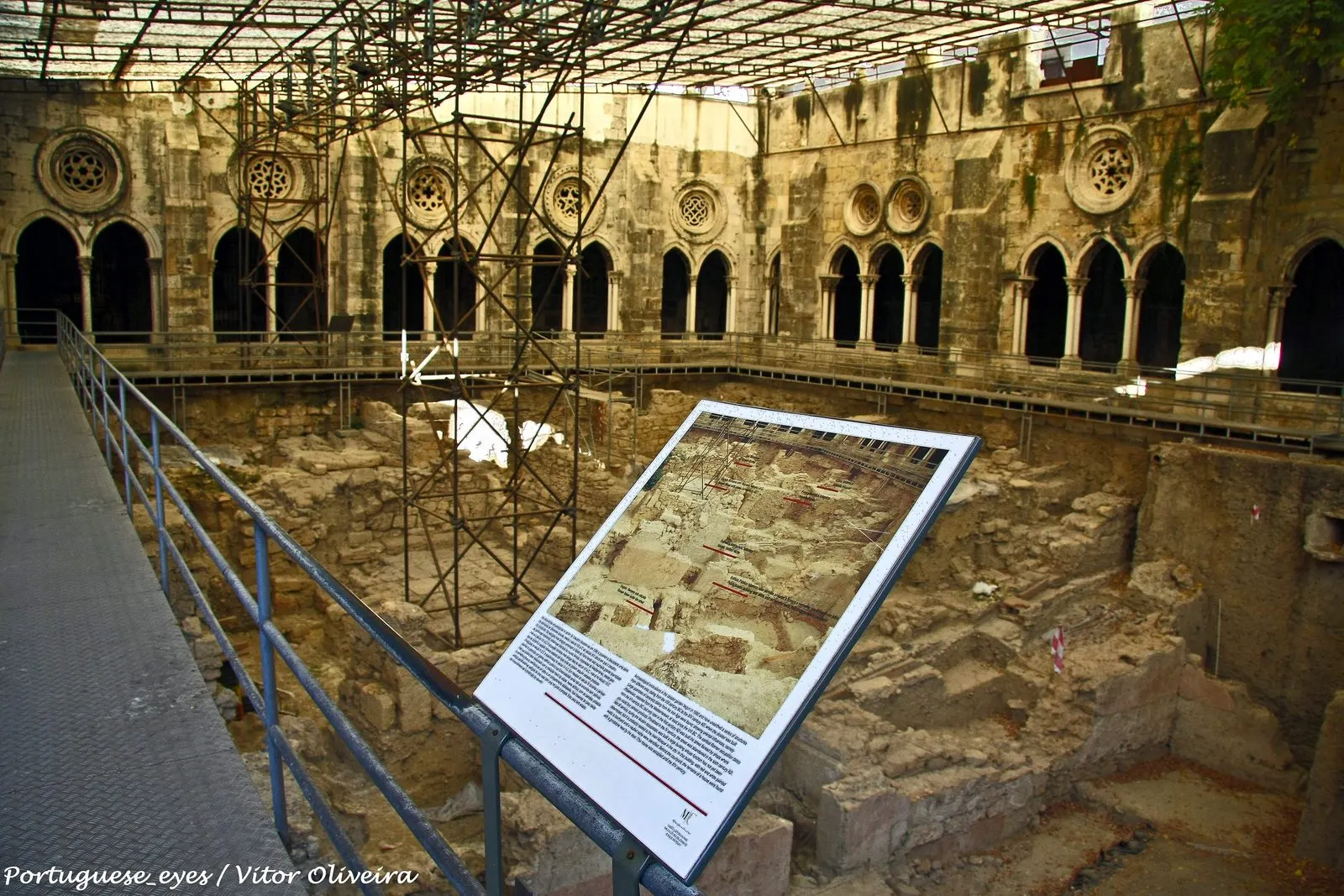
Photograph by Vitor Oliveira, dated 8 August 2014, of the excavations in the cloister of the Sé de Lisboa. Original on Wikimedia Commons, under CC BY-SA 2.0; resized and compressed for the web, without altering the composition.

Frequently asked questions
- What is Endovélico?
- It is the information and data management system for the terrestrial and underwater archaeological heritage, and for archaeological activity, in mainland Portugal. The 2014 Regulation on Archaeological Works defines it in these terms, and the Archaeologist's Portal is the platform that provides public access to its data.
- What is the CNS of an archaeological site?
- It is the Código Nacional de Sítio (National Site Code), the number that identifies each site in Endovélico. In the Archaeologist's Portal you can search for a site by name or by CNS; the number appears in brackets in the title of the record.
- Is registration required to use the Archaeologist's Portal?
- No, not for searching sites and works. Registration is needed by those who require more detailed information or who wish to read digital reports, and it is reserved for professionals, archaeology companies, students and enquiring or contracting entities.
- If a site does not appear on the portal, does it not exist?
- That cannot be concluded. Endovélico is continuously being updated, depends on the registration of works and the digitisation of reports, and does not cover the autonomous regions. Some records also lack an available cartographic location.
Sources
- Património Cultural, I.P. — Portal do Arqueólogo (página inicial, termos e níveis de acesso)
- Património Cultural, I.P. — Portal do Arqueólogo, Ficha técnica
- Património Cultural, I.P. — Portal do Arqueólogo, Sítios
- Património Cultural, I.P. — Portal do Arqueólogo, Trabalhos
- Património Cultural, I.P. — Portal do Arqueólogo, Sítios Visitáveis
- Património Cultural, I.P. — Portal do Arqueólogo, ficha de sítio «Aimable» (s.d.) - Cabo Mondego (CNS 29147)
- Património Cultural, I.P. — GeoPortal de arqueologia
- Decreto-Lei n.º 164/2014, de 4 de novembro — Regulamento de Trabalhos Arqueológicos (versão PGDL, cópia municipal de Alijó)
- CCDR Lisboa e Vale do Tejo — Parecer sobre um PATA, 06-11-2024 (cópia publicada pela ADA Loures)
- CCDR Lisboa e Vale do Tejo — Formulário de relatório de trabalhos arqueológicos
- Município de Tavira — Fichas do Património Arqueológico (Código Nacional de Sítio)
Resources for research
Find the sources. Follow the story.
Guides to researching buildings, exploring museum collections and understanding heritage protection.
SIPA
Get to know the architectural inventory, building records and documentary archive.
Read the guideMuseum collectionsMatrizNet
Explore the museum catalogue and records of works, materials, authorship and provenance.
Read the guideHeritage protectionHeritage classification
Understand cultural property categories and the levels of national, public and municipal interest.
Read the guide