Archaeology
Classified Roman Villae of Ribatejo and Alentejo
Three Lusitanian-Roman villae classified as National Monuments: Vila Cardílio (Torres Novas), Santa Vitória do Ameixial (Estremoz) and Nabância (Tomar).
- Location
- Torres Novas, Santarém
A Lusitanian-Roman villa was the house and estate of a rural landowner, with a residence, production areas and, in the finest examples, baths and mosaics. Among the National Monuments of Ribatejo and Alentejo there are three sites of this type whose public information is very uneven: the villa near Torres Novas, fairly well known; Santa Vitória do Ameixial, in Estremoz, with recent excavations; and the «Ruínas ditas de Nabância», in Tomar, about which little is known. For an overview, read the Roman villae of Lusitania; for a villa with regular visits and a palaeochristian basilica, Torre de Palma.
Classification data come from the Atlas of Cultural Heritage, consulted on 5 November 2026. The descriptive text of the national records (SIPA) was not legible on that date; the details below come from museums, syntheses that cite the inventory, and cited bibliography.
Vila Cardílio, near Torres Novas
The Atlas (NINV 3986) designates it «Vila lusitano-romana junto de Torres Novas (ruínas)», with the alternative designation Villa Cardillio, in the civil parish union of Torres Novas (Santa Maria, Salvador and Santiago). It was classified by Decree No. 47 508, of 24 January 1967.
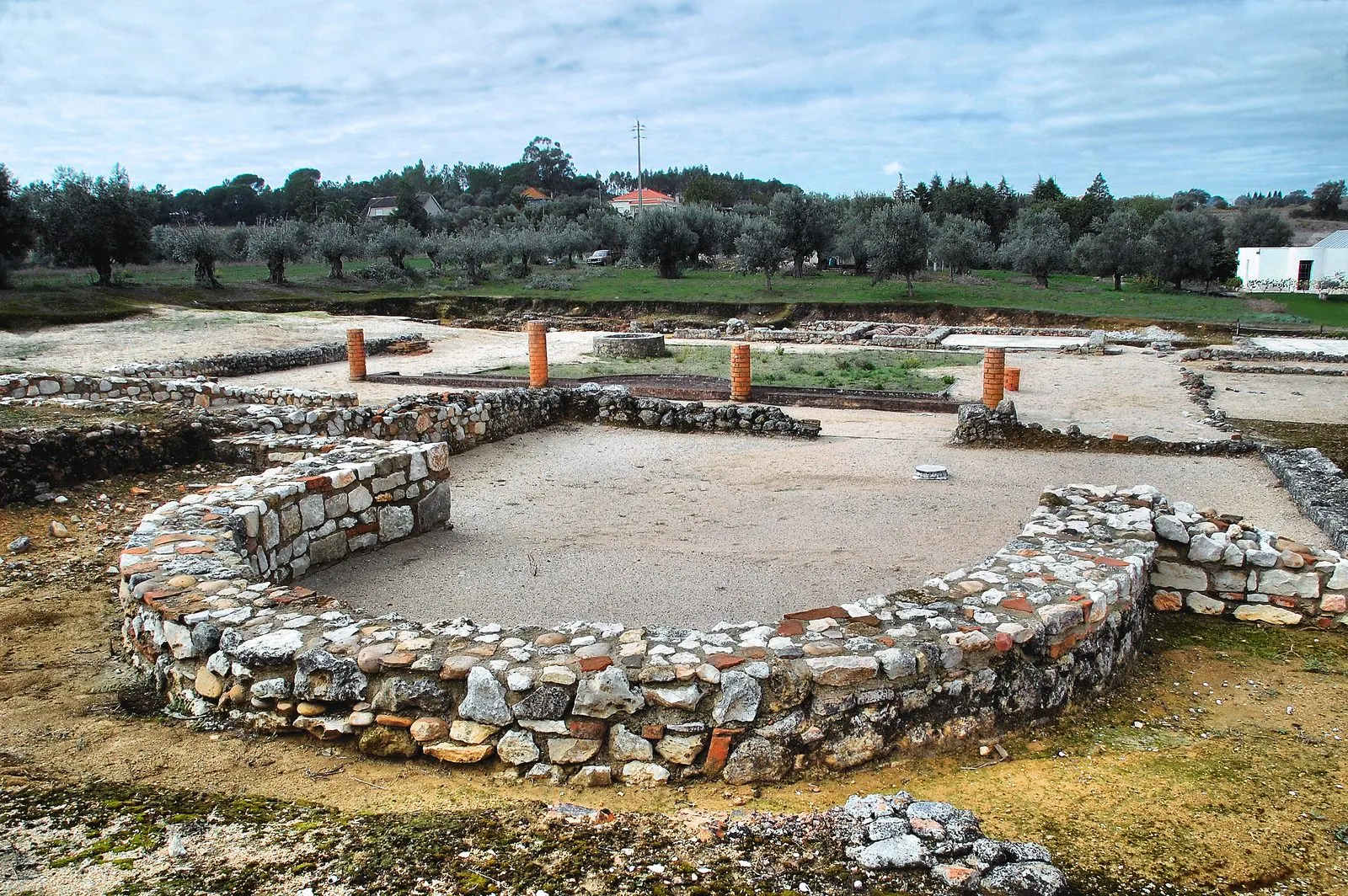
The syntheses that refer to the inventory place it about 3 km from the town, near Caveira, on an agricultural plain beside the Almonda river. They describe a house with mosaics, a hypocaust heating system, baths and an inner courtyard with a peristyle. The name comes from a mosaic inscription read as a wish of happiness to a Cardílio and an Avita, presumably the owners. There was an initial phase in the 1st century, of which the original atrium and the baths survive, and a remodelling around the 4th century. The coins found, hundreds of them, range from the 2nd to the 4th century, and a numismatic study of 2017 (Conejo Delgado, Portugalia) reviewed them. The finds are held at the Museu Municipal Carlos Reis, in Torres Novas.
The excavations are dated slightly differently depending on the source: the Portuguese Wikipedia gives 1962, the English one an initial investigation in 1932 and formal excavations in 1963–1964 under Afonso do Paço, with a review in the 1980s by Jorge Alarcão and a team from Coimbra. We could not access the inventory to confirm this. The same syntheses say the site is open to the public; we found no official opening hours or access conditions, so consult the Torres Novas municipality before going. The town also has the Castle of Torres Novas.
Santa Vitória do Ameixial, in Estremoz
The Atlas (NINV 2690) records the Villa Lusitano-Romana de Santa Vitória do Ameixial, in the parish of Ameixial (Santa Vitória and São Bento), classified by Decree No. 735/74, of 21 December 1974. The same decree classified the Castro de São Caetano, in Monção (see the classified castros).
The site is best known for the Mosaic of Ulysses, now in the National Archaeology Museum (inventory 17950). The museum mentions a panel showing Notus, the south wind, among the wind deities who hindered Ulysses’ return to Ithaca. The mosaic was restored at the National Museum of Conímbriga and was part of the exhibition Energias. Perpétuo Movimento, held at the former Central Tejo in Lisbon from 24 April to 7 October 2024. In July 2023 (from the 3rd to the 28th), the museum announced an excavation campaign at the ruins, part of a multi-year research programme and of the Archaeological Charter of the Municipality of Estremoz. A study published in O Arqueólogo Português notes that the villa was discovered during the quarrying of a stone pit in the village and that, in a heap of building materials, a reused Roman brick bearing an Arabic inscription was found in 1970.
A consulted tourist sheet dates the mosaics to the 3rd–4th centuries and says part of the baths and the residential area were excavated. We have not confirmed the full chronology of the site. In the same village there are other classified assets, such as the Padrão do Ameixial and the Terreiro da Batalha, unrelated to the villa. For context, Estremoz.
The so-called Ruins of Nabância, in Tomar
The Atlas (NINV 3981) uses the designation «Ruínas ditas de Nabância» and gives as an alternative Villa romana de Cardais, in Tomar (São João Baptista) and Santa Maria dos Olivais. It is the oldest classification in the group: the decree of 16 June 1910 (Diário do Governo No. 136, of 23 June 1910).
The name Nabância has a history of its own. According to a university study of which we read only the abstract, the Cardais finds, about 2 km from Tomar on the left bank of the Nabão, were once interpreted as the remains of a Roman city identified with the legendary Nabância; that identification has been abandoned. The Roman city of Tomar is Sellium, and Cardais is today treated as a villa. A study of workshop stamps on Roman bricks from Seilivm notes that a stamp of the Res Publica Conimbrigensis appeared in the old Cardais excavations, without exact provenance. We found no description of the structures and no visiting information. See Tomar.
What to compare
Torres Novas is the only one with described baths and mosaics and with public access indicated; Santa Vitória do Ameixial has a celebrated piece (the Mosaic of Ulysses) and active excavation; Nabância is, above all, a name that has changed its meaning. All three fall outside the group that the general page compares in Rabaçal, Pisões, São Cucufate and Torre de Palma. For the context of Romanisation, see Roman archaeology.
Photograph by Paulo Juntas, dated 24 October 2009. Original on Wikimedia Commons, under CC BY-SA 3.0; resized and compressed for the web, without altering the composition.
Frequently asked questions
- Which villae are covered on this page?
- The Lusitanian-Roman villa near Torres Novas (Vila Cardílio), the Lusitanian-Roman Villa of Santa Vitória do Ameixial, in Estremoz, and the so-called Ruins of Nabância (Roman Villa of Cardais), in Tomar. All three are National Monuments.
- When were they classified?
- Nabância by decree of 16 June 1910; the villa near Torres Novas by Decree No. 47 508, of 24 January 1967; and Santa Vitória do Ameixial by Decree No. 735/74, of 21 December 1974.
- What does the name Cardílio reveal?
- A mosaic inscription, according to the syntheses consulted, refers to a Cardílio and an Avita, to whom happiness in the house is wished; this is why the name is associated with the probable owners.
- Was Nabância a Roman city?
- That is not the current reading of the bibliography consulted: the Cardais finds were once interpreted as a Roman city identified with Nabância, an identification later abandoned, and today the site is treated as a villa.
Sources
- Património Cultural, I.P. — Atlas do Património Imóvel, camada PatrimonioImovel (NINV 3986, 2690, 3981)
- Museu Nacional de Arqueologia — Campanha de escavações arqueológicas nas ruínas romanas de Santa Vitória do Ameixial (2023)
- Museu Nacional de Arqueologia — Mosaico de Ulisses, restauro e exposição 2024
- Wikipédia — Vila Cardílio (ponteiro para o SIPA 3376 e Alarcão, Dicionário de Arqueologia Portuguesa, 2012)
- Wikipédia — Roman ruins of Villa Cardillio (ponteiro para Paço, Alarcão e Conejo Delgado, Portugalia, 2017)
- Wikidata — Roman ruins of Villa Cardillio (Q10390694), coordenadas
- Wikidata — Nabância (Q10335278)
- Marcas de oficina em tijolos romanos de Seilivm, Universidade de Coimbra (repositório)
Keep exploring
Heritage nearby
More places to discover from here. Approximate straight-line distances, within 50 km.