Monuments
Torres Novas Castle
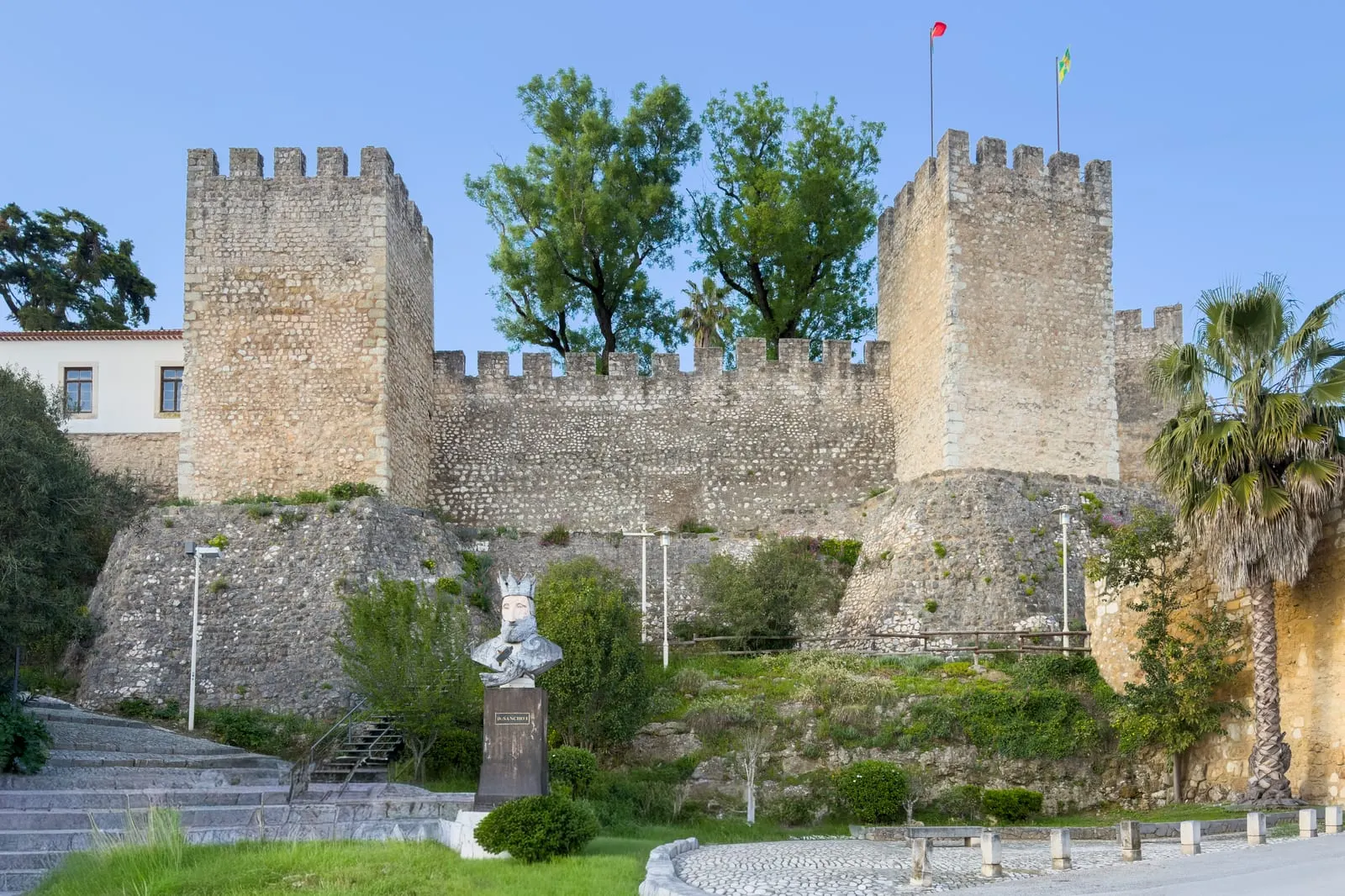
Torres Novas Castle: ten-tower Gothic wall rebuilt by D. Fernando, shaken in 1755, dismantled in the 19th century, DGEMN-restored. National Monument.
- Location
- Torres Novas, Santarém
- Built
- Séc. XIV (reconstrução no reinado de D. Fernando), sobre recinto de D. Sancho I
The Castle of Torres Novas rises in the centre of Torres Novas, seat of a municipality that shares with Golegã the Paul do Boquilobo Biosphere Reserve. It has a Gothic enclosure with a shield-shaped plan and ten square towers. Its history is above all that of a fortress rebuilt more than once: first in the Middle Ages, then after a destruction in the 14th century, and again in the 20th century, after the Municipal Chamber itself had dismantled part of the walls.
From the origins to King Fernando
The national register of Cultural Heritage, I.P. is cautious about its origins. It is not clear whether there was occupation of the site before the Middle Ages. It is known that King Sancho I promoted the construction of a fortified enclosure. That enclosure was destroyed in the 14th century, during the reign of King Fernando. The king himself ordered its repair and reconstruction, and the most significant elements of the castle seen today date from that campaign.
The people responsible for the work are known. The works were led by master Estêvão Domingues, and the overseer of the works was the judge Lourenço Peres of Santarém. This information was recorded on two stone plaques placed near the Praça and Salvador gates. The plaques have since been removed from their original positions.
A Gothic enclosure
The layout of the castle is clearly Gothic. The plan is shield-shaped (escudiforme), and the curtain wall is defended by ten projecting square towers, with access via the adarve, the wall-walk along the top of the wall. The main gate, on the southern stretch, incorporated the former residence of the alcaide, who controlled the entry and exit of people and goods. The national register suggests that the keep was located there. Local tradition places it at the opposite point, near the Porta da Traição.
To place this work in the context of 14th-century military architecture, see Gothic architecture in Portugal. In the same region, the Castle of Ourém and the Castle of Almourol show other medieval solutions.
Earthquake, prison and cemetery
The 1755 earthquake severely damaged the castle and is thought to have brought down four towers. In the following decades, some spaces changed function. The alcaide’s palace was turned into a gaol, and the neighbouring land came to be used by private individuals. In 1790, the alcaide Francisco Feliciano Castelo Branco went so far as to claim ownership of these properties.
In 1835, the interior of the enclosure began to serve as a cemetery. On 3 April 1839, Queen Maria granted the Municipal Chamber full possession of the castle. According to the national register, this donation precipitated the ruin of the complex, because the municipality chose to dismantle the structure. On this type of space, see historic cemeteries.
The 20th-century reconstruction
The dismantling process was partly reversed between the 1940s and the 1960s. The Directorate-General for Buildings and National Monuments (DGEMN) then rebuilt some sections of curtain wall and the towers that were practically demolished. For this reason, the present castle combines medieval fabric and 20th-century reconstructions. When visiting, it is worth bearing in mind that not everything seen is original.
Classification
The castle is a National Monument under the Decree of 16 June 1910, published in the Diário do Governo no. 136, of 23 June 1910. The national register does not indicate a special protection zone of its own, but the castle falls within the protection zone of the Church of the Misericórdia of Torres Novas. It is not part of any UNESCO designation.
Preparing the visit
The castle is in the centre of Torres Novas, next to Rua do Conde de Torres Novas. When consulted on 5 November 2026, the website of the Municipal Chamber of Torres Novas was unavailable, and it was not possible to confirm opening hours, access conditions or any guided visits from an official source. Please check this information with the Municipal Chamber before going.
In the same region, it is worth continuing to Tomar, with the Castle of Tomar, and to Santarém. The regional context is in Lisbon and the Tagus Valley and the national network in castles of Portugal.
Photograph by Kent Wang, dated 22 March 2026. Original on Wikimedia Commons, under CC BY 4.0; resized and compressed for the web, without altering the composition.
Frequently asked questions
- When was the Castle of Torres Novas built?
- King Sancho I promoted a first fortified enclosure, which was destroyed in the 14th century. King Fernando, during whose reign it was destroyed, ordered its repair and reconstruction, and the most significant elements of the present castle date from that campaign.
- Why does part of the castle look recent?
- The 1755 earthquake is thought to have brought down four towers, and after 1839 the Municipal Chamber dismantled part of the structure. Between the 1940s and the 1960s, the Directorate-General for Buildings and National Monuments (DGEMN) rebuilt sections of curtain wall and towers that had been almost demolished.
- Is the castle listed?
- Yes. It is a National Monument under the Decree of 16 June 1910, published in the Diário do Governo no. 136, of 23 June 1910.
- What are the opening hours?
- When consulted on 5 November 2026, opening hours could not be confirmed from an official source, as the website of the Municipal Chamber of Torres Novas was unavailable. Please check with the Chamber before going.
Sources
Keep exploring
Heritage nearby
More places to discover from here. Approximate straight-line distances, within 50 km.