Monuments
Alegrete Castle
Ruined Alegrete Castle in Portalegre was a border fortress in the Serra de São Mamede, linked to D. Dinis's 1319 foral. National Monument since 1946.
- Location
- Alegrete, Portalegre, Portalegre
- Built
- séc. XIV (foral de 1319); reparações no séc. XVII
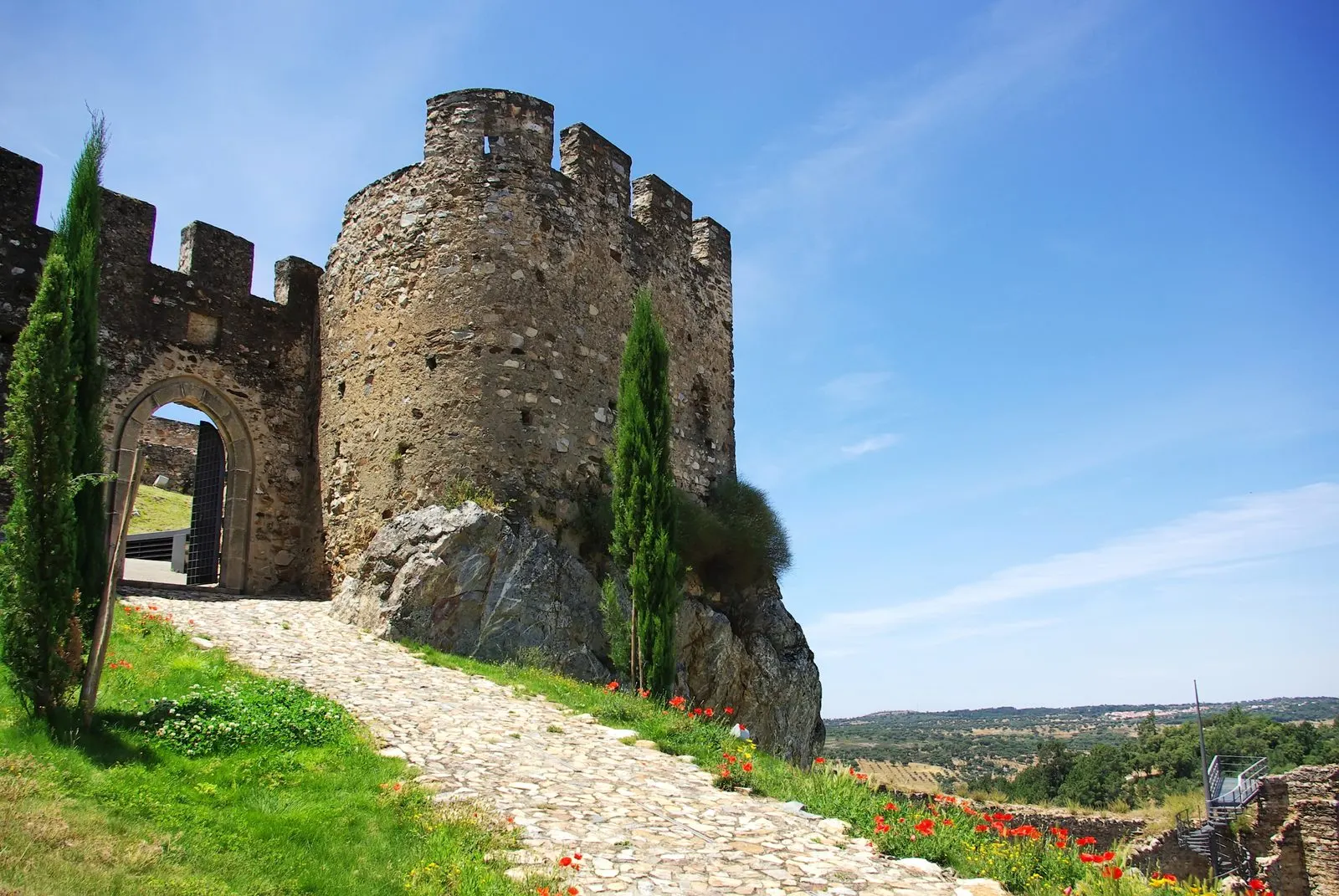
The Alegrete Castle crowns the village of Alegrete, just over ten kilometres from Portalegre, on the slope of the São Mamede Mountains. According to the national register of the Cultural Heritage, I.P., it is one of the most important fortresses of the frontier region of Upper Alentejo and, since the Middle Ages, a key element in the region’s defence. Today it is above all a ruin: sections of wall, gateways and traces of the keep survive. The top of the fortress nevertheless still offers a wide view over the plain.
Uncertain origins
The traditional account attributes an origin to the castle earlier than the foundation of Portugal and claims that D. Afonso Henriques conquered it from the Muslims. The national register is more cautious. It considers the origins obscure and places the first secure references in the 13th century, during the reign of King Afonso III. In 1267, following the Convention of Badajoz, the town was definitively integrated into Portuguese territory.
In 1319, King Denis granted a charter to Alegrete. According to the national register, the construction of the present castle is thought to have coincided with that date, although it is accepted that the works may have begun soon after the Badajoz agreement. The Parish Council page, hosted on the municipal website, also mentions a second charter, granted by King Manuel I in 1516.
What is known of the fortress
Destruction and abandonment make the original layout difficult to reconstruct. On the available evidence, the perimeter was quite irregular and did not follow the generally oval plan of other Portuguese Gothic castles. The keep would have stood beside the eastern wall, associated with a cistern supplying the population and the garrison. It is not possible to know how it was organised in height. The main gate apparently opened to the south and is now walled up.
A town wall enclosed the village and linked it to the castle. It too is badly destroyed, but some sections survive. The national register highlights the Porta da Vila, flanked by two towers, as a prototype of Gothic gates in urban walls. The castles page of the Municipality of Portalegre, updated in January 2023, lists what remains: the ruins of the keep, part of the cistern and three gates, the Porta da Vila, the Porta de Santana and the Porta do Sol.
Border wars and decline
Its frontier position gave Alegrete a role in the wars with Castile. In 1384, during the crisis that would bring King John I to the throne, D. Nuno Álvares Pereira visited the town, which already supported the cause of Avis.
The transition to warfare with artillery brought an early period of decline. The conflicts of the 17th century reversed this trend, because the frontier position put the old castle on the front line against Spanish troops. During the War of the Restoration, under the impetus of the Marquis of Marialva, the walls were repaired and updated. According to the national register, it was a rapid job, carried out with localised adjustments. A bastioned fortification is thought to have been built, which cannot be identified today.
At the start of the 19th century, Alegrete was again attacked by Spanish troops, but the fortress was already in decline. The municipality was abolished on 26 June 1855, and the castle was gradually abandoned. In the 1970s there were occasional consolidation works. The national register noted that a coherent programme of enhancement was still lacking. Later, according to the municipality, the castle and the small castle (castelejo) were requalified, with access walkways, protective railings and a stage for performing arts.
Classification
The castle is a National Monument under Decree No. 35 443, published in the Diário do Governo, I series, No. 1, on 2 January 1946. The same instrument classified, among others, Terena Castle. The castle is not part of any UNESCO inscription.
Preparing a visit
Alegrete is a parish of the municipality of Portalegre, within the São Mamede Mountains Natural Park. According to the municipality, from the top of the fortress, at 502.9 metres above sea level, one can see Assumar, Monforte, Veiros, Estremoz and Evoramonte. In the village, the Parish Council also highlights the Mother Church, the Church of the Misericórdia, the Chapel of Saint Peter and the Clock Tower.
When consulted on 5 November 2026, no official opening hours or prices for the castle had been published. To confirm access, contact the Municipality of Portalegre (245 307 400, [email protected]) or the Parish Council of Alegrete (+351 245 965 134, [email protected]).
In the same mountains and on the same frontier stand Marvão Castle and Vide Castle. Further south, Elvas was the focus of the Crown’s major fortification effort during the Restoration. For other fortresses, see the page on Portuguese castles and the page on the Alentejo.
Photograph by Inacio Pires, 23 June 2011. Original on Wikimedia Commons, under CC BY-SA 3.0; resized and compressed for the web, without altering the composition.
Frequently asked questions
- When was Alegrete Castle built?
- Its origins are obscure. According to the national register of the Cultural Heritage, I.P., the first secure references date from the 13th century, during the reign of King Afonso III. The present castle is thought to have been built around 1319, when King Denis granted a charter to the town, although the works may have begun soon after the Convention of Badajoz of 1267.
- What remains of the castle?
- The complex is heavily ruined. The website of the Municipality of Portalegre mentions the ruins of the keep, part of the cistern and three gates: Porta da Vila, Porta de Santana and Porta do Sol. Some sections of the town walls survive, most notably the Porta da Vila, flanked by two towers.
- Is Alegrete Castle classified?
- Yes. It is a National Monument under Decree No. 35 443, published in the Diário do Governo, I series, No. 1, on 2 January 1946.
- Can it be visited?
- The castle is in the village of Alegrete, just over ten kilometres from Portalegre. When consulted on 5 November 2026, no official opening hours or prices had been published. For information, contact the Municipality of Portalegre or the Parish Council of Alegrete.
Sources
- Património Cultural, I.P. — Castelo de Alegrete (71109)
- Património Cultural, I.P. — Atlas do Património Classificado, Castelo de Alegrete (NINV 3575)
- Diário do Governo — Decreto n.º 35 443 (I série, n.º 1, 02-01-1946)
- Município de Portalegre — Castelos
- Município de Portalegre — Junta de Freguesia de Alegrete
- Wikidata — Castelo de Alegrete (Q5049735)
Keep exploring
Heritage nearby
More places to discover from here. Approximate straight-line distances, within 50 km.