Monuments
Castro Laboreiro Castle
Perched at around 1,000 metres in Melgaço, Castro Laboreiro Castle is a rocky stronghold taken in 1141 and rebuilt by King Dinis. National Monument.
- Location
- Castro Laboreiro, Melgaço, Viana do Castelo
- Built
- Origens desconhecidas; conquistado por D. Afonso Henriques em 1141; reforma no reinado de D. Dinis; consolidação em 1979–1980
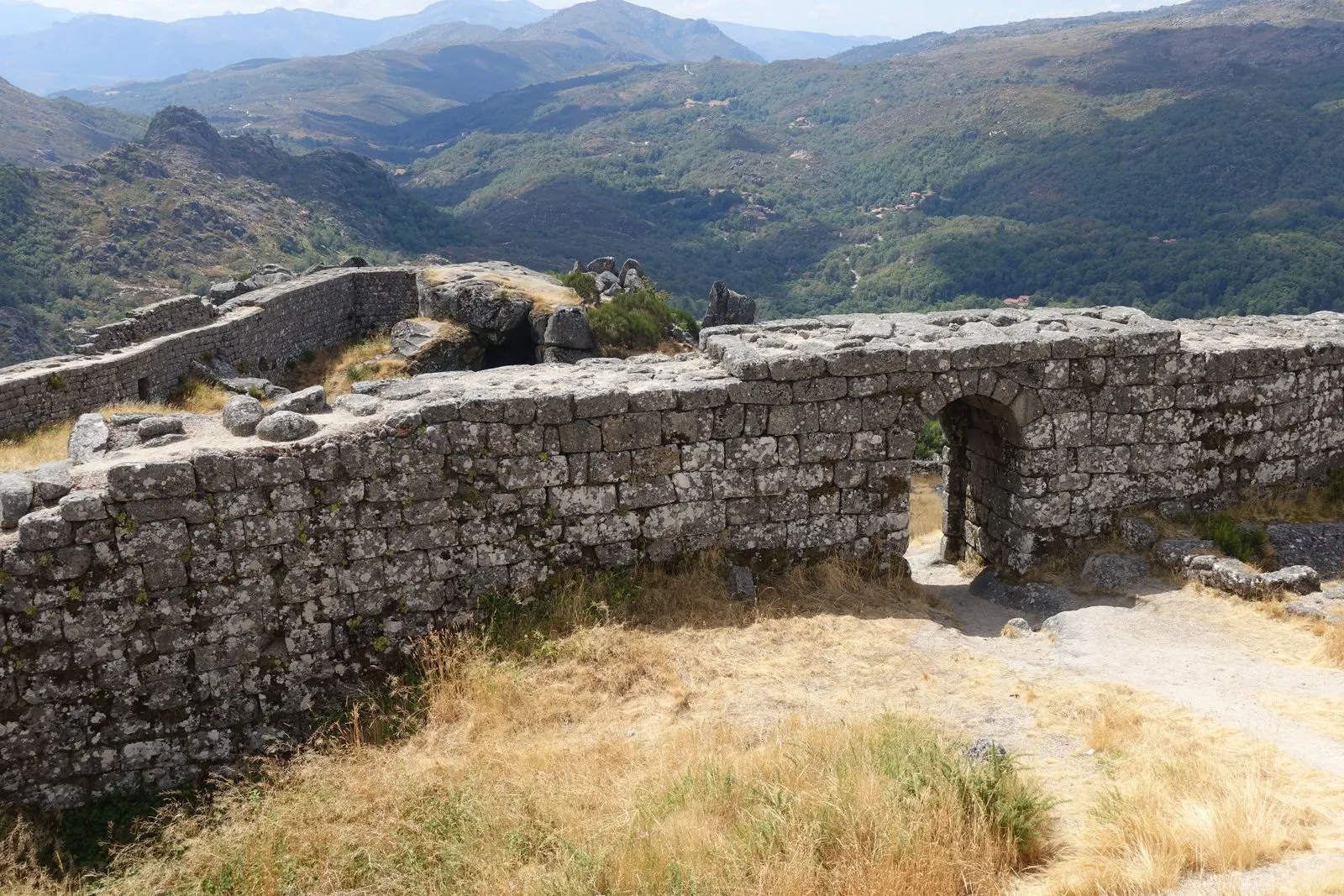
The Castle of Castro Laboreiro occupies the summit of an isolated granite massif, above the village of Castro Laboreiro, in the municipality of Melgaço. It stands on an inland stretch of the border between Alto Minho and the zone of influence of Ourense, in Galicia. The national register of the Património Cultural, I.P. places it “at practically 1000 metres above sea level”; the tourism website of the Câmara Municipal de Melgaço gives 1033 metres. It is classified as a National Monument under the name Castelo de Castro Laboreiro ou Laboredo. The register stresses that its fame derives more from its location, open to the Galician plateaus, than from any leading role in Portuguese military history.
Unknown origins
The origins of the castle are not known. The national register gathers what most authors accept: the fortress had important functions from the early phase of the Reconquista. It is in this context that the link between the comital family of D. Hermenegildo and the castle is explained, in the first half of the 10th century, during the resettlement promoted by Afonso III of Asturias. Excavations carried out in the 1970s revealed High Middle Ages materials, still awaiting conclusive study.
The municipal tourism website offers another version. It traces the history of the site back to the Iron Age and says that the castle, destroyed by a violent storm, was rebuilt by D. Dinis. The national register mentions neither claim.
From D. Afonso Henriques to D. Dinis
In the 12th century, when Portugal was asserting itself as a kingdom, Castro Laboreiro received constant attention from D. Afonso Henriques, who captured the castle in 1141. It is not known what works were carried out then. The register admits a courtyard with an isolated keep in the Romanesque manner, but later transformations erased this first structure.
About 150 years later, with the fortress partly in ruins, the reign of D. Dinis brought the reform that gave it the overall appearance it still retains. D. Dinis is best known in Alto Minho for the riverside settlements he founded along the river, but this campaign shows that the crown also looked after the dry border. The project had two walled enclosures:
- at the top, the main core, with keep and cistern. It was the military centre and would correspond to the oldest stronghold;
- to the south, a second enclosure, larger and reached through a single gate, served to “gather livestock and goods in times of invasion”. The register considers this feature to be unique in the country. For the register, it proves how essential livestock farming was to the life of the medieval mountain communities of Castro Laboreiro.
At the start of the 16th century, Duarte de Armas drew a lofty castle, isolated from the settlement, which lay well below. The military core had five square towers, including the keep, and two gates: the Porta do Sol, which opened onto the larger enclosure, and another linking the two strongholds.
Early modern period and restoration
The castle was partly altered in the early modern period, but it did not undergo a reform comparable to that of D. Dinis. In the age of firearms, it was valued above all for its strategic position in an area of difficult access.
It also stood apart from the major restoration campaigns of the Estado Novo, which sought to restore castles to a supposed original medieval form. The indispensable works only came in 1979–1980. They were limited to consolidating and reinforcing the structures, without significant alterations, according to the national register.
What can be seen today
According to the municipal tourism website, of the fortification, now almost in ruins, sections of the walls, the keep and an old cistern remain. According to the municipality, from the top one has one of the finest views of Melgaço. The municipal trail network describes the castle as a rock castle on an isolated granite massif, surrounded by steep cliffs. It is also visible from the natural viewpoint of the PR IV Interpretive Trail of Castro Laboreiro.
Castro Laboreiro and Peneda-Gerês
The co-management plan of the Peneda-Gerês National Park, available on the website of the Câmara Municipal de Melgaço, includes the Union of Parishes of Castro Laboreiro and Lamas de Mouro among the parishes of the park. The municipal tourism website says the park was created in 1971, that it extends from the Mourela plateau to that of Castro Laboreiro, and lists the castle among the sites to visit in Peneda-Gerês. According to the same source, the Porta de Lamas de Mouro is the park’s reception and information centre in Melgaço. The park forms part of the Gerês-Xurês Transboundary Biosphere Reserve.
Around the village there are other classified assets, according to the Atlas do Património Classificado. The Church of Santa Maria da Visitação and the Pelourinho of Castro Laboreiro are Property of Public Interest. The Megalithic and Rock Art Complex of the Castro Laboreiro Plateau is a Site of Public Interest.
Classification and protection
The castle is a National Monument under Decree No. 33 587, published in the Diário do Governo, I Série, No. 63, of 27 March 1944. The decree registers it as “Castelo de Castro Laboreiro ou Laboredo”, in the municipality of Melgaço. The national register lists it under the typology of fortified settlement (category Archaeology). The Atlas do Património Classificado does not indicate a special protection zone of its own. The castle is not on the UNESCO World Heritage List. The Gerês-Xurês Biosphere Reserve, which includes the park’s territory, is a different UNESCO designation.
Planning the visit
As consulted on 5 November 2026, the tourism website of the Câmara Municipal de Melgaço indicated:
- access: parking beside the Castle Viewpoint, followed by a somewhat rough trail of about 20 minutes to the top;
- hours: every day;
- price: free entry.
As the trail is rough, suitable footwear is advisable. The visit can be combined with that of the Castle of Melgaço, in the Minho valley. For other border fortifications, see the castles of Portugal and the Norte region.
Photograph by Joseolgon, 14 August 2020. Original on Wikimedia Commons, under CC BY-SA 4.0; resized and compressed for the web, without altering the composition.
Frequently asked questions
- Who built the Castle of Castro Laboreiro?
- Its origins are unknown. According to the register of the Património Cultural, I.P., D. Afonso Henriques captured the castle in 1141, and the reform carried out during the reign of D. Dinis gave it the overall appearance it still retains, with two walled enclosures.
- How do I get to the ruins?
- According to the tourism website of the Câmara Municipal de Melgaço, consulted on 5 November 2026, you park beside the Castle Viewpoint (Miradouro do Castelo) and follow a somewhat rough trail of about 20 minutes to the top. Entry is free and the site is open every day.
- Is the castle inside the Peneda-Gerês National Park?
- The civil parish of Castro Laboreiro and Lamas de Mouro is listed among the parishes of the Peneda-Gerês National Park in the park's co-management plan, and the municipal tourism website includes the castle among the sites to visit in Peneda-Gerês. We did not, however, find an official source indicating the park boundary at the exact location of the castle.
- Is the castle classified?
- Yes. It is a National Monument under Decree No. 33 587, published in the Diário do Governo, I Série, No. 63, of 27 March 1944, under the designation Castelo de Castro Laboreiro ou Laboredo.
Sources
- Património Cultural, I.P. — Castelo de Castro Laboreiro ou Laboredo (69848)
- Património Cultural, I.P. — Atlas do Património Classificado, Castelo de Castro Laboreiro ou Laboredo (NINV 4115)
- Diário do Governo — Decreto n.º 33 587, de 27 de março de 1944
- Câmara Municipal de Melgaço (Discover Melgaço) — Castelo de Castro Laboreiro
- Câmara Municipal de Melgaço (Discover Melgaço) — Peneda-Gerês
- Câmara Municipal de Melgaço — Rede municipal de trilhos
- Câmara Municipal de Melgaço — Plano de Cogestão do Parque Nacional da Peneda-Gerês, III. Atores-chave
- Wikidata — Castelo de Castro Laboreiro (Q5050787)
Keep exploring
Heritage nearby
More places to discover from here. Approximate straight-line distances, within 50 km.