Monuments
Sanctuary of Nossa Senhora da Peneda
Our Lady of Peneda Sanctuary, Arcos de Valdevez: sacred mount in Peneda-Gerês National Park, with twenty chapels, Stairway of Virtues and pilgrimage.
- Location
- Peneda, Gavieira, Arcos de Valdevez, Viana do Castelo
- Built
- culto documentado desde o séc. XIII; conjunto erguido entre finais do séc. XVIII e o terceiro quartel do séc. XIX; igreja concluída em 1875
The Sanctuary of Nossa Senhora da Peneda occupies an enclosed valley of the Peneda range, at the place of Peneda, civil parish of Gavieira, municipality of Arcos de Valdevez, within the Peneda-Gerês National Park. Unlike other sanctuaries in the North, it does not dominate a town: it appears as a succession of staircases, squares and whitewashed chapels beneath great granite boulders, and it is the destination of one of the largest and oldest pilgrimages of the Alto Minho. Since 2023 it has been a National Monument.
From the cult of the Snows to the present ensemble
According to the classification decree, the sanctuary was erected between the late eighteenth century and the third quarter of the nineteenth century, continuing a cult of Nossa Senhora das Neves documented on the site since the thirteenth century, in spaces successively enlarged. The Municipality of Arcos de Valdevez states that the church was completed in 1875, and admits that the centuries-old tradition of Nossa Senhora das Neves and the route of the monks from the Mosteiro de Ermelo to Fiães, in Melgaço, may have given rise to a small place of worship around the thirteenth century.
Tradition holds that the Virgin appeared on 5 August 1220. The record of the National Inventory of Intangible Cultural Heritage summarises two versions, one involving a shepherdess, according to Friar Agostinho de Santa Maria in 1712, and one involving a fugitive from Ponte de Lima, according to a version of 1869; it is a legend, not a documented fact. Firmer is the testimony of a hermitage of Nossa Senhora das Neves da Peneda, already an important centre of pilgrimages by 1758.
What can be seen
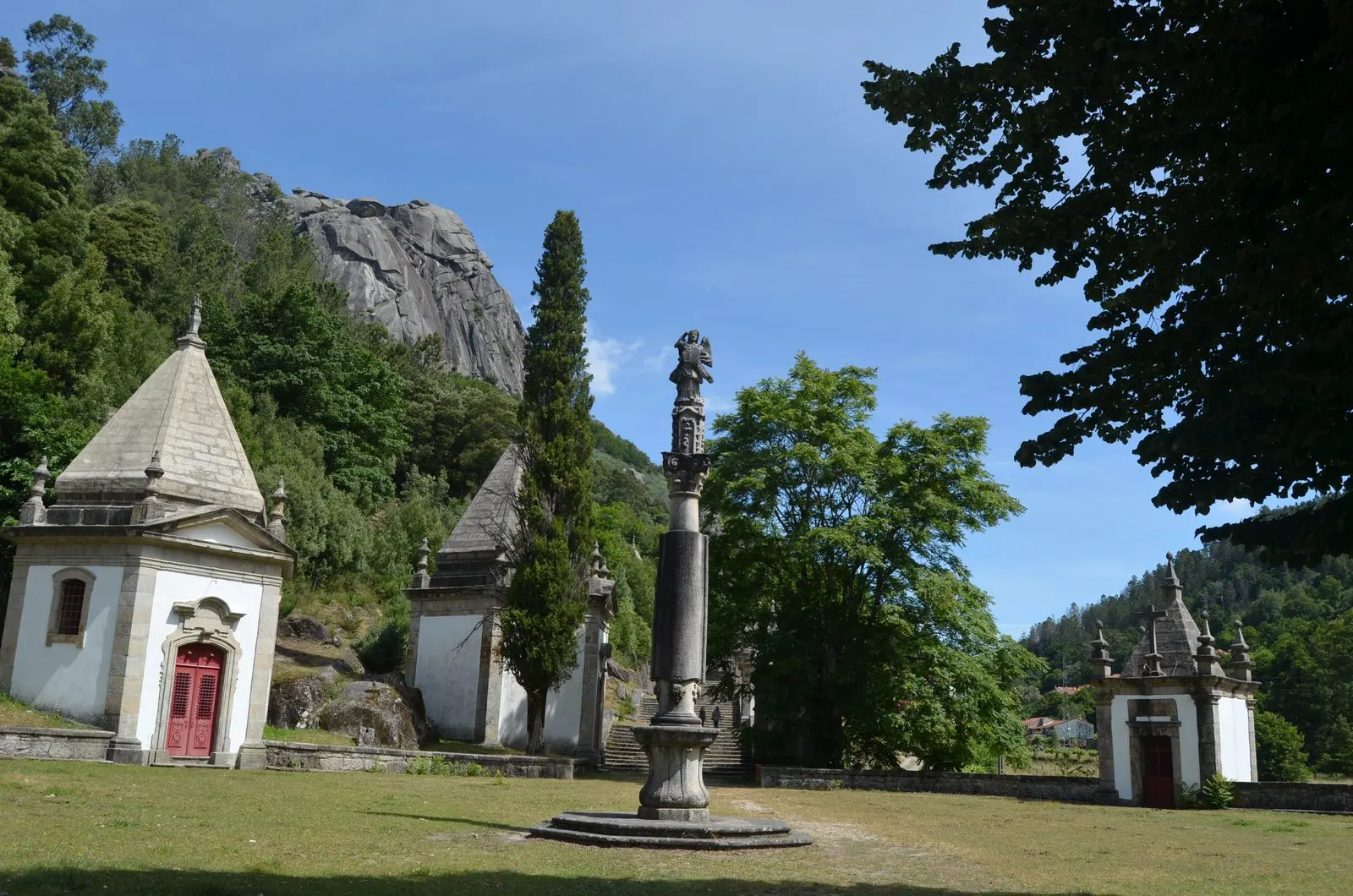
The decree describes an ensemble composed of the neoclassical church, the buildings of the former pilgrims’ lodging, and a succession of staircases and squares leading to the wooded avenue along the valley, punctuated by twenty chapels that evoke the Passion of Christ. The Way of the Cross, of Baroque conception, results from a campaign earlier than the present church, which replaced a smaller building situated in today’s Terreiro dos Evangelistas; its original arrangement was later altered.
The decree classifies the ensemble as a Marian sacro monte which, although smaller in scale and decorative richness, reveals the direct influence of the Bom Jesus do Monte, in Braga. The most evident proof is the Escadório das Virtudes, with landings adorned by fountains and statuary conceived by the sculptor Francisco Luís Barreiros. The Municipality of Arcos de Valdevez dates this staircase to 1854 and identifies the figures of Faith, Hope, Charity and Glory.
The same municipal text adds details of the route: the avenue descends some 300 metres with the twenty chapels, one of them bearing an inscription attesting that it was donated by the negus of Ethiopia, and ends in a circular square with a pillar donated by Queen D. Maria I. The former pilgrims’ dormitories, the «quartéis», stand in a triangular square beyond the church; the intangible heritage record indicates that one of them was restored in 2022 as a mountain shelter with capacity for 28 people, alongside the Hotel da Peneda. The interior of the church is not described in detail in the sources consulted, so this page does not describe it. For the church’s style, see neoclassicism in Portugal.
The pilgrimage
The decree stresses that the sanctuary is the centre of one of the largest and oldest pilgrimages of the Alto Minho, which brings together the traditions and devotion of the local populations, and an important example of a mountain sanctuary with exceptional setting in the landscape. The Romaria da Senhora da Peneda is inscribed in the National Inventory of Intangible Cultural Heritage (INPCI_2023_008), according to the Municipality since October 2023, and takes place every year from 31 August to 8 September, in the form of a novena. The record describes pilgrims coming from neighbouring municipalities and from Galicia, prayers at each of the twenty chapels, circuits around the chapel and the church, the fair on the night of 6 September and, on the 8th, the final mass and the Procession of Farewell. See the national inventory of intangible heritage and the page on sanctuaries and pilgrimage sites.
Classification
Decree No. 27/2023, published in the Diário da República, 1st series, No. 198, of 12 October 2023, classified as a set of national interest, under the designation of national monument, the «Sanctuary of Nossa Senhora da Peneda, including the integrated movable heritage». The classification was approved by the Council of Ministers on 28 September 2023, following a request from the Municipal Chamber of Arcos de Valdevez of October 2020, and Ministerial Order (Portaria) No. 699/2023, of 22 November 2023, set the restrictions. The record identifies the property as a National Monument and does not indicate inscription on the World Heritage List.
Context: park and biosphere
The sanctuary lies within the Peneda-Gerês National Park which, together with the Spanish natural park of Baixa Limia–Serra do Xurés, forms the Transboundary Park and the Gerês–Xurés Biosphere Reserve; the reserve’s portal includes Arcos de Valdevez among the Portuguese municipalities of the territory. The Via Mariana, linking Braga to Muxía, in Galicia, has a stage from Soajo to the sanctuary. These connections concern the landscape and the routes, not the building’s status.
Planning the visit
The road to Peneda crosses the range, and the Municipality cites about 26 km by car between the Porta do Mezio and the sanctuary. When consulted on 5 November 2026, we found no published opening hours for the church nor visiting rules from an official source; the municipality suggests walking the avenue and the staircase from the car park above. Confirm access, the condition of the road and the rules of the national park before travelling.
Photograph by Pedro from Maia (Porto), Portugal, of 10 June 2020. Original on Wikimedia Commons, under CC BY 2.0; resized and compressed for the web, without altering the composition.
Frequently asked questions
- Is the Sanctuary of Peneda a National Monument?
- Yes. Decree No. 27/2023, published in the Diário da República, 1st series, No. 198, of 12 October 2023, classified it as a set of national interest, under the designation of national monument, including the integrated movable heritage. Ministerial Order (Portaria) No. 699/2023, of 22 November 2023, set the restrictions.
- When does the pilgrimage take place?
- According to the record of the National Inventory of Intangible Cultural Heritage and the Municipality of Arcos de Valdevez, the pilgrimage takes place annually from 31 August to 8 September, with a novena, and 6 September is the day of the fair (arraial). Dates should be confirmed with the organisers.
- What are the twenty chapels?
- According to the classification decree, a wooded avenue along the valley, set in a scenographic layout, is punctuated by twenty chapels evoking the Passion of Christ. The Way of the Cross, of Baroque conception, predates the present church, and its original arrangement was later altered.
- Is the sanctuary within the Peneda-Gerês National Park?
- Yes. The 2023 decree states that the sanctuary is integrated in the area of the Peneda-Gerês National Park, at the place of Peneda, civil parish of Gavieira, municipality of Arcos de Valdevez.
Sources
- Património Cultural, I.P. — Santuário de Nossa Senhora da Peneda, incluindo o património móvel integrado (71236)
- Património Cultural, I.P. — Atlas do Património Classificado e em Vias de Classificação (NINV 736)
- Diário da República — Decreto n.º 27/2023, de 12 de outubro
- Diário da República — Portaria n.º 699/2023, de 22 de novembro
- Município de Arcos de Valdevez / Visit Arcos — Santuário de Nossa Senhora da Peneda
- Município de Arcos de Valdevez / Visit Arcos — A Via Mariana do Soajo à Peneda
- Município de Arcos de Valdevez / Visit Arcos — Romaria de Nossa Senhora da Peneda
- Património Cultural, I.P. — Romaria da Senhora da Peneda (INPCI_2023_008), MatrizPCI
- Reserva da Biosfera Gerês–Xurés — Território
- Wikidata — Santuário de Nossa Senhora da Peneda (Q10368306)
Keep exploring
Heritage nearby
More places to discover from here. Approximate straight-line distances, within 50 km.