Monuments
Longroiva Castle (Langóbria)
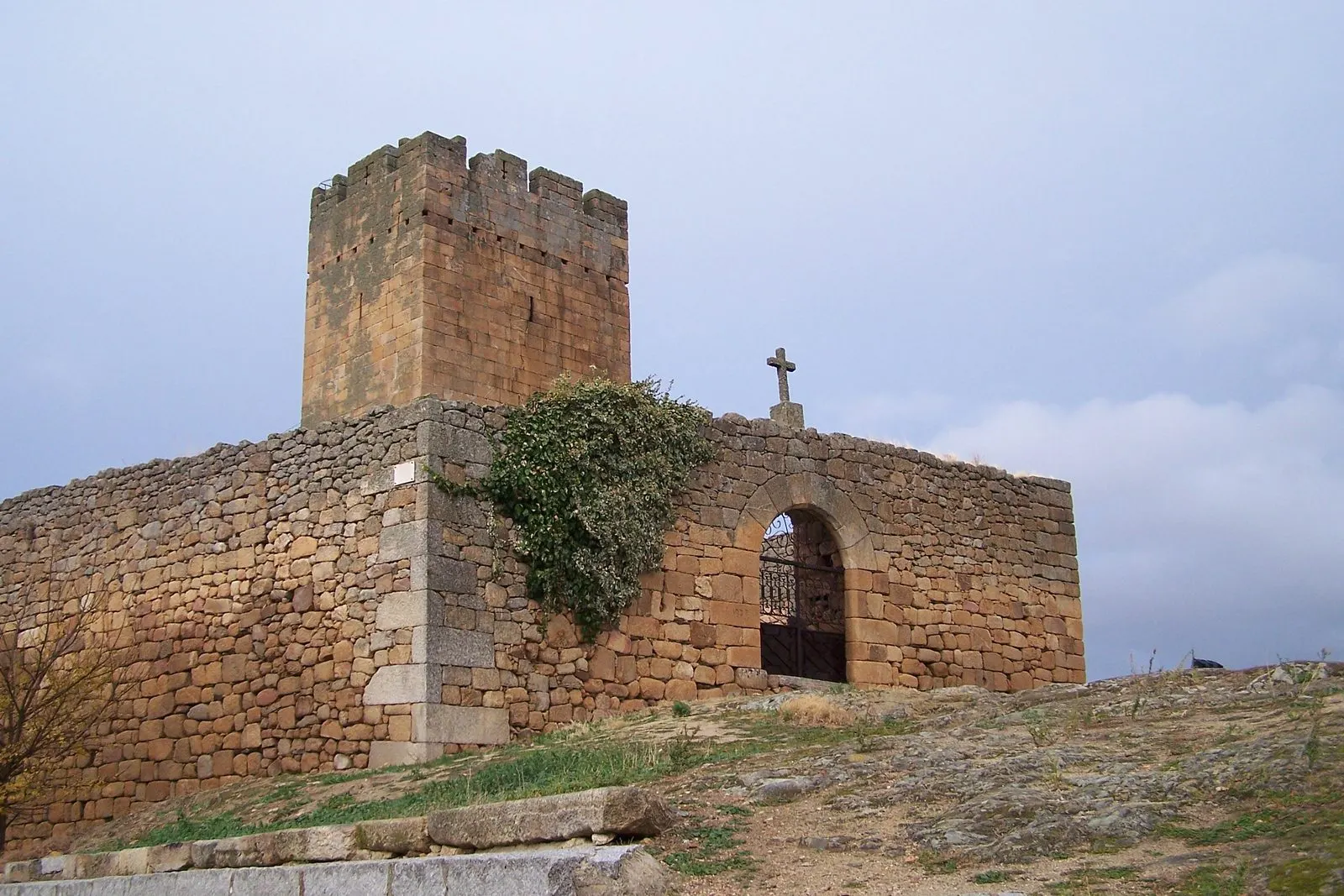
Castle of Langóbria, or Longroiva, in Mêda: a Templar castle with a keep dated 1174, later a commandery of the Order of Christ. National Monument.
- Location
- Longroiva, Mêda, Guarda
- Built
- Torre de menagem templária datada epigraficamente de 1174; paço do comendador da Ordem de Cristo em 1505
The Castle of Longroiva stands in the village of Longroiva, in the municipality of Mêda, district of Guarda. In the national register of Cultural Heritage (Património Cultural, I.P.) and in the decree that classified it as a National Monument in 1943, it is called Castelo de Langóbria. Castelo de Longroiva is the other designation accepted by the register and the name used by the Municipality of Mêda. Little of the medieval castle remains, but the register considers it one of the most important works of Templar military architecture in Beira Interior and one of the best surviving examples of Romanesque castles in the region.
Two names for the same place
The Municipality of Mêda links the name Langóbria to the Roman period. According to the municipality, during the Roman occupation the settlement of “Langóbria” took shape here, with the Romanisation of the earlier hillfort. The municipality also notes that the Muslims supposedly razed the fortification and that the region was reconquered in the 11th century by Fernando Magno, king of León. The national register is more cautious: it says only that an early castle, of unknown form and style, is first mentioned in 960.
A castle of the Templars
The Romanesque castle of Longroiva arose from the defence of Coimbra, then the capital of the kingdom. D. Afonso Henriques entrusted the Templars with protecting the approaches to the south and east of the Mondego. In 1145 the Order received, among other lands, Mogadouro and Penas Róias, in Trás-os-Montes.
In that same decade, the early castle of Longroiva was in the hands of the Braganção family. According to the national register, it was Fernão Mendes de Bragança who donated it to the Templars. The Municipality of Mêda attributes the handover of the land to the Order of the Temple to D. Afonso Henriques, around 1145. The Templars built an exemplary fortification here.
The keep of 1174
The only original element that remains is the keep, dated by inscription to 1174. This is an early date for this type of tower in Portugal. The register cites the historian Mário Barroca, for whom it was the Templars who introduced the keep into Portuguese castles, first at Tomar, in the early 1160s. Longroiva thus belongs to the group of fortresses promoted by D. Gualdim Pais, master of the Order in Portugal. It is contemporary with Almourol and Pombal, both from the 1170s.
A Visitation of 1505 shows that the tower was then a freestanding structure in the central courtyard, a fully Romanesque characteristic. It had three floors and already had the Manueline window with mullion that it still preserves. On the tower can also be seen the supports of a hoarding: a timber gallery running all around, which protected the top and allowed attackers at the foot of the wall to be struck from above.
Commandery of the Order of Christ
With the suppression of the Order of the Temple, in the reign of D. Dinis, Longroiva passed to the Order of Christ. According to the Municipality of Mêda, this possession lasted at least until the mid-16th century. In 1505, the Romanesque courtyard was almost entirely occupied by the commander’s residence. The Visitation says some parts were new, which points to work from the same period as the Manueline window. The architect José Daniel Santa Rita attempted a schematic reconstruction of this residence.
According to the municipality, D. Teresa granted a charter (foral) to Longroiva in 1124, confirmed by D. Afonso II in 1220, and D. Manuel I issued a new charter in 1510.
Ruin, quarry and cemetery
Longroiva lost importance in the early modern period. Two centuries after 1505, the residence’s houses were roofless and in ruin. The cistern was blocked up, and the castle gates no longer had grilles or doors.
At the turn of the 19th century, the castle began to serve as a quarry, and the walls were gradually dismantled. According to the register, this coincided with the abolition of the municipality of Longroiva. The municipality dates that abolition to a decree of 6 November 1836. Later, the central courtyard was turned into the village cemetery.
In the 20th century, investigations revealed some original structures, such as the cistern. Despite some attempts at rehabilitation, the monument has reached us in ruin. The municipality notes that conservation work has allowed parts of the walls and the keep to be kept.
Classification and protection
The castle is a National Monument under Decree No. 32 973, published in the Diário do Governo, I Série, No. 175, of 18 August 1943. The decree registers it as “Concelho de Meda. — Castelo de Langóbria”. The Atlas of Classified Heritage does not indicate a special protection zone of its own. In the same parish, the Pillory of Longroiva and the Roman Bridge of Longroiva are Properties of Public Interest. The castle is not part of any UNESCO inscription.
Planning a visit
The castle stands in the village of Longroiva itself. When consulted on 5 November 2026, the Municipality of Mêda page did not publish opening hours or visiting conditions.
In the same municipality stands the Castle of Marialva, in the historic village of Marialva. For other Templar and frontier castles, consult the castles of Portugal and the Centro region.
Photograph by Lusitana, 6 December 2008. Original on Wikimedia Commons, under CC BY-SA 3.0; resized and compressed for the web, without altering the composition.
Frequently asked questions
- Are Castelo de Langóbria and Castelo de Longroiva the same monument?
- Yes. The National Heritage Register (Património Cultural, I.P.) and the 1943 classification decree use the designation Castelo de Langóbria; the register gives Castelo de Longroiva as another designation, and this is the name used by the Municipality of Mêda. It is located in the parish of Longroiva, municipality of Mêda.
- Who built the castle?
- According to the national register, an early castle, first mentioned in 960, was donated to the Templars by Fernão Mendes de Bragança in the 1140s. The Templars built a new fortification, of which the keep remains, dated by an inscription to 1174.
- What remains of the castle?
- The keep, the only original element that survives, and parts of the walls. At the turn of the 19th century the castle served as a quarry, and the central courtyard was turned into the village cemetery.
- Is the castle classified?
- Yes. It is a National Monument under Decree No. 32 973, published in the Diário do Governo, I Série, No. 175, of 18 August 1943, which registers it as Castelo de Langóbria, in the municipality of Mêda.
Sources
- Património Cultural, I.P. — Castelo de Langóbria (71169)
- Património Cultural, I.P. — Atlas do Património Classificado, Castelo de Langóbria (NINV 2978)
- Diário do Governo — Decreto n.º 32 973, de 18 de agosto de 1943
- Município de Mêda — Castelo e Aldeia de Longroiva
- Município de Mêda — Freguesia de Longroiva
- Wikidata — Castelo de Longroiva (Q5049787)
Keep exploring
Heritage nearby
More places to discover from here. Approximate straight-line distances, within 50 km.