Monuments
Montalegre Castle
Montalegre Castle, in Barroso: a Gothic frontier castle whose keep was completed around 1331, a National Monument since 1910. History and visiting information.
- Location
- Montalegre, Vila Real
- Built
- Séculos XIII–XIV (torre de menagem concluída c. 1331)
The Montalegre Castle dominates the town of the same name, on the Barroso plateau, a short distance from the border with Galicia. It is a Gothic castle of modest dimensions, with a small walled courtyard, but its tall, massive granite keep can be seen from afar and has become the emblem of the town. It is one of the pieces of the network of castles that defended the north of Trás-os-Montes, alongside fortresses such as those of Chaves and Bragança.
A royal foundation on a difficult frontier
The national register of the Portuguese Cultural Heritage, I.P. describes the castle as a medieval military structure of relatively late construction. It belongs to the reorganisation of the border areas east and west of Chaves undertaken by D. Afonso III, who sought to give the northern Trás-os-Montes frontier a territorial and legal order dependent on the king. The result fell short of expectations. Before the end of the 13th century, D. Dinis had to grant Montalegre a new charter, in 1289, and entrust its settlement to Pedro Anes, because the population had then dwindled.
These difficulties are reflected in the building. The initial design would have included three smaller towers integrated into the oval enclosure. The national register considers the castle modest in resources, yet with the main features of a Gothic fortress: an oval plan, curtain walls interrupted by square and rectangular towers, and a keep linked to the enclosure rather than isolated in the centre of the courtyard.
The keep
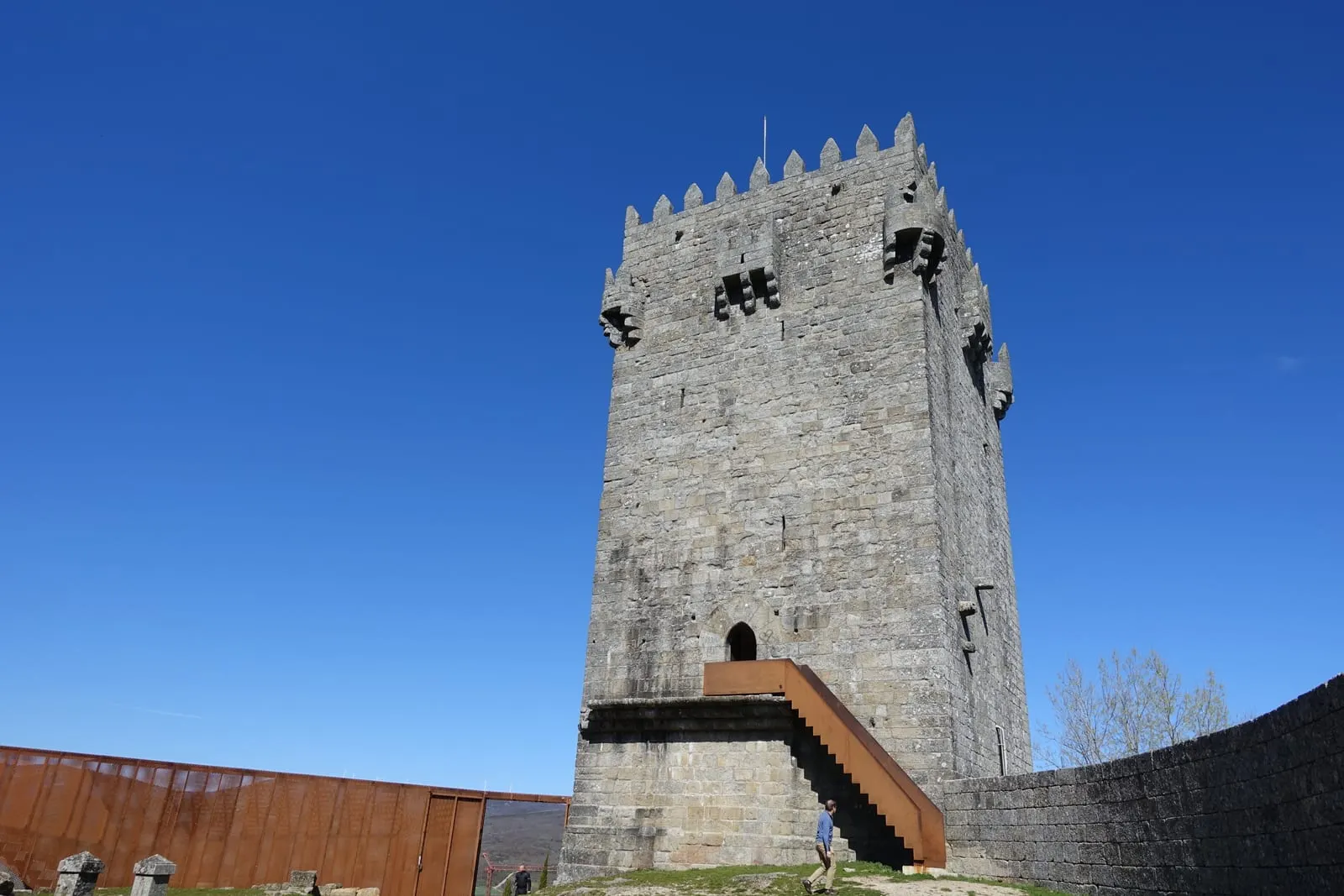
The keep does not belong to the first phase of works. According to the national register, it dates from the reign of D. Afonso IV and was probably completed around 1331. It is taller and wider than the other towers and stands as the principal mark of power of the castle and the town.
It has a stepped, projecting plinth and four storeys, which from the outside are only hinted at by the window openings and the corbelled machicolated balconies. Inside there are vaulted spaces and drainage systems. On the top floor, narrow passages cut into the thickness of the walls give access to the balconies. The tower is crowned by pentagonal crenellations, also used on the balconies. Entry is through a single raised doorway, at the level of the wall walk and facing the courtyard. In case of assault, the tower could thus function as an independent stronghold.
The enclosure and the other towers
The national register identifies three towers besides the keep. The Torre Furada is the only one with a square plan and is crowned with crenellations. It has two doorways, one at courtyard level and another at the height of the wall walk. The latter, with a round arch, has its tympanum decorated with the cross of the Order of Christ. The Pequena and do Relógio towers are rectangular and lower.
The courtyard is small and contains a cistern. The castle had two gates, of which the eastern one survives. The main entrance lay to the north, protected by the keep.
Early modern works
The last major medieval campaign took place under D. João II. It is known from the drawings of Duarte de Armas, from the early 16th century. The main entrance was then reinforced with a redoubt of circular towers, equipped with gun loops on two firing levels. Only the lower levels survive.
The castle received works again only in the 17th century, during the Wars of the Restoration. Several bastions and star-shaped ravelins date from this phase. This is the ensemble that has come down to the present day. The national register also notes that in 1990 the castle received a museum nucleus and that, more recently, exploratory excavations were carried out on the site.
Classification and protection
The castle is a National Monument under the Decree of 16 June 1910, published in the Diário do Governo no. 136, of 23 June 1910. It has a special protection zone, with a non aedificandi zone, set by the Ordinance of 21 September 1957, published in the Diário do Governo, II Series, no. 272, of 22 November 1957. It is not part of any UNESCO inscription.
Preparing the visit
The castle stands at the top of the town, in the Terreiro do Açougue. When consulted on 5 November 2026, the tourism portal of the Alto Tâmega e Barroso Intermunicipal Community listed opening hours of 10:00 to 13:00 and 14:00 to 18:00, with closing on Mondays, except public holidays. Information on the admission price was not clear. We did not find published hours on the website of the Montalegre Municipal Council. Before going, confirm opening hours, price and access to the interior of the tower with the municipality or on the regional tourism portal.
The visit can continue eastward to Chaves, another town of the former Trás-os-Montes frontier. To compare Montalegre with other fortresses, consult the castles of Portugal and what the classification of National Monument means.
Photograph by Joseolgon, dated 14 March 2020. Original on Wikimedia Commons, under CC BY-SA 4.0; resized and compressed for the web, without altering the composition.
Frequently asked questions
- When was Montalegre Castle built?
- The castle arose from the reorganisation of the Trás-os-Montes frontier promoted by D. Afonso III in the 13th century. D. Dinis granted the town a new charter in 1289. The keep is later: it dates from the reign of D. Afonso IV and was probably completed around 1331.
- Is Montalegre Castle listed as a heritage site?
- Yes. It is a National Monument under the Decree of 16 June 1910, published in the Diário do Governo no. 136, of 23 June 1910. It also has a special protection zone, with a non aedificandi zone, set by a ministerial ordinance of 1957.
- What towers does the castle have?
- Besides the keep, the national register identifies three towers: the Torre Furada, the only square one, with the Order of Christ cross in the tympanum of the upper doorway, and the Pequena and do Relógio towers, rectangular and lower.
- Can the castle be visited?
- Yes. When consulted on 5 November 2026, the tourism portal of the Alto Tâmega e Barroso Intermunicipal Community listed opening hours of 10:00 to 13:00 and 14:00 to 18:00, closed on Mondays except public holidays. Please confirm before going.
Sources
- Património Cultural, I.P. — Castelo de Montalegre (70167)
- Património Cultural, I.P. — Atlas do Património Classificado, Castelo de Montalegre (NINV 4485)
- Diário do Governo — Decreto de 16 de junho de 1910 (n.º 136, 23-06-1910)
- Visit Alto Tâmega e Barroso (CIM do Alto Tâmega e Barroso) — Montalegre Castle
- Wikidata — Castelo de Montalegre (Q6904195)
Keep exploring
Heritage nearby
More places to discover from here. Approximate straight-line distances, within 50 km.