Monuments
Sanctuary of Our Lady of Aires
Sanctuary of Our Lady of Aires, in Viana do Alentejo: Baroque complex of 1743–1760, gilded wood baldachin, ex-votos, pilgrimage and classification.
- Location
- Aires, Viana do Alentejo, Évora
- Built
- Obras documentadas entre 1743 e 1760 (barroco); substitui um templo primitivo de fundação quinhentista
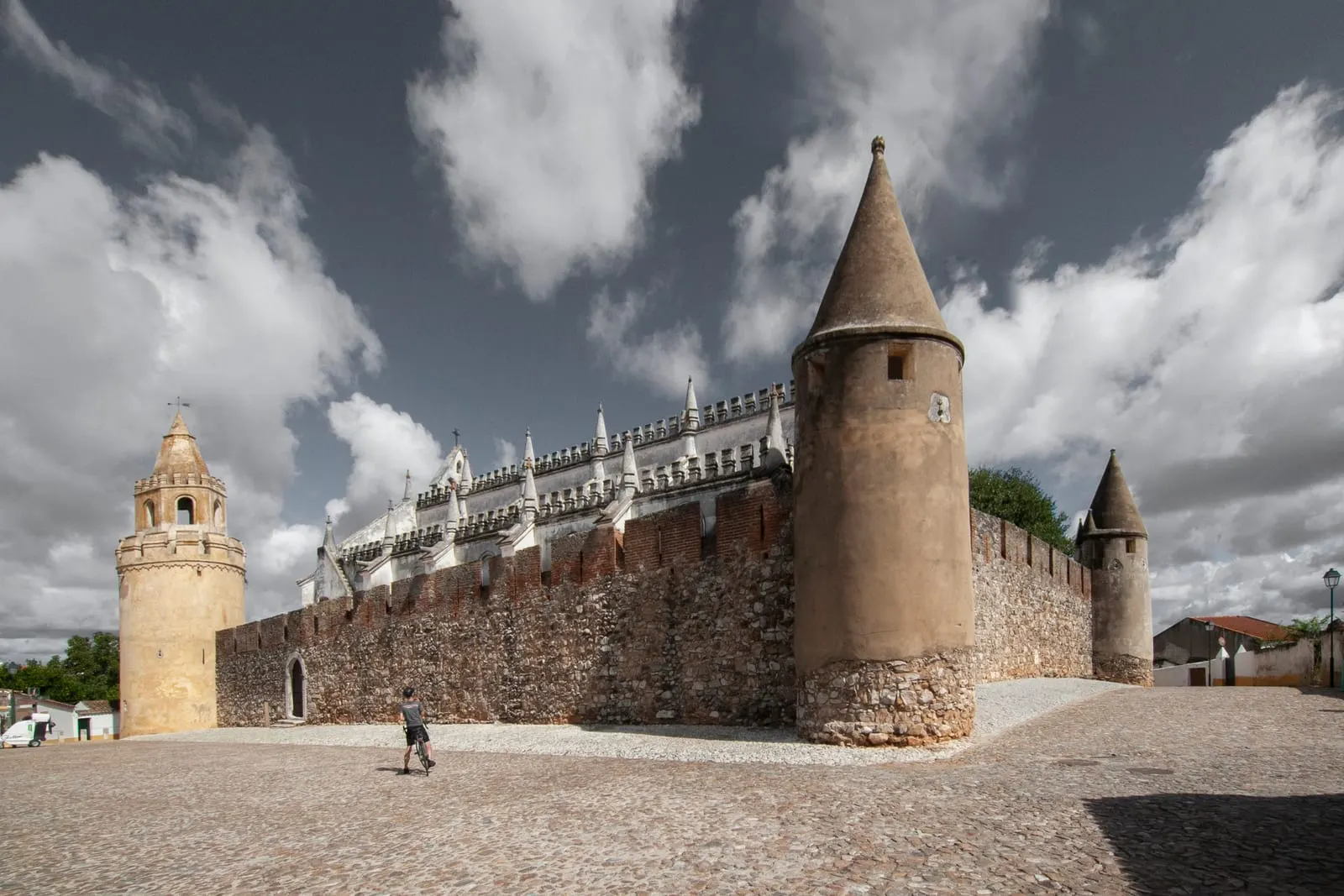
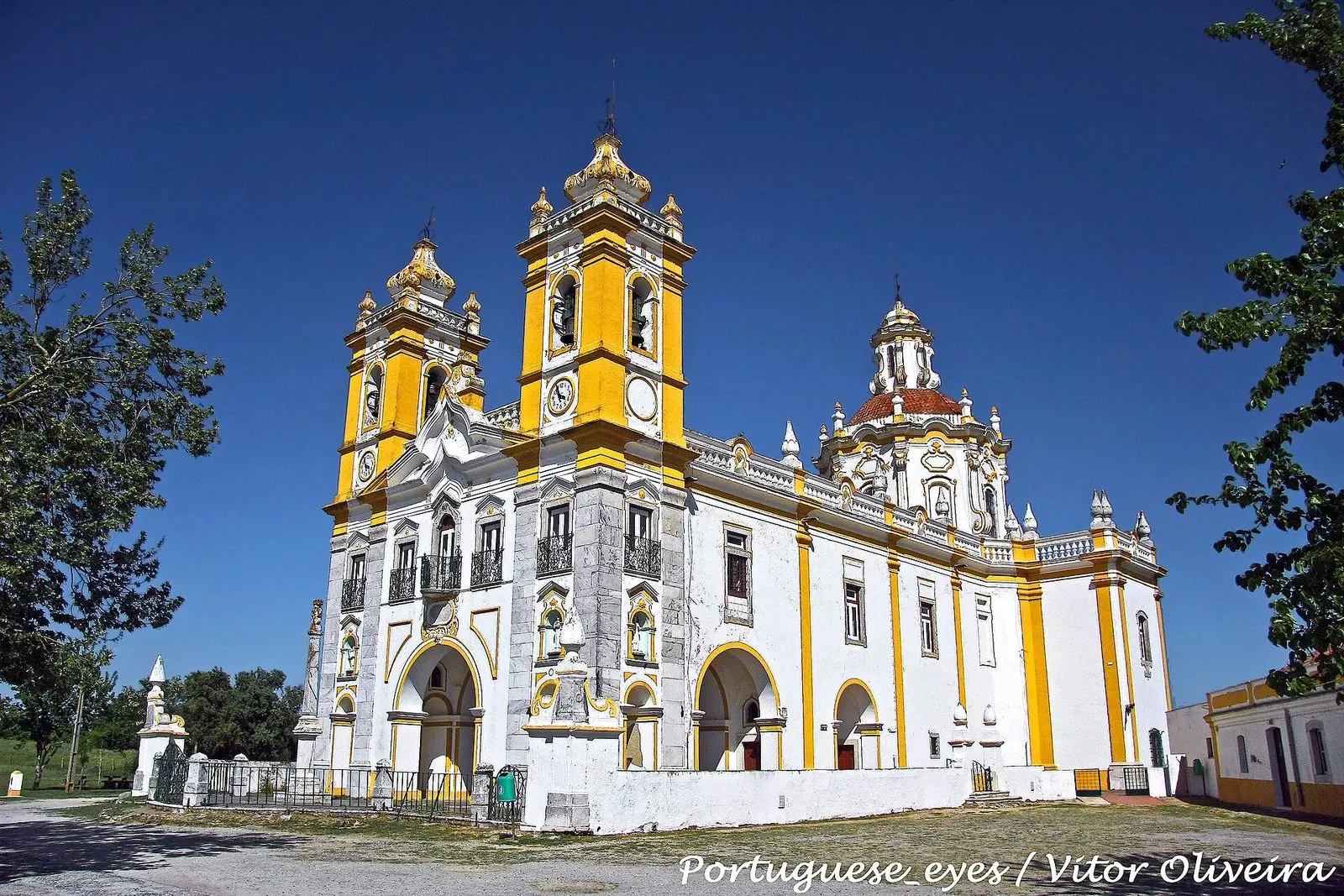
The Sanctuary of Our Lady of Aires stands isolated in the countryside on the outskirts of Viana do Alentejo, in the district of Évora. From a distance, what one sees is a mass of whitewash with yellow quoins, two towers with bulbous finials and an octagonal drum. It is neither a Manueline church nor a fortified temple, as is sometimes stated: the classification decree defines it as one of the most interesting and outstanding ensembles of Alentejo Baroque. The town’s Manueline parish church lies elsewhere, within the castle of Viana do Alentejo.
An Ancient Cult, a New Temple
The decree states that the present sanctuary, with works documented between 1743 and 1760, replaces an earlier building founded in the sixteenth century. What survives from that origin is the image that gives the place its name: a fifteenth-century Our Lady of Pity (Virgin of Pity), brought from the earlier construction and now kept in a glazed niche on the high altar. The decree recalls that the sanctuary is the destination of pilgrimages from across the region, the Alentejo, so the cult predates the present church.
The diploma also notes that the design reveals Mafra influences, visible in the undulating walls and in the façade with its octagonal drum, of great scenographic effect, flanked by towers with bulbous domes. The reference is the Convent of Mafra, and the complex belongs to the Portuguese Baroque architecture of the eighteenth century.
What to See
The decree describes an interior of festive decoration, combining mural painting, coloured stucco, azulejos, marble and carved woodwork. The most striking element is the enormous gilded woodwork baldachin that shelters the image of the Virgin. For the context of azulejos in churches, see the general article.
The classification covers more than the church. It includes the entire sanctuary enclosure: the temple and its annexes, the former hospice, now in ruins, and the fountain and basin of Our Lady of Aires, in the Terreiro dos Peregrinos, dated to 1640, therefore earlier than the eighteenth-century work. In the Casa dos Milagres (House of Miracles), formerly the hall of the confraternities, and in the annexes, a large number of ex-votos are kept, from the eighteenth century to the present, direct testimony to vows made to the Virgin.
Not far away is the Hermitage of the Lord Jesus of the Cruzeiro, classified in the same decree. It is a small, nearly square temple, covered by a dome in the manner of the Alentejo «cubas», with a Baroque chronology (perhaps from the first half of the eighteenth century). It is partly ruined but retains traces of mural painting. The decree suggests that it may have preceded the sanctuary and that the image was kept there while the church was being built.
The Pilgrimage and the Fair
The decree attributes the origin of the Pilgrimage of Our Lady of Aires to a royal charter of King José I which, in 1751, authorised a free fair on the site. According to the tourist information and press consulted, the main festival takes place on the fourth weekend of September, with a procession around the temple. Rádio Renascença also reported an equestrian pilgrimage, departing from the Church of Our Lady of Good Voyage in Moita, which reaches the sanctuary in April. We did not find the official 2026 programme: the dates should be confirmed with the municipality. For other cases, see Portuguese sanctuaries and pilgrimage sites.
Rádio Renascença also reported the reopening of the sanctuary in May 2021. For the study of its architecture and devotion, the cited reference is the master’s dissertation by Raquel Seixas, O Santuário de Nossa Senhora de Aires: arquitectura e devoção (1743-1792) (Universidade Nova de Lisboa), which we were unable to consult.
Classification and Protection
The sanctuary is a National Monument under Decree No. 31-J/2012 of 31 December (Diário da República, 1st series, No. 252, supplement), which classified it together with the Hermitage of the Lord Jesus of the Cruzeiro. The special protection zone was set by Ministerial Order No. 307/2014 of 14 May (Diário da República, 2nd series, No. 92). The Atlas of Classified Heritage places it in a rural setting and indicates that no restrictions apply. It is not a UNESCO World Heritage Site.
Planning a Visit
The sanctuary lies in the locality of Aires, in the civil parish and municipality of Viana do Alentejo. When consulted on 5 November 2026, we did not find an official opening schedule or visiting conditions published in a source we could read. The municipality maintains pages on the Pilgrimage Route to Our Lady of Aires and on the Feira D’Aires; it is there, or through the Câmara Municipal de Viana do Alentejo, that you should confirm opening hours, access to the interior and festival dates, especially in September.
Photograph by Vitor Oliveira (Portuguese_eyes), dated 29 June 2012; the image carries the author’s signature. Original on Wikimedia Commons, under CC BY-SA 2.0; resized and compressed for the web, without altering the composition.
Frequently asked questions
- Is the Sanctuary of Our Lady of Aires Manueline?
- No. The classification decree describes it as one of the most interesting Baroque complexes in Alentejo, with works documented between 1743 and 1760 and influence from Mafra. The Manueline parish church of Viana do Alentejo stands inside the town's castle, not at the sanctuary, which lies on the outskirts.
- When does the pilgrimage take place?
- The decree links the pilgrimage to a royal charter of King José I which, in 1751, authorised a free fair on the site. According to the press and tourist information consulted, the main festival takes place on the fourth weekend of September, and an equestrian pilgrimage departing from Moita takes place in April. Please confirm the dates with the Câmara Municipal de Viana do Alentejo.
- What is the classification of the sanctuary?
- National Monument, under Decree No. 31-J/2012 of 31 December (Diário da República, 1st series, No. 252, supplement). The special protection zone was set by Ministerial Order No. 307/2014 of 14 May. The same decree classified the Hermitage of the Lord Jesus of the Cruzeiro.
- Can I visit the sanctuary?
- When consulted on 5 November 2026, we did not find an official schedule published in a source we could read. For opening hours, visits to the interior and the festival programme, please contact the Câmara Municipal de Viana do Alentejo.
Sources
- Património Cultural, I.P. — Santuário de Nossa Senhora de Aires (11942233)
- Património Cultural, I.P. — Atlas do Património Classificado (NINV 74130)
- Diário da República — Decreto n.º 31-J/2012, de 31 de dezembro (1.ª série, n.º 252, suplemento)
- Diário da República — Portaria n.º 307/2014, de 14 de maio (ZEP)
- Município de Viana do Alentejo — Rota de Peregrinação a Nossa Senhora D'Aires
- Rádio Renascença — Reabertura do Santuário de Nossa Senhora de Aires (14-05-2021)
- Rádio Renascença — Da Moita a Viana do Alentejo. Está de volta a Romaria a Cavalo (19-04-2022)
- Wikidata — Santuário de Nossa Senhora de Aires (Q39999251)
Keep exploring
Heritage nearby
More places to discover from here. Approximate straight-line distances, within 50 km.