Monuments
Fountains Listed as National Monuments
Seven fountains classified as National Monuments: Virtudes and Passeio Alegre in Porto, Esperança in Lisbon, Portas de Moura, Borba, Santarém and Caminha.
A fountain was the final point of a water supply network: water arrived by conduit or gallery and left through spouts, usually into separate basins, one for people and one for animals. The seven gathered here are National Monuments and span six centuries, from Gothic to Baroque, with the Renaissance in between. The fountains of Évora (Praça do Giraldo) and Torres Vedras (Chafariz dos Canos) have their own pages. The descriptions follow the records of the Património Cultural.
A Gothic fountain: Santarém
The Fonte das Figueiras, commonly called the «Fonte Mourisca», stands in the city of Santarém. The record regards it as one of the rare examples of Gothic civil architecture for water supply in medieval Portugal. It has a square plan, corner piers supporting a crenellated portico, and a pointed arch on each façade, the main one being the largest. Two coat-of-arms stones on the south and west façades show that the work was carried out jointly by the municipality and the king, either D. Dinis or D. Afonso IV. A master mason with an alphabetiform mark, read as «Ioannis», is thought to have carved the capital «of the three florets» and also worked on the cloister of São Francisco in Santarém. The record compares it with the fountain of Atouguia da Baleia and with the contemporary Chafariz dos Canos in Torres Vedras.
The Renaissance fountains
The Chafariz das Portas de Moura, in Évora, was inaugurated on 4 December 1556, according to the inscription on the sphere, and is believed to be the work of Diogo de Torralva, who directed the works on the Aqueduto da Prata. Two rectangular basins, the main one on a higher level, receive water from a marble sphere on a circular shaft, with four gargoyles in the form of seraphs. It forms part of the urban renewal of Cardinal D. Henrique and introduces the Mannerist type of fountain to which the Giraldo fountain belongs. It is a National Monument under Decree No. 8 218 of 29 June 1922.
The Chafariz da Praça Municipal in Caminha, or Chafariz do Terreiro, arose from a municipal decision in 1551: residents had to fetch water from outside the town, and the Viana master João Lopes, the Elder, was engaged. It follows the pyramidal model the master had already used in Porto and Pontevedra: a large basin on a staircase, a decorated pillar, a column of great proportions and two superimposed bowls, the larger with six masks and the second with four, topped by a pinnacle bearing the town’s coat of arms. The record describes the masks as men of the sea, legendary figures and hybrid beings, and suggests they may represent the «quarters of the world», since some figures appear to be of different races. See also Caminha.
The Baroque and 18th-century fountains
The Chafariz das Virtudes, in Porto, was built in 1619, also called the Fonte do Rio Frio, as part of the municipal programme to rationalise the water supply. Little is known about the work; the surviving indication attributes its design to Pantaleão de Seabra e Sousa, the city’s regedor. It is a Baroque fountain of three panels set against a back wall, with a marble inscription bearing the date, two castles from the city’s arms flanking an empty niche thought to have been intended for an image of Nossa Senhora das Virtudes, and a circular pediment with the royal arms, a later addition in a Neoclassical style.
The Chafariz da Esperança, in Lisbon, is connected to the Aqueduto das Águas Livres. In 1752 the Câmara bought land from the Franciscan convent of Nossa Senhora da Esperança, and the design is by Carlos Mardel. The supply gallery came from the Amoreiras reservoir. The ensemble abuts a building and has two levels served by side staircases, with a basin on each: the lower one, at ground level, served as a watering trough for animals. It is crowned by a portico in the Pombaline taste. It has had a special protection zone since 1998 (Portaria No. 512/98).
The Chafariz do Passeio Alegre, in Foz do Douro (Porto), is an 18th-century work from the last quarter of that century, and its history «remains shrouded in contradictions». It has been attributed to Nicolau Nasoni and to the Quinta da Prelada, but some authors cited in the record say it came from the cloister of the Convent of São Francisco, destroyed in 1833, where the Palácio da Bolsa now stands. It has a quadrilobed basin, a polylobed bowl on a fusiform column and four gargoyles on the bowl; the garden, designed in 1870 by Emílio David, opened in 1888. See Porto.
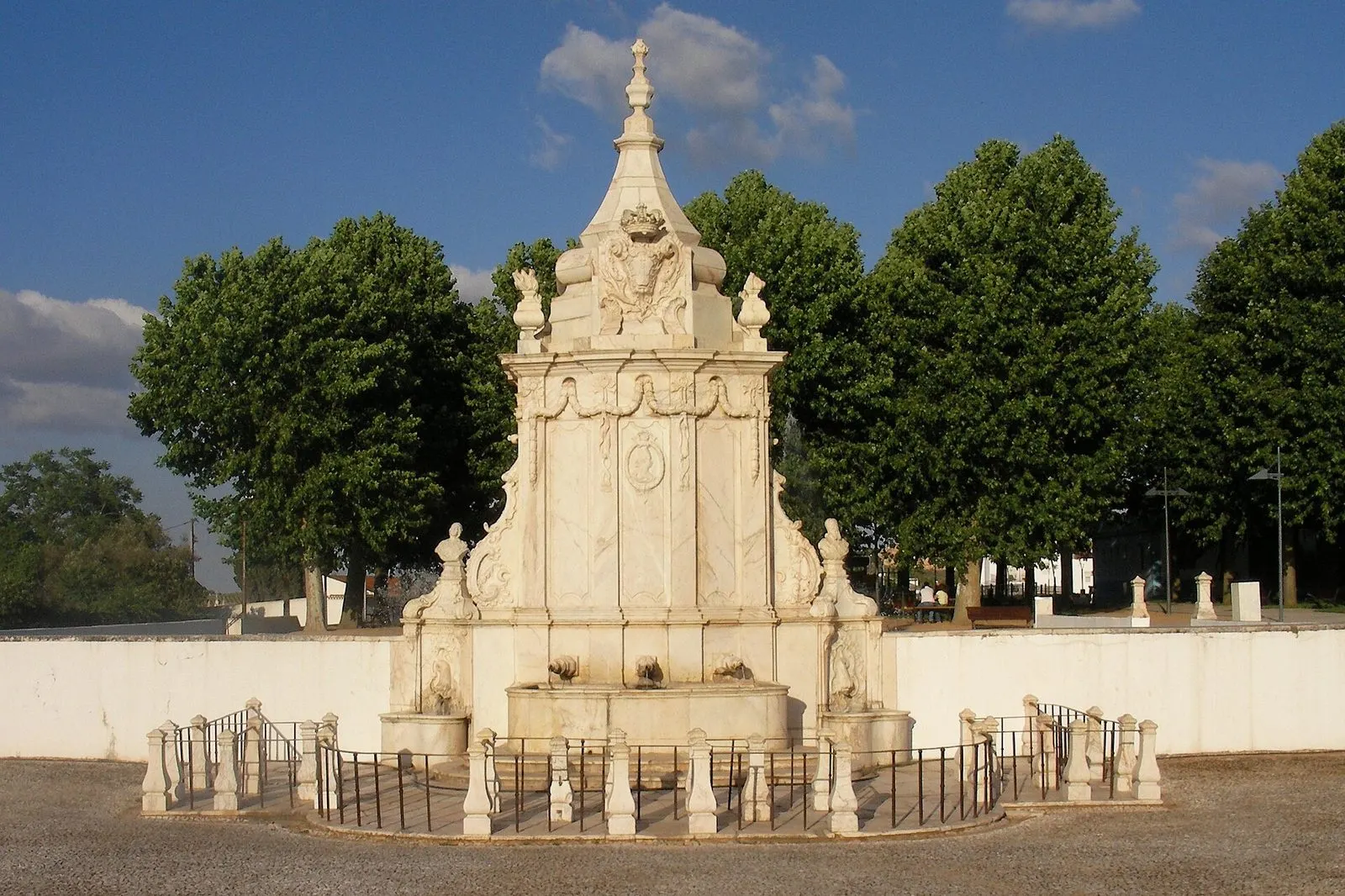
The Chafariz de Borba, or Fonte das Bicas, is the largest work. It is Baroque, in white marble, and the municipality commissioned it in 1781 to mark the visit of D. Maria I and D. Pedro III, as the inscription states. The design is by the engineer José Álvares de Barros, the execution by José Mendes da Silva and the sculptor António Franco Painho, and the final inspection in 1785 was carried out by the local artists António and Angélico Velez. It has three basins, busts of the kings, Neoclassical garlands and a frontispiece with a medallion of the queen. Attached, a long basin runs into the Jardim Municipal and ends in a watering trough and a washing place, linking the commemorative monument to everyday needs.
Reading the group
The oldest and the latest show two logics. In Santarém, the medieval fountain is the product of cooperation between municipality and crown. In Borba, more than four centuries later, it is the town that commissions a piece of royal propaganda and public service. In between lie the Renaissance works of Évora and Caminha and the supply of Lisbon by the Águas Livres. For typology, see fountains and wells.
The fountains stand in public space and can be visited at any hour. When consulted on 5 November 2026, we did not find a recent official source on the current water-flow status of each one; please check with the municipality.
Photograph by Bobacajana (Chafariz de Borba, 10 June 2007). Original on Wikimedia Commons, under CC BY-SA 4.0; resized and compressed for the web, without altering the composition.

Frequently asked questions
- Which of these fountains are Gothic?
- Only the Fonte das Figueiras in Santarém, which the official record describes as a rare example of Gothic civil architecture for water supply, dating from the 14th century, with pointed arches and a crenellated portico.
- Which predate the 17th century?
- The Fonte das Figueiras (14th century), the Chafariz das Portas de Moura (inaugurated in 1556) and the Chafariz da Praça Municipal in Caminha (commissioned in 1551). The others are from the 17th or 18th centuries.
- Are there other fountains that are National Monuments?
- Yes: the Praça do Giraldo fountain in Évora and the Chafariz dos Canos in Torres Vedras each have their own page in this guide. There are also others in the Atlas, such as the one in Viana do Castelo, which we do not cover here.
- When were they classified?
- Six by decree of 16 June 1910. The Portas de Moura fountain was classified by Decree No. 8 218 of 29 June 1922.
Sources
- Património Cultural, I.P. — Chafariz das Virtudes (registo 70202, NINV 3718)
- Património Cultural, I.P. — Chafariz do Passeio Alegre (registo 70686, NINV 3720)
- Património Cultural, I.P. — Chafariz da Esperança (registo 70183, NINV 3224)
- Património Cultural, I.P. — Chafariz das Portas de Moura (registo 69787, NINV 2710)
- Património Cultural, I.P. — Chafariz de Borba (registo 70230, NINV 2669)
- Património Cultural, I.P. — Fonte das Figueiras (registo 70663, NINV 3923)
- Património Cultural, I.P. — Chafariz da Praça Municipal, Caminha (registo 70682, NINV 4101)
- Património Cultural, I.P. — Atlas do Património Classificado
- Diário do Governo n.º 136, de 23 de junho de 1910
- Diário do Governo, I Série, n.º 130, de 29 de junho de 1922 (Decreto n.º 8 218)