Monuments
Giraldo Square Fountain, Évora
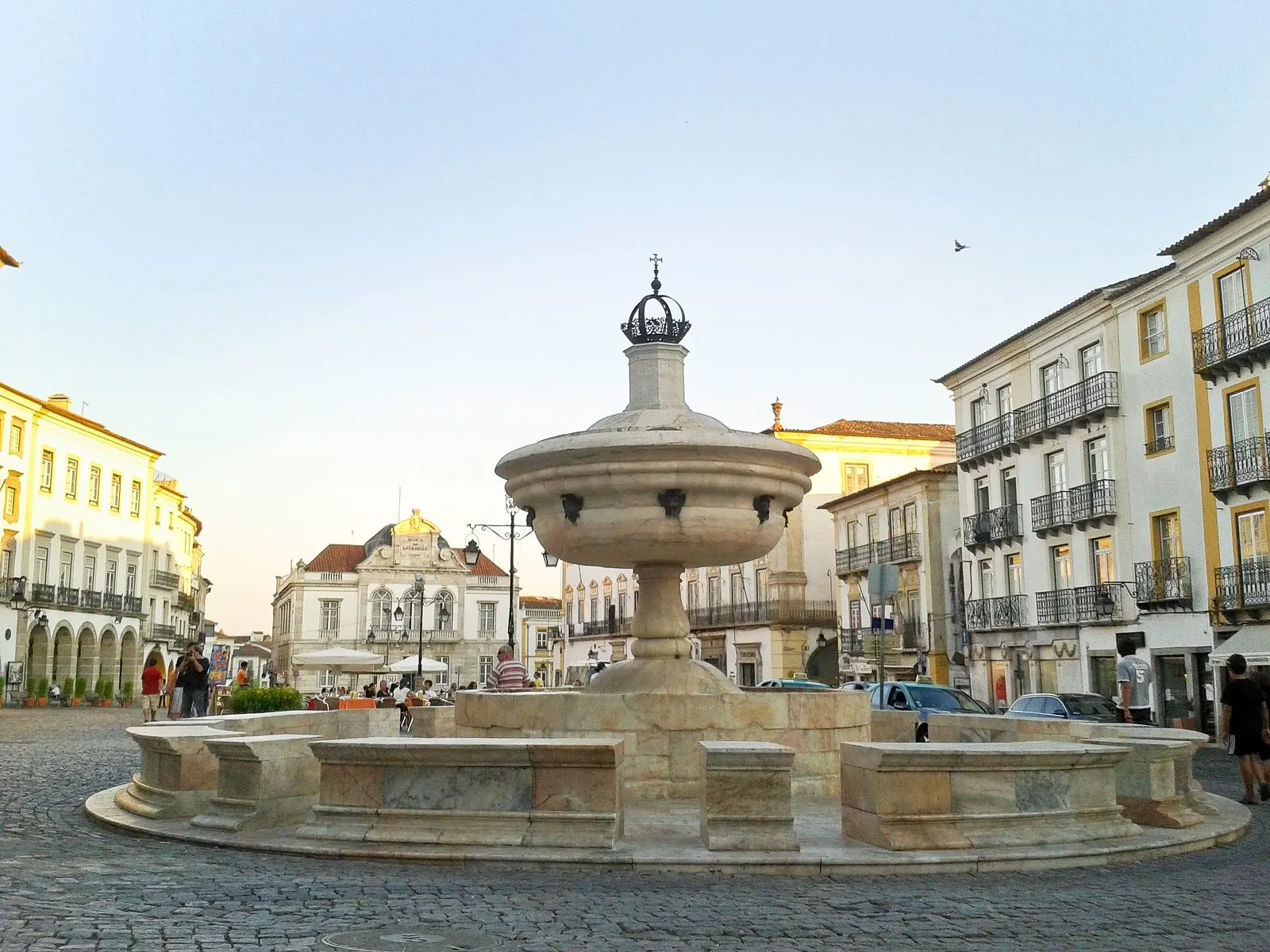
Chafariz da Praça do Giraldo, in Évora: a marble work of 1571 by the architect Afonso Álvares, with eight bronze gargoyles and the crown of D. Sebastião.
- Location
- Évora, Évora
- Built
- 1571
The Chafariz da Praça do Giraldo is the symbolic centre of Évora. It was built in 1571, in white marble, and still marks the square where several streets of the historic centre converge. The work belongs to the family of Renaissance fountains linked to a public water supply network, in this case that of the Aqueduto da Água de Prata.
A fountain that replaced another
When the Aqueduto da Água de Prata was completed, in 1537, it ended in this square. The official inventory of architectural heritage (SIPA) records that a first fountain was then raised, at an undetermined location, leaning against the Roman triumphal arch that stood in the square. It is known to have been decorated with marble lions.
In 1570, the Cardinal-Infante D. Henrique, Archbishop of Évora, asked the council to have the arch dismantled, to clear the square and the view of the recently built Church of Santo Antão, which he himself had promoted. The marble columns of the arch were recovered from the Colégio do Espírito Santo. In 1571 the new fountain was erected. The Património Cultural record places it within Henrician plans to modernise the city centre.
The design: shaft, basin and case
The project is attributed to the architect Afonso Álvares, master builder to the Infante D. Henrique. The structure has a circular, centralised plan, entirely in white marble, and reads from bottom to top in five parts: cylindrical base, turned shaft, basin, case and finial.
The basin takes the form of a very shallow spherical cap, deeply moulded. The case, taller, has the shape of a pyx, the liturgical vessel that holds the consecrated hosts. At the top, on a small octagonal shaft, sits the royal crown of D. Sebastião, in bronze. An inscription around this section honours the monarch, marking the royal patronage of the work.
The most easily recognised feature, even from a distance, are the eight bronze gargoyles that terminate the spouts. Water runs from them into the basin. Popular tradition links the eight gargoyles to the eight streets that open onto the square; this is a common reading in local guides, but it does not appear in the official record as a documented fact.
The sobriety of the ensemble was noted by the inventory compilers. The SIPA record describes it as very sober and says it harmonises with the plain-style façade of the Church of Santo Antão, which lies opposite, and considers it the most monumental of the water supply structures built downstream of the aqueduct.
Water, market and square
For centuries the square, known as the Terreiro or Praça de Alconchel in the 13th and 14th centuries and later as the Praça Grande, was a daily market, an annual fair and a venue for bullfights, according to the same record. The fountain was therefore one of the most important water supply structures for the population. Today SIPA indicates a cultural and recreational use, as an ornamental fountain.
For visitors strolling through Évora, it is worth seeing the square together with the walls of Évora and the pillory of Évora, which show the city as a political and commercial centre.
Classification
The fountain is classified as a National Monument by the Decree of 16 June 1910, published in the Diário do Governo no. 136, of 23 June 1910. It also has a special protection zone, recorded in SIPA as published in the Diário do Governo, 2nd series, no. 101, of 2 May 1950. The property is municipal.
This entry deals only with the fountain as a classified monument; the other buildings on the square, such as the Church of Santo Antão, have their own records.
How to visit
The fountain stands in a public square, in the heart of the historic centre, and has no opening hours or tickets. It is a good starting point for a walking route, with the aqueduct, the Cathedral and the walls all in the same area. As the square is used for events and urban traffic, check any restrictions on the Évora municipality website before planning your visit.
Photograph by José Miguel Soares, 19 August 2013. Original on Wikimedia Commons, under CC BY-SA 3.0; resized and compressed for the web, without altering the composition.
Frequently asked questions
- When was the Chafariz da Praça do Giraldo built?
- The national heritage register dates its construction to 1571, during the reign of D. Sebastião. It replaced an earlier fountain, erected around 1537, when the Aqueduto da Água de Prata reached the square.
- How many spouts does the fountain have?
- It has eight. According to the official inventory, water flows from eight bronze gargoyles (carrancas) and falls into the basin. Tradition links the eight outlets to the eight streets that open onto the square, but this reading is popular and is not recorded as a documented fact.
- Who designed the fountain?
- The architect Afonso Álvares, master builder to the Cardinal-Infante D. Henrique, according to the inventory of architectural heritage.
- Is the fountain a National Monument?
- Yes. It was classified by decree of 16 June 1910, published in the Diário do Governo no. 136, of 23 June 1910. It also has a special protection zone published in 1950.
Sources
- Património Cultural, I.P. — Chafariz da Praça do Giraldo (registo 69714, NINV 2709)
- Património Cultural, I.P. — Atlas do Património Classificado (NINV 2709)
- SIPA — Chafariz da Praça do Giraldo (IPA.00003855)
- Diário do Governo n.º 136, de 23 de junho de 1910
- All About Portugal — Chafariz da Praça de Giraldo
- Wikidata — Chafariz da Praça do Giraldo (Q16934806)
Keep exploring
Heritage nearby
More places to discover from here. Approximate straight-line distances, within 50 km.