Monuments
Church of Azurara (Church of Santa Maria)
Visit Igreja de Azurara, Vila do Conde: 15th-century late-Gothic mother church, Manueline portal, 1552 vault, woodcarving, Joanine azulejos, listed 1910.
- Location
- Azurara, Vila do Conde, Porto
- Built
- Final do séc. XV; abóbada da capela-mor concluída em 1552
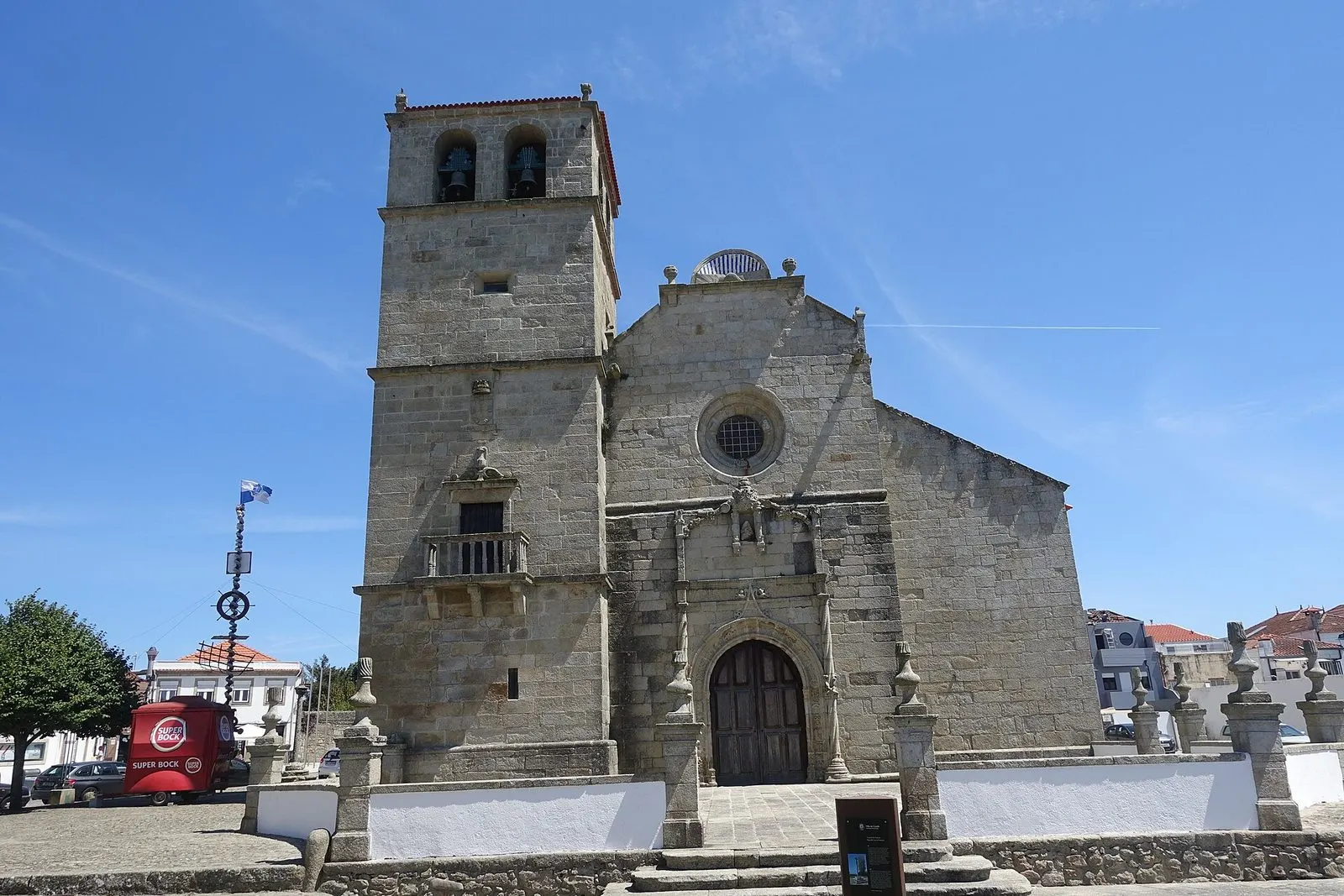
The Church of Azurara, the parish church of Santa Maria de Azurara, dominates a square in the parish of Azurara, in the municipality of Vila do Conde. The Atlas do Património Classificado lists it as the «Igreja de Azurara», also called the Igreja Matriz de Azurara or Igreja de Santa Maria. It is a late Gothic building, begun in the late 15th century, with a Manueline portal, a coffered vault over the chancel and an interior in which Mannerist woodcarving, Baroque woodcarving and Joanine azulejos follow one another. It should not be confused with the Igreja Matriz de Vila do Conde, in the centre of Vila do Conde, also Manueline but dedicated to Saint John the Baptist.
A church that took more than half a century to finish
The SIPA inventory chronology places the start of construction in the late 15th century, when the revenues of Azurara and Árvore were granted to the Chapter of the Porto Cathedral (the grant was confirmed by Pope Alexander VI in 1492). In 1502 King Manuel I granted royal aid for the work; in 1517 the record mentions the contract with the builders to whom the stonework of the nave was entrusted, to be carried out according to «mostras» sent; and in 1552 the coffered vault was completed by the master mason Gonçalo Lopes, according to the inscription, bringing the construction to an end on a site where the chapel of Our Lady of the Presentation had stood, whose image is in the niche of the main façade.
The church was later enlarged over the centuries. The inventory dates the bell tower flanking the west façade to the 17th century, although its description characterises it as typical of the 16th century, and dates to 1720 the chapel of Our Lady of Grace, on the exterior, abutting the rear façade. The Parish Memoirs of 1758 give the patronage as Our Lady of the Conception, with its feast on 8 December, and describe a church with three naves and seven altars.
Architecture and Manueline elements
The inventory describes a church with a rectangular plan and three stepped naves, a chancel, a sacristy and a bell tower on the left side, with exposed granite façades topped by a cornice and decorative merlons, zoomorphic gargoyles and armillary spheres on the gable. The main façade has a round-arched portal with archivolts of plant-motif decoration, framed by an alfiz and flanked by twisted pillars, above which is a niche with a canopy; higher up, a circular oculus with multiple mouldings. The bell tower, in four registers, has a balcony resting on three corbels and two openings on each face.
Inside, the naves are divided into five bays, with chamfered-arris arches resting on faceted pillars with cordiform capitals bearing vegetal motifs, features the record places in the 16th century. The triumphal arch rests on clusters of Manueline colonnettes. The covering of the chancel, a ribbed vault, has bosses with Manueline royal motifs: a shield, an armillary sphere and the Cross of Christ.
For the wider context, see the pages on the Manueline style and Gothic architecture in Portugal.
Woodcarving, painting and azulejos
The interior shows centuries of successive commissions:
- The side altarpieces in Mannerist woodcarving have painted panels; the inventory notes that Francisco Correia is said to have painted, in 1573–1574, the panels of the altarpiece of Our Lady of the Rosary. Today there are panels with scenes of the Passion and the Resurrection.
- In 1677, the woodcarver Domingos Lopes is recorded as working on woodcarving in the church.
- The high altarpiece, in gilded woodcarving of the national Baroque style, was made in 1722–1723 by Francisco Machado, according to the record, on a model similar to that of the Chapel of the Terceiros in Porto. See the page on gilded woodcarving.
- In 1737 the azulejos of the chancel were commissioned from António Vital Rifarto; the inventory today describes two panels of figurative Joanine azulejos, with the pelican feeding its young and the phoenix reborn. See azulejo.
In the nave floor there are inscribed and sepulchral slabs, and in the chancel an armorial tomb dated 1661.
Classification
The church is a National Monument by the Decree of 16 June 1910 (Diário do Governo, 1st series, no. 136, of 23 June 1910). In Azurara, the Pelourinho (pillory), the Cruzeiro (wayside cross) and the Church of São Francisco de Azurara (former church of the convent of Our Lady of the Angels) are also classified as Properties of Public Interest, according to the Atlas do Património Classificado. The church is owned by the Catholic Church (Diocese of Porto) and does not form part of any UNESCO inscription. On this type of monument, see the page on pillories.
Recent restoration
The inventory records that in 2018 a protocol was signed between the Regional Directorate of Culture of the North, the Directorate-General of the Treasury and Finance and the Municipality of Vila do Conde for the restoration of the church, with an investment of about 200 thousand euros, of which 140 thousand were provided by the State and 60 thousand by the municipality. On 18 April 2026 (International Day for Monuments and Sites), the Municipality of Vila do Conde promoted a guided visit to the church to show the conservation and restoration work on its movable heritage.
Planning the visit
The inventory gives the access roads as Azurara, Rua Padre Serafim das Neves and Rua Nossa Senhora de Fátima; the municipal agenda indicates Rua Nossa Senhora da Conceição as the address of the 2026 event. When consulted on 5 November 2026, we did not find regular opening hours or visiting rules published in an official source we could read. This is a parish church in active use: please confirm access with the parish or the Municipality of Vila do Conde (cm-viladoconde.pt).
Photograph by Joseolgon, 14 August 2024. Original on Wikimedia Commons, under CC BY 4.0; resized and compressed for the web, without altering the composition.
Frequently asked questions
- When was the Church of Azurara built?
- The SIPA inventory dates the start of construction to the late 15th century, the royal aid of King Manuel I in 1502, the contract for the stonework of the nave in 1517, and the completion of the coffered vault by Gonçalo Lopes in 1552.
- What is the patron saint of the church?
- For classification purposes, the church is the Church of Azurara, also called Church of Santa Maria or Parish Church of Azurara. The Parish Memoirs of 1758 give the patronage as Our Lady of the Conception.
- What Manueline features does the church have?
- The axial portal, with alfiz and plant-motif decoration, the small colonnettes of the triumphal arch and the bosses of the vault of the chancel, bearing a shield, an armillary sphere and the Cross of Christ, according to the SIPA inventory.
- What is its classification?
- National Monument, by Decree of 16 June 1910 (Diário do Governo no. 136, of 23 June 1910). It does not form part of any UNESCO designation.
Sources
- Património Cultural, I.P. — Igreja de Azurara (70407)
- Património Cultural, I.P. — Atlas do Património Classificado e em Vias de Classificação (NINV 3823)
- DGPC — SIPA: Igreja de Azurara / Igreja de Santa Maria (IPA.00005240)
- Diário do Governo — Decreto de 16 de junho de 1910 (n.º 136, 23-06-1910)
- Município de Vila do Conde — Dia Internacional dos Monumentos e Sítios: visita orientada à Igreja Matriz de Azurara (18-04-2026)
- Wikidata — Igreja de Santa Maria de Azurara (Q25440581)
Keep exploring
Heritage nearby
More places to discover from here. Approximate straight-line distances, within 50 km.