Monuments
Church of Cárquere
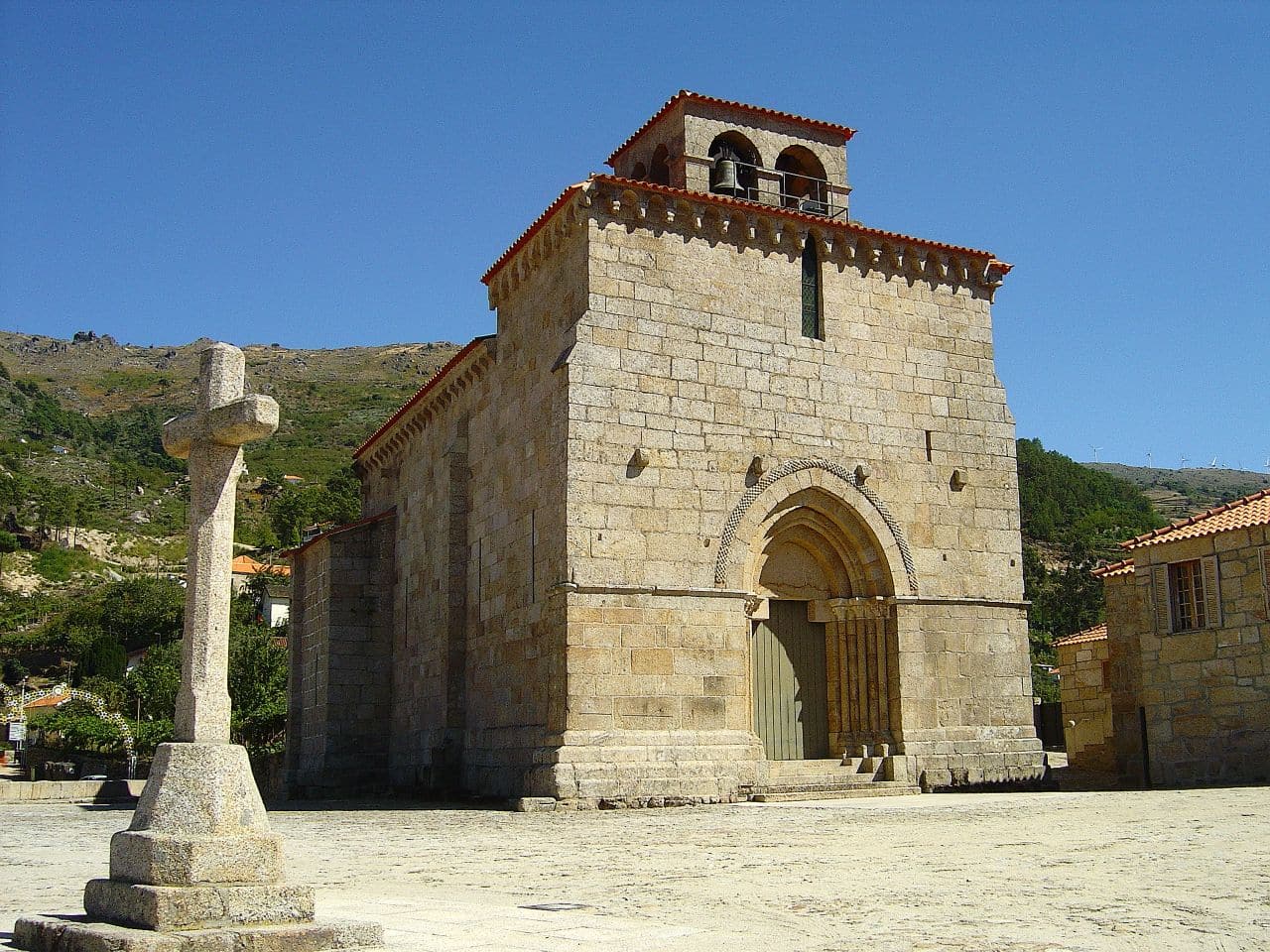
Cárquere's Mother Church in Resende, once an Augustinian monastery, has the Resendes Chapel, Manueline portals and a medieval tower. National Monument.
- Location
- Cárquere, Resende, Viseu
- Built
- Mosteiro fundado no século XII; torre e capela-mor medievais; igreja transformada no ciclo manuelino (século XVI)
The Parish Church of Cárquere, or Church of Santa Maria de Cárquere, stands on Rua do Mosteiro, in the parish of Cárquere, in the municipality of Resende, on the northern slope of the Serra de Montemuro. It is what remains of a monastery of Augustinian canons regular, linked by tradition to Egas Moniz and the infante Afonso Henriques and, later, to the pantheon of the lords of Resende. It is a National Monument, and the Românico Route includes it, under the name Monastery of Santa Maria de Cárquere, among its monuments. Little of the Romanesque survives; what can be seen is above all a transitional church, Gothic and Manueline.
Between legend and history
The legend says that Egas Moniz, tutor of D. Afonso Henriques, brought the infante to Cárquere, who was said to have been born with a defect in his legs, and that there, through the intercession of the Virgin, a miraculous cure took place, following which the monastery is said to have been founded. The register of the Cultural Heritage, I.P. records the founding of the convent in the 12th century on the initiative of Egas Moniz (c. 1080-1146), who had obtained the honour of Resende, and adds that other sources point to 1099 and Count D. Henrique. The Românico Route treats the attribution to Egas Moniz as a legend and places the foundation in the second quarter of the 12th century. It further notes that Egas Moniz is said to have left bequests to the monastery in his will of 1146, and that the bull of Nicholas III of 1279 confirms its autonomy; in 1320 it was the only monastery of Augustinian canons regular in the diocese of Lamego.
In the 15th century it was entrusted to ecclesiastics whom the Route’s guide describes as less mindful of their duties and, in 1511, to a commendatory abbot. In 1541, by order of D. João III, Cárquere passed to the Society of Jesus and, according to the register, was the first Jesuit site in Portugal; the Route states that the handover was definitive in 1562 and that a bull of 1578 transferred the revenues to the College of Coimbra. With the expulsion of the Jesuits in 1759, the complex came under the administration of the University of Coimbra and, according to the register, was only incorporated into the Bens Próprios Nacionais in 1835. Reduced to a parish church, it fell into decline. In 1910 it was included in the first list of national monuments.
The Romanesque tower and window
The present building results from a Manueline reworking of the original Romanesque fabric. From this first phase the Route highlights the tower, set on an outcrop of granite, of defensive and seigneurial character, which some authors date to the last quarter of the 12th century or already to the 13th, and the window of the chapel of the Resendes. This is decorated on both sides: with geometric motifs on the inside and, on the outside, with so-called beak-heads, unifrontal animals with a projecting beak, of Anglo-Saxon origin; the capitals bear birds with intertwined necks or with open wings. The organisation of the spaces, within the church and in the cemetery, which occupies the former cloister, remains Romanesque.
Gothic and Manueline
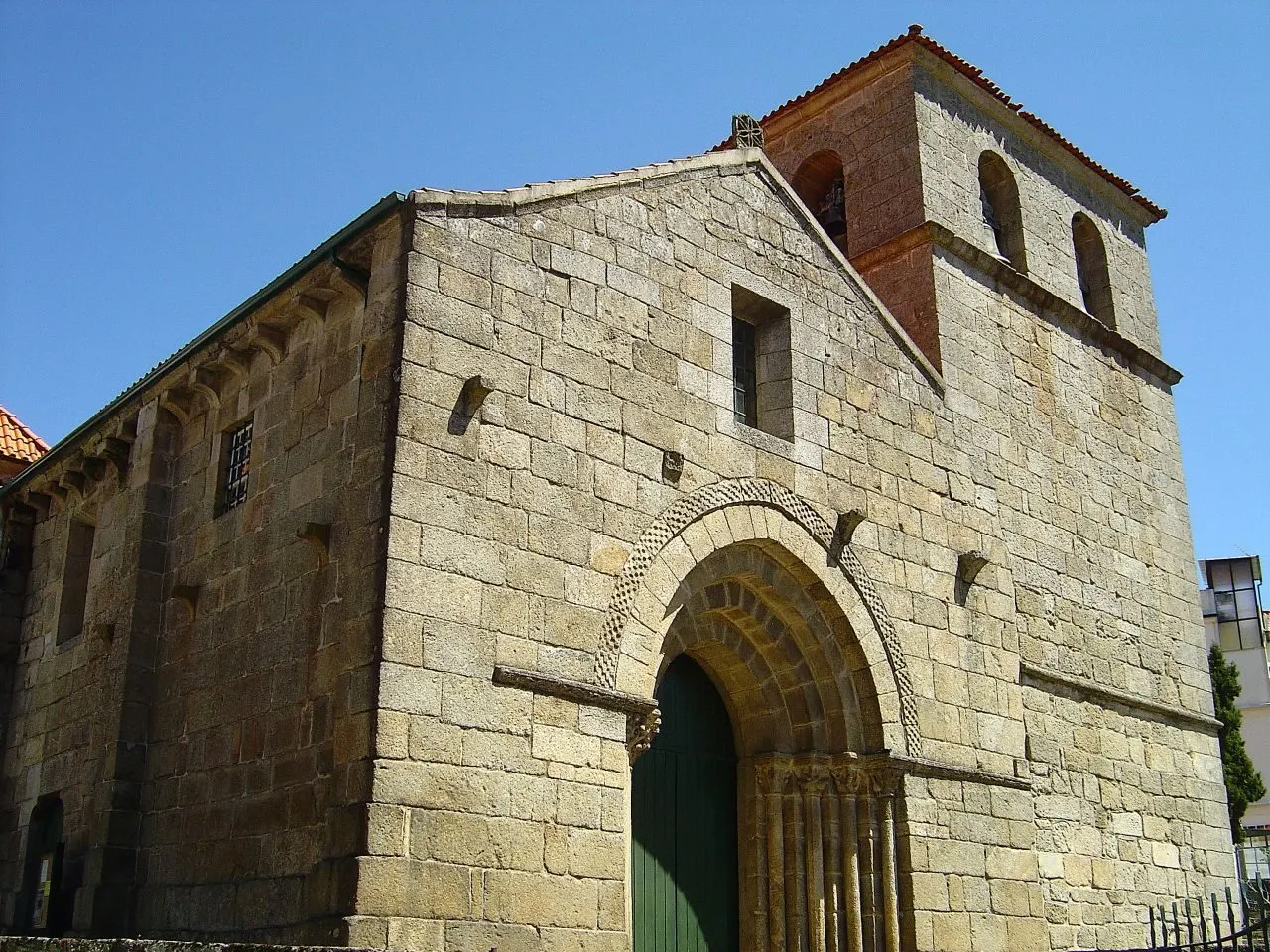
From the Gothic period dates the chancel, with a ribbed vault and a mullioned window, visible only from the exterior. Between it and the single nave, with a timber ceiling, opens a triumphal arch of three archivolts on columns. The main portal, with a round arch of three archivolts, and the north side portal date from the Manueline campaign of the 16th century; above the main one there is an ogee arch and an oculus, and the bell tower is built against the right side. For context, see Manueline style and Gothic architecture in Portugal.
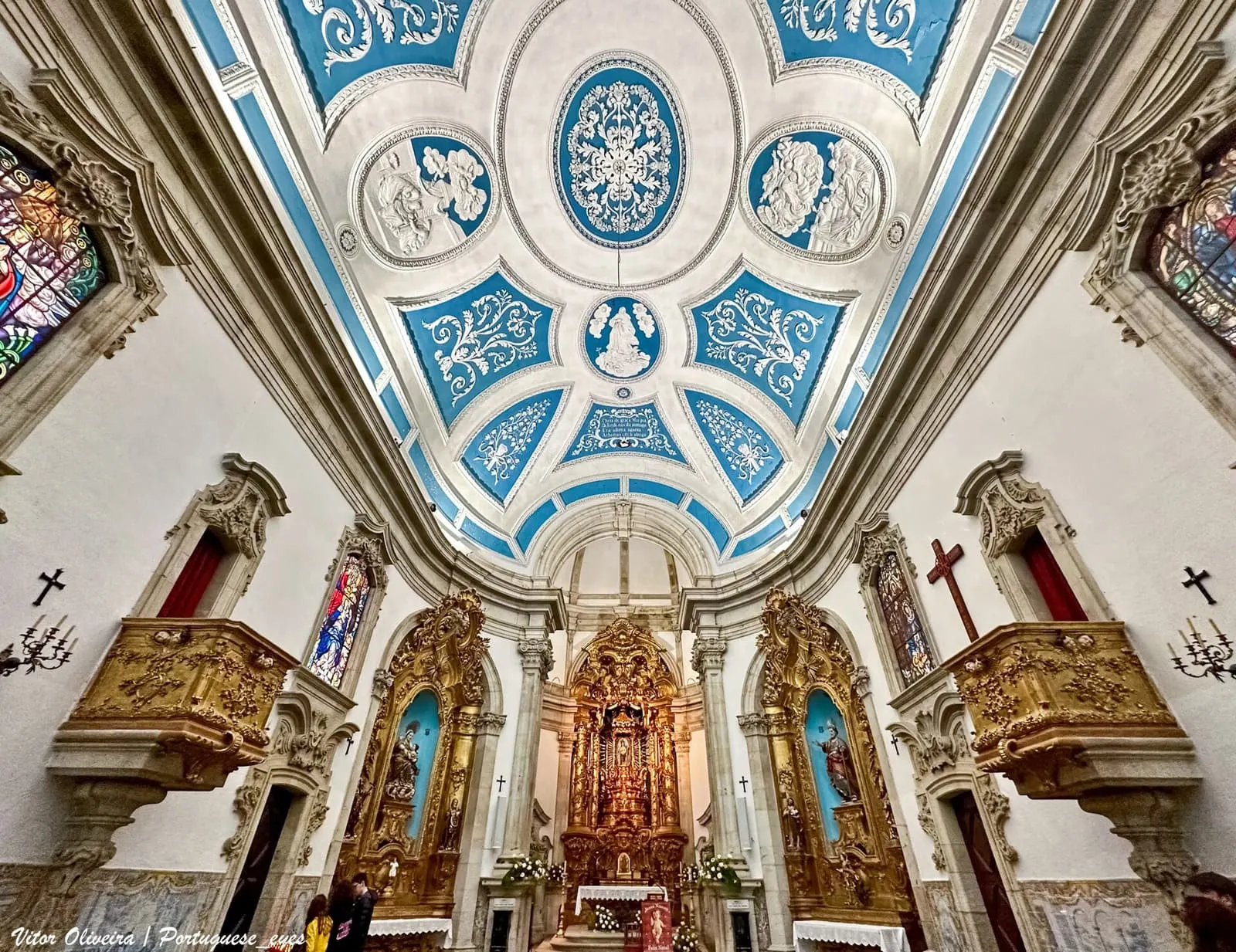
In the nave survive mural paintings from the same period, beneath the altarpiece on the back wall: Saint Anthony and Saint Lucy on one side and a group of fluttering angels on the other. The Route’s guide proposes the 1530s or 1540s and the page’s chronology mentions a painting campaign between 1545 and 1560. The high altarpiece is of gilded carved wood, divided into three by twisted columns (see gilded carving); the Route speaks of altar structures from the 17th and 18th centuries, in the national style.
The Resendes and the two Virgins
The funerary chapel of the Lords of Resende, on the Gospel side, has four tomb chests, two set into arcosolia. The Route’s guide says that Vasco Martins de Resende, the Troubadour, is buried there with a son and a relative also named Vasco, and that all the tombs are Gothic; the Route admits the pantheon may have been made in the first half of the 15th century. On the same side there is a richly decorated baptismal font with vegetal motifs and spiral cords. According to the guide, the lineage inspired Eça de Queirós in A Ilustre Casa de Ramires.
Cárquere is a Marian shrine, and the Virgin is venerated under two titles: the Virgin of Cárquere, seated with the Child, and the White Lady or Virgin of the Milk, standing and in limestone. The Route dates the first to the 13th century and the second to the 14th century. The official register attributes the image of Our Lady of Cárquere to the 6th–7th centuries; this dating differs greatly from the Route’s and we have not reconciled them, so the chronology of the image should be treated as unresolved.
Classification
It is a National Monument by decree of 16 June 1910, published in the Diário do Governo no. 136, of 23 June 1910. The Atlas and the register do not indicate a special protection zone. The 1910 gazette is digitised as an image and we have not transcribed it. The church is not part of any UNESCO inscription.
Planning a visit
When consulted on 5 November 2026, the Românico Route page indicated visits by appointment (telephones +351 255 810 706 and +351 918 116 488; email [email protected]), Mass on Saturdays at 5pm (winter) or 7pm (summer) and on Sundays at 8:15am and 11:30am, the patron saint’s feast on 15 August, and the monument as not accessible to people with reduced mobility. The page gave no price. The Route notes that the church’s inclusion in the route dates from 2010 and that the surroundings were redeveloped in 2017, in the Parque do Carvalhal. These details may change: please confirm them on the official monument page before travelling.
In the same municipality, the Church of São Martinho de Mouros is also a National Monument. For the region, see Romanesque architecture in Portugal and the page on the North.
Photograph by Vimacopeca, October 2026. Original on Wikimedia Commons, under CC BY-SA 4.0; resized and compressed for the web, without altering the composition.
Frequently asked questions
- Was Cárquere founded by Egas Moniz?
- That is what tradition says, linked to the legend of the healing of the infante Afonso Henriques. The Cultural Heritage register refers to the founding of the convent in the 12th century on the initiative of Egas Moniz, but notes that other sources point to 1099 and Count D. Henrique. The Românico Route treats the attribution to Egas Moniz as a legend and dates the foundation to the second quarter of the 12th century.
- What remains from the Romanesque period?
- Little, according to the Românico Route: the tower, of defensive and seigneurial character, which some authors date to the end of the 12th century or to the 13th, and the window of the chapel of the Resendes, decorated with geometric motifs on the inside and with beak-heads (beak-heads) on the outside. The layout of the spaces, including the cemetery over the former cloister, maintains the Romanesque organisation.
- Is it part of the Románico Route?
- Yes. The Românico Route indicates that the Monastery of Santa Maria de Cárquere was integrated into the route in 2010. When consulted on 5 November 2026, it indicated visits by appointment.
- What is its classification?
- National Monument, by decree of 16 June 1910, published in the Diário do Governo no. 136, of 23 June 1910, the decree of the first list of national monuments.
Sources
- Património Cultural, I.P. — Igreja matriz de Cárquere (70582)
- Património Cultural, I.P. — Atlas do Património Classificado e em Vias de Classificação (NINV 4331)
- Diário do Governo — Decreto de 16 de junho de 1910 (n.º 136, de 23 de junho de 1910)
- Rota do Românico — Monastery of Saint Mary of Cárquere
- Rota do Românico — Guia: Mosteiro de Santa Maria de Cárquere (n.º 29)
- Wikidata — Igreja Matriz de Cárquere (Q10300026)
Keep exploring
Heritage nearby
More places to discover from here. Approximate straight-line distances, within 50 km.