Monuments
Church of Saint Martin of Cedofeita
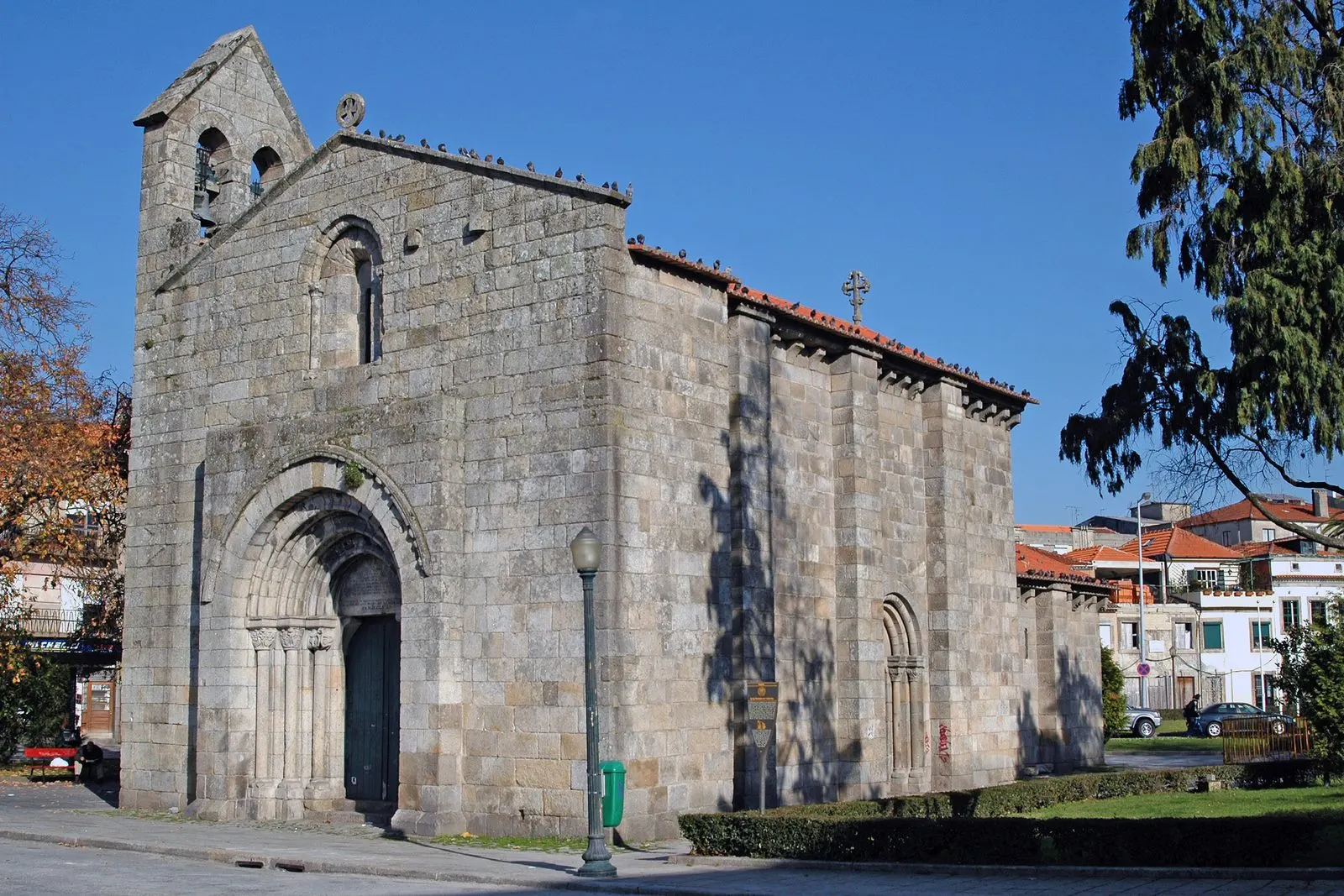
Church of São Martinho de Cedofeita, Porto: Romanesque, single vaulted nave, 9th-century capitals, Coimbra sculpture, National Monument since 1910.
- Location
- Porto, Porto
- Built
- Capitéis do final do séc. IX ou início do séc. X; campanha de 1087; obra românica na viragem para o séc. XIII
The Church of Saint Martin of Cedofeita stands on the Largo do Priorado, in Porto, in an area now surrounded by 19th-century housing. Outside it is a small granite temple with a plain façade, a bell tower and a portal of concentric arches. The national Património Cultural, I.P. record gives it a prominent place in the history of Portuguese Romanesque: it is one of the first monuments of the North to repeat the sculptural and iconographic repertoire of Coimbra, and one of the reference works of the so-called late Romanesque of the Douro Litoral. For the stylistic context, see Romanesque architecture in Portugal.
A place with several churches
The national record warns that at least two churches preceded the present Romanesque church. An inscription placed in 1767 on the tympanum of the main portal, which probably copies an earlier one, speaks of an original Suevic temple from the 6th century. This fed the idea of a past more remote than can be proven.
The oldest surviving remains date from the late 9th or early 10th century. After the taking of Porto by Vímara Peres, in 868, a temple was (re)built here, of which the two capitals of the triumphal arch survive, reused in the Romanesque work. They are of soft limestone, apparently from the Coimbra region, unlike the granite used later, and are stylistically related to late Asturian works such as San Salvador de Valdediós and Priesca. For that horizon, see Asturian and pre-Romanesque art.
There was also a campaign in the 11th century, attributed to the patronage of the bishop of Braga, D. Pedro, who consecrated the church in 1087. From it survive the lower parts of the chancel, with blind arcading resting on very archaic bases.
The Romanesque building
The fully Romanesque phase is late: it falls at the turn of the 13th century. A document from the reign of D. Afonso II mentions the reconstruction of the building in the time of D. Afonso Henriques, but the national record stresses that archaeology has not yet confirmed this.
The plan is a single nave, formed by two juxtaposed bodies, the chancel and the nave, a solution the record reads as a sign of pre-Romanesque persistence. The building is entirely vaulted, a feature that, according to the cited bibliography, is not repeated in any other single-nave Romanesque church that has survived. The design also envisaged a harmonious façade, with a portal and window at the centre between two towers; the north tower was in fact built, as a drawing of 1906 shows.
Sculpture linked to Coimbra
Cedofeita’s artistic importance lies in its decoration. Most of the capitals repeat models from the Coimbra workshops, which dispersed after the completion of the Old Cathedral and the Church of Santiago: birds pecking, confronted lions and other motifs. On the tympanum of the north portal there is an Agnus Dei, the mystical lamb of the Apocalypse, enclosed by spiral vegetal interlace, whose anatomy and composition, according to the record, are practically identical to those of a piece in the Machado de Castro National Museum, in Coimbra.
The same record considers it probable that Cedofeita was a work contemporary with the late Romanesque project of the Porto Cathedral, where Soeiro Anes, a name linked to the Old Cathedral of Coimbra, is thought to have worked. This would explain the evident connection to the Romanesque of the city on the Mondego.
Classification
The church is a National Monument, classified by the Decree of 16 June 1910, published in the Diário do Governo no. 136, of 23 June 1910. The special protection zone and the non aedificandi zone were set by the Ordinance of 2 November 1971 (Diário do Governo, II series, no. 263, of 9 November 1971).
The “Other classification” field of the record is empty. The church is near the Historic Centre of Porto, inscribed by UNESCO in 1996, but we found no source that includes it in that property. For other churches in Porto, see the city of Porto page. Those wishing to compare it with the Romanesque of the Sousa and Tâmega valleys will find it on the Rota do Românico, which brings together monuments of the Sousa, Douro and Tâmega valleys.
Planning a visit
The church is an active parish church. When consulted on 5 November 2026, we found no visiting or worship hours published in an up-to-date official source: the national record does not list them, and the hours circulating in tourist directories cannot be verified. Please confirm with the parish or the Diocese of Porto before travelling and respect the celebrations. The square lies in the city centre, a short distance from Rua de Cedofeita.
Photograph by António Amen, of 9 December 2004. Original on Wikimedia Commons, under CC BY-SA 3.0; resized and compressed for the web, without altering the composition.
Frequently asked questions
- When was the Church of Cedofeita built?
- The Romanesque building seen today dates from the turn of the 13th century. The national Património Cultural, I.P. record identifies an earlier temple from the late 9th or early 10th century, of which two capitals survive, and a campaign from the 11th century, consecrated in 1087.
- Is it true that the church was founded by the Suevi in the 6th century?
- This tradition rests on an inscription of 1767 that probably copies an earlier one. The national record warns that the site's past cannot be proven beyond what the surviving remains show.
- Is the Church of Cedofeita a National Monument?
- Yes, by the Decree of 16 June 1910 (Diário do Governo no. 136, of 23 June 1910). The protection zone was set by the Ordinance of 2 November 1971.
- What is special about the church's sculpture?
- The capitals and the tympanum of the north portal, which bears an Agnus Dei, repeat models from the Romanesque workshops of Coimbra, which is why the church is a reference for late Romanesque in the Douro Litoral.
Sources
- Património Cultural, I.P. — Igreja de São Martinho de Cedofeita (70398)
- Património Cultural, I.P. — Atlas do Património Classificado e em Vias de Classificação (NINV 3745)
- Diário do Governo — Decreto de 16 de junho de 1910 (n.º 136, 23-06-1910)
- Wikidata — Igreja de São Martinho de Cedofeita (Q3780685)
- Wikimedia Commons — António Amen, Igreja de São Martinho de Cedofeita (CC BY-SA 3.0)
Keep exploring
Heritage nearby
More places to discover from here. Approximate straight-line distances, within 50 km.